
Golden Boy with Josh O’Connor at Almeida Theatre – review
Sam Yates’ revival of Clifford Odets’ play runs until 31 October and will then be broadcast in cinemas on 5 November
 |
London
|
|
London
|
16 September 2026
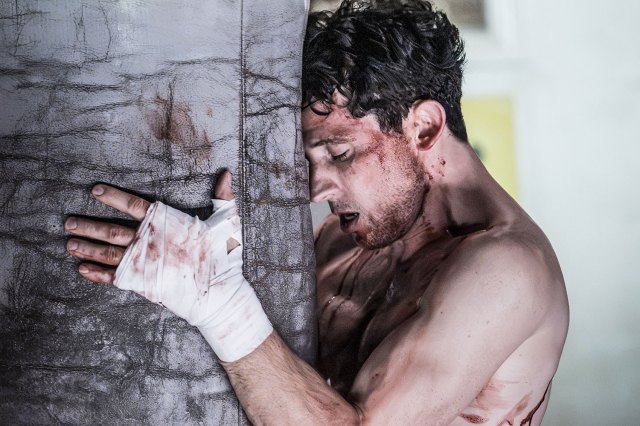
They don’t write them like this anymore. Clifford Odets’ Golden Boy is a stirring, on-the-nose melodrama that feints and jabs its way to its message-heavy conclusion.
You can see why it’s rarely performed. But in a production as good as this one by Sam Yates and with a forceful central performance by Josh O’Connor as Joe Bonaparte, violinist turned boxer in Depression-era America, it makes its case as a powerful, admonitory slice of theatre noir.
Written in 1937, it both cemented Odets’s reputation as the golden boy of political theatre, and clarified his own fight between God (writing for the stage) and Mammon (writing for Hollywood). In Joe’s case he decides to leave behind his talent for the violin, and his love for music, to try his luck as a prize fighter, inevitably finding himself involved in the lowlife machinations of a corrupt world.
As staged by Yates, music has a literal form: in the opening scene, as Joe sits pensively at the table of Rosanna Vize’s impressive white-walled set – staircases, kitchen, office, both real and flexible – a young boy with a violin (Oscar Prout in this performance) appears. Listening intently, Joe walks to the panelled wall, and pushes back the folding shutters, revealing a string quartet playing Isobel Waller-Bridge’s plangent score. At key moments of his physical and psychological journey, they reappear.
The staging is full of these bold touches. The fights are superbly staged by fight director Kate Waters and choreographer Imogen Knight with Joe punching a heavy bag, dancing and weaving around its swaying weight; small cameras catch the spinning emotions of his face and the images are beamed in black and white across the walls (video designs by Jack Phelan).
When Joe’s father’s neighbour, the aptly named Mr Carp (a wonderful Nicholas Woodeson) starts to talk of culture and its value in the good life, Yates lets the noise of the production bleed across him, so that his words are drowned out. Although Joe is proclaimed the golden boy, the great white hope with a shot at the title, at the end of a bloody bout in the ring, the only two moments that lighting designer James Farncombe bathes him in warm light, are when he talks of love with Hayley Squires’ touching, hard-boiled Lorna, the “tramp from Newark” who is as confused as he is about what represents success.
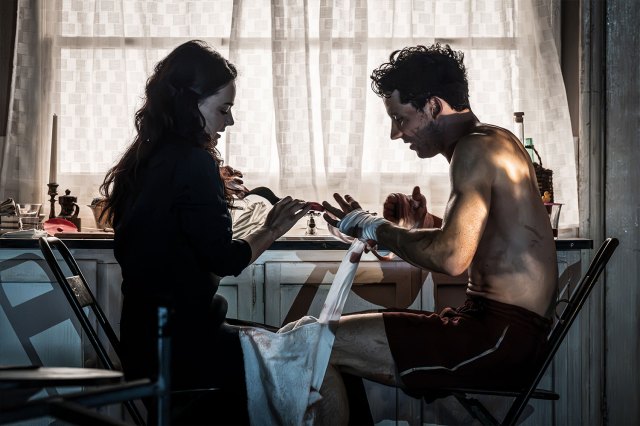
These constant touches, plus a new, wistful epilogue, frame the play beautifully, making Odets’ warnings about the fragility of the American Dream if it is based only on money ring true. Some of his writing is over-insistent – “a violinist is a servant to humanity” is contrasted with Joe’s belief that “you’re dead if you ain’t got a dollar” – but some of it still strikes a suitable warning note. When Joe’s brother, the union organiser Frank (an impressive Richard Fleeshman) says: “A man hits his wife and it’s the first step to fascism” the echo is particularly loud.
But above all this is a production that thrives on its performances. Even the smallest scene is made consistently vivid and real. O’Connor is absolutely compelling as Joe. He is one of the few actors who you can imagine both as a violinist and as a boxer, and he exhibits both possibilities: seething with anger and frustration in the boxing sections, longing to make something of himself, to make people see him and respect him; quietly introspective when he thinks of music or talks of another life.
His long body seems to bend into the world, ready for the blows; all the time, even as the character hardens, he lets the sensitive boy he is peep out, his eyes shining, his face troubled.
But he is matched by Daniel Mays as his manager, twitching, squirming, cajoling, a man constantly at odds with a life where he is never the toughest man in the room. Zubin Varla, truly repellent as the evil, manipulative mob man Eddie Fuseli, and David Ganly as the gross, callous Roxy nearly always outplay him. Jason Barnett beautifully represents the decency of the trainer Tokio, while Stanley Townsend just about breaks your heart as Joe’s father, speaking for honesty and beauty in a broken world.






source on Google
Related Articles
See all

Latest Reviews
See all







Latest Videos

Into the Woods: Children will listen – West End cast and creatives regale us their theatrical childhood stories
Careful the things you say…