
The Lives of Others review – Keira Knightley, Luke Thompson and Stephen Dillane bring the surveillance thriller to the stage
Robert Icke’s adaptation of the Oscar-winning film is running at the Adelphi Theatre until 9 January
 |
London
|
1 November 2026
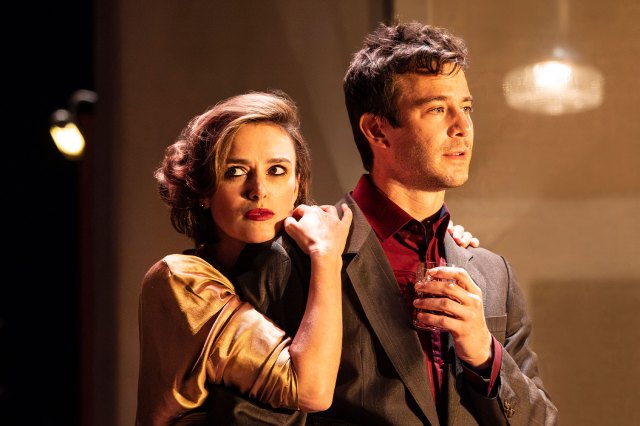
“Ready to listen?,” says Stephen Dillane’s Stasi officer Gerd Wiesler, as he saunters up through the audience, to begin a lecture on the East German security service’s torture techniques. “Now the story begins,” he says later, as he puts on headphones to listen to activities inside the bugged flat of his suspect, the playwright Georg Dreyman (Luke Thompson) and his glamorous actress girlfriend Christa-Maria Sieland, played by Keira Knightley.
Inside those remarks is the clue to director Robert Icke’s gripping stage adaptation of Florian Henckel Von Donnersmarck’s magnificent 2006 film about the way the secret police in a divided Germany spied on its own citizens, recording and interfering in their lives, breaking its own subjects under the guise of being the “shield and sword” of the state. At two hours long, it has the pace and suspense of a thriller but wrapped in its heart is an examination of the purpose of art – and the reflective nature of stories to destroy or enhance lives.
It’s wonderfully, fluently, staged on Hildegard Bechtler’s revolving set, which contrasts the beige utilitarian plainness of Wiesler’s dank flat, with the elegance of Dreyman’s where the plain walls are enlivened by fine modern paintings. As the flat turns, events unfold inside it and Wiesler, at first sitting to one side, earphones clamped to his head, typing his impersonal reports – “unwrap presents, then have intercourse” – becomes changed by them. Giles Thomas’s soundscape adds crackle and distortion to the conversations listened to; when Wiesler takes his headphones off, Dreyman and his friends are suddenly silenced.
The events are fictional, but they truly reflect the state of a country that at one moment had one Stasi agent for every 166 citizens, and where by 1984, when the play is set, had become a society of eavesdropping and betrayal. Von Donnersmarck and Icke focus on the suppression of all creative endeavour which makes even a man like Dreyman, who essentially believes all will be well because communism has good aims and people can change, an object of suspicion.
But the Stasi here have another reason for their snooping; the brutal Minister Hempf (Andrew Woodall) is forcing Sieland into a relationship with him. Wiesler intervenes twice to save her, with unforeseen consequences. The moment that breaks him, though, is when Dreyman’s director, Jerska, who has been blacklisted, commits suicide; in response the playwright opens the sheet music his friend has sent him, and plays ‘Sonata for Humanity’ on the piano. As Max Richter’s mournful music (specially composed for the play) sounds out, Dillane’s tough-guy interrogator collapses into uncontrollable sobbing, his soul and conscience awakened.
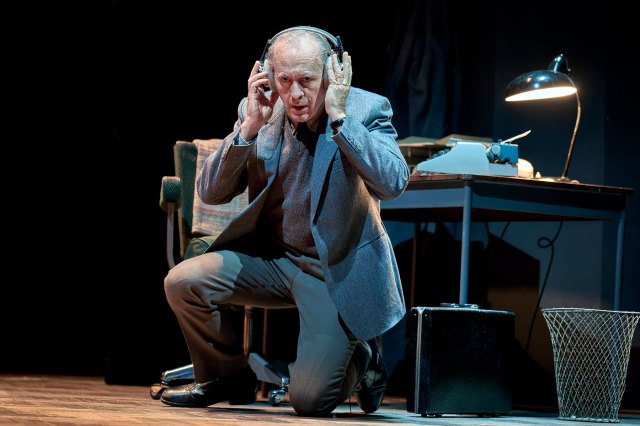
Icke’s direction superbly charts the way that Wiesler becomes increasingly entwined with his subjects’ lives, moving – in the intricate, constantly shifting choreography of the scenes – from the sidelines, to sit between the friends on the sofa, or walk around them as he snoops.
Icke also constantly emphasises the show’s theatricality: characters vanish into the exposed wings; when the scene changes as the set unfolds like a series of boxes, revealing different vistas, streets, cafes, and offices evocatively lit by Jon Clark, stagehands appear, doing their work, pushing the scene into view. Some sections appear on film.
This is more than a director’s trope; it feeds into the central theme of the play. “People will watch the pretend people to help them understand the real ones,” says Sieland, quoting Jerska. “Sure, the theatre used to be absurd. But now it’s the only thing that makes any sense. It’s the only thing that knows how real it is.”
Knightley, whispering into her lover’s ear, lends the line real urgency. She is fragile, febrile and utterly convincing as the tortured actor who knows with absolute certainty that “an artist cannot survive the world you’ve made.” Icke has transmuted a film about heroic resistance to authority and the moments that people crack or rebel into a play about the power of art and the need for the kind of understanding it provokes, subtly but insistently altering the focus.
His vision is an immense achievement not least because it is nigh-on perfect in execution. Dillane, always excellent, has never been better than he is as Wiesler, letting each moment of disillusion register while seeming utterly still and contained. As Dreyman, Thompson is equally still, equally powerful, catching the character’s essential decency, gradually eroded and transformed into opposition by the situation he finds himself in. Paul Higgins as Wiesler’s ambitious, unprincipled boss is also superb, constantly moving and weaselly.
The whole production is a triumph because it embodies its own theme. Art matters, empathy counts. A society that forgets compassion for the lives of others is not worth having. And it shows that by being a deeply moving and utterly spellbinding evening of theatre.





source on Google
Featured In This Story

Related Articles
See all

Latest Reviews
See all








Latest Videos

Keira Knightley, Luke Thompson and Stephen Dillane on surveillance and kindness in uncertain times – The Lives of Others opens in the West End
Robert Icke’s stage adaptation of Florian Henckel von Donnersmarck’s Oscar-winning film is running at the Adelphi Theatre