
Middlemarch at the RSC’s Swan Theatre – review
The two-part drama, based on George Eliot’s novel and adapted for the stage by Nina Raine, is directed by Jeremy Herrin
 |
Stratford-upon-Avon
|
29 October 2026
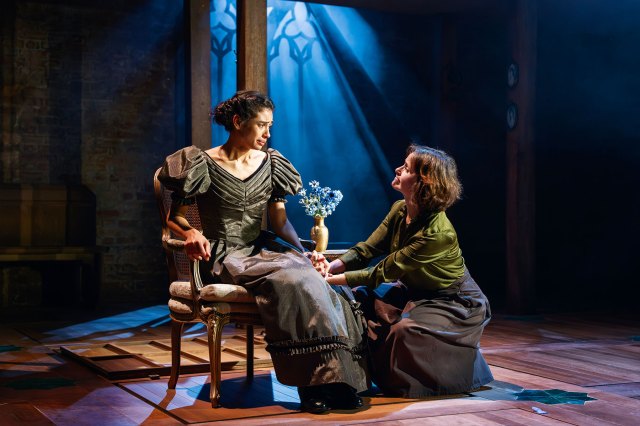
“The growing good of the world is partly dependent on unhistoric acts; and that things are not so ill with you and me as they might have been, is half owing to the number who lived faithfully a hidden life and rest in unvisited tombs.” Those famous words that end George Eliot’s study of provincial life also end Nina Raine’s theatrical version for the Royal Shakespeare Company.
It is a deftly clever adaptation. More than 800 pages boiled down into some six hours and two plays, a whole world unfolding on a virtually bare stage, and an entire community brought vividly into view as they grapple with the twists and turns of lives that make it hard to fulfil their hopes and dreams.
Figures as different as Virginia Woolf and Martin Amis thought the book, written in 1871-2 and describing events in a small Warwickshire town from 1829-32, was the great 19th-century English novel. Its quality is its humanity, its empathy with all its characters and that is the quality beautifully preserved here.
Raine has swept away much of the social detail – the arrival of the railways and the radical Reform Act – but lets the narrative of intertwined stories unfold with great clarity. Her key theme is the idea that each man or woman is the centre of their own universe, represented by the image of a candle reflected in glass, which opens both plays with the cast ranked across the back of the theatre holding a light.
Her stroke of genius is to introduce the character of Eliot herself, not as a traditional omniscient narrator – though she does speak many of the novel’s words – but as an author to whom her characters appeal, asking what to do, describing their feelings, and occasionally begging her to take better control of her prose. As played by Amanda Root, with just the right balance of acerbity and sympathy, and a real tenderness towards the characters she has created, it lends warmth, insight and humour to proceedings.
To begin with, the focus is on Dorothea Brooke, a young woman whose desire to make her mark on life and her tendency – as her sister Celia remarks – to “do something uncomfortable” leads her into a disastrous marriage with Casaubon, an elderly scholar who has devoted his life to research that has led him towards darkness rather than enlightenment.
But gradually the view widens to encompass more of Middlemarch’s inhabitants, including ambitious doctor Lydgate who marries the beautiful but vain Rosamond Vincy and becomes entangled with the complicated history of the hypocritical Bulstrode, whose wealth and sanctity hide a terrible secret in his past.
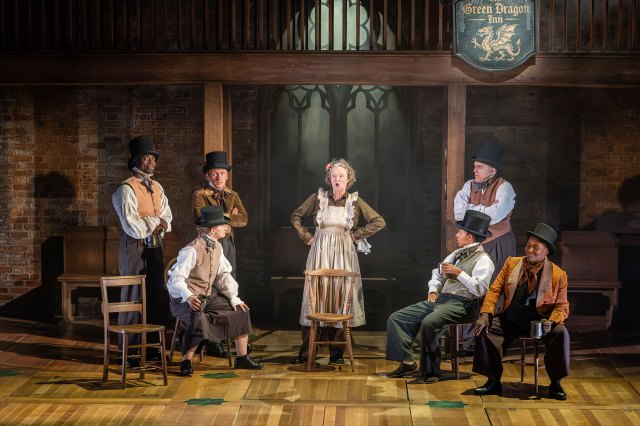
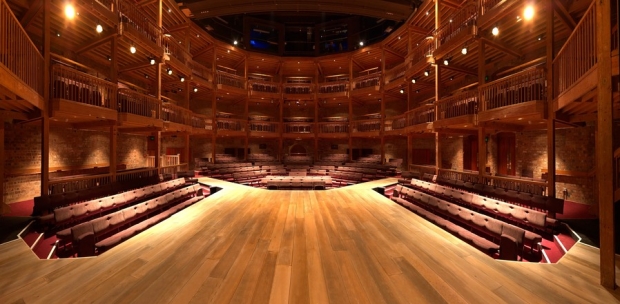
In this co-production with Second Half Productions, Jeremy Herrin’s tightly modulated direction lets each scene unfold and engross, while constantly moving the action on. Grace Smart’s design consists of a bare space with clever use of props and signs that float in from the eaves of the Swan Theatre, while Ben Jacob’s lighting bathes people in warm spotlights, dividing the space, making vistas and tableau where none exist.
There are occasional awkwardnesses – Rosamond’s brother Fred (appealingly played by Ebenezer Gyau) has to fight typhoid fever sitting at a table, and a few scenes are a little too eager to ingratiate themselves – but the benefits of the simplicity are the tightness of the ensemble, dressed in Victorian costume when they are playing particular roles, putting on contemporary clothes in russet and green when they are background viewers of the story.
What makes the whole entirely compelling is its fluidity and grace and the sheer calibre of the acting. John Hodgkinson seizes the contrasting roles of a florid auctioneer and the tortured Bulstrode with relish; Peter Forbes displays the same range (with the help of a variety of wigs) as a bluff but kindly landowner and the dissolute Raffles, the figure from the past who brings about Bulstrode’s downfall.
Lizzie Annis is funny as Celia and touching as the good-hearted Mary Garth. The scene where Gunnar Cauthery’s Reverend Farebrother realises she can never love him is mapped in all its quiet desolation. Similarly, Andrew Richardson poignantly charts Lydgate’s progress from arrogant confidence to a hollow man who always counts his life a failure, while Rory Alexander allows dashing Will Ladislaw to grow in the opposite direction, from disappointment to fulfilled love. Emma McDonald is astonishing as the monstrous Rosamond, subtly catching the indestructible narcissism that makes her believe that “nobody could behave better than I do”.
Holding the still centre as Dorothea, Nia Towle is simply, sensationally heartbreaking, with a directness and intensity that lets every emotion flood across her face as she moves from a priggish desire for martyrdom through sad realisation and dignified despair to a final grasping of her own happiness.
It’s a pleasure to watch all these characters grow and change as Root’s Eliot offers her observations on the patterns of society that trap these individuals in patterns of behaviour. For the full effect, you need to see both plays, but taken as a whole this is an adaptation that celebrates those hidden lives in rural England and the brilliance of the woman who described it.






source on Google
Related Articles
See all


Related City Guide
Latest Reviews
See all


Latest Videos
The cast of The Haunting of Hill House on jump scares, spooky stories and Halloween costumes
It’s time to go trick or treating at Hill House…