
The Sea with Jennifer Saunders at Theatre Royal Bath – review
Jonathan Munby’s revival of the Edward Bond dark comedy runs until 7 November
 |
Bath
|
29 October 2026

The sea is everywhere in Edward Bond’s strange, slippery play. Not just in the storm that opens it, nor in the death that sends ripples through an Edwardian coastal village, but in the shape of the thing itself. Tides of farce crash into stretches of philosophy; moments of broad comedy recede to reveal grief sitting beneath like a wreck glimpsed through clear water. It is a play forever changing temperature beneath your feet. Jonathan Munby’s revival understands that instability.
It begins magnificently. Luke Halls’ projections, Richard Howell’s lighting and EJ Boyle’s movement work transform the Theatre Royal stage into a coastline lashed by wind and water, as two young men are caught in a storm and only one returns. It is a startlingly assured opening, theatrical without feeling showy, establishing the sea as the production’s most powerful presence: beautiful, dangerous and utterly indifferent.
What follows is the aftermath. A grieving fiancée, a guilt-ridden survivor and a village more interested in status, gossip and amateur dramatics than confronting loss. While Rose struggles to imagine a future beyond tragedy, her formidable aunt Mrs Rafi busies herself preparing a local production of Orpheus and Eurydice, Bond weaving one story of mourning through another.
At the centre of it all sits Jennifer Saunders’ Mrs Rafi, the village’s self-appointed First Lady. The casting is clever because it cuts against expectation. So much of Saunders’ comic brilliance has been built on glorious disorder. Mrs Rafi is the opposite. She controls every room she enters and expects everybody else to know it. Saunders finds the comedy through precision. An arched eyebrow, a carefully weighted pause, a line delivered with just enough disdain to remind everyone of their position. The voice swoops elegantly through conversation, wrapping every observation in the certainty of somebody who has never doubted her own importance.
Particularly delightful are her scenes with Lucy Briers’ Jessica Tilehouse, whose apparent friendship resembles a decades-long campaign of passive aggression conducted through impeccable manners. Their sequence at a funeral is one of the evening’s comic highlights. As remembrance gradually becomes competition, the two women engage in an escalating battle of hymn-singing, each determined to soar just a little higher than the other. It is ridiculous, vicious and very funny.
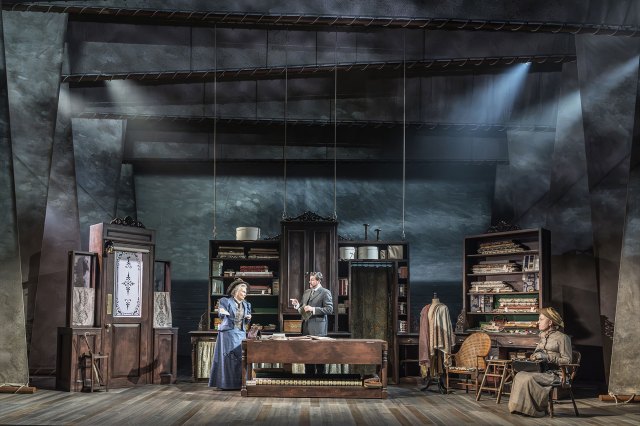
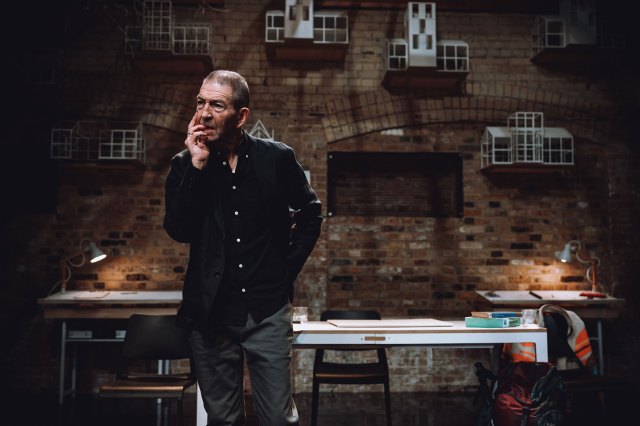
If Saunders provides the steel framework of the production, Lloyd Hutchinson supplies its soul. As Evens, the village eccentric living by the shoreline, he becomes Bond’s conduit for the play’s larger ideas. Much of The Sea involves conversations about humanity’s capacity for cruelty, fear and change, particularly as Sean Delaney’s Willy struggles to make sense of the tragedy he has survived and begins, tentatively, to gravitate towards Rose. Hutchinson delivers these passages with warmth, intelligence and a quietly magnetic presence. Yet this is also where the production runs aground. Bond gives Evens and Willy scene after scene of philosophical discussion and, while both Hutchinson and Munby do everything possible to keep them afloat, there are stretches where attention visibly ebbs away. The ideas remain intriguing; the drama less so.
Dominic Rowan takes an unexpectedly effective approach to Hatch, the increasingly paranoid draper, convinced dark forces are gathering beyond the horizon. Where some interpretations lean into menace, Rowan emphasises fragility. His anger is not particularly dangerous; it is sad. This Hatch feels like a man shrinking inside his own fears, desperately inventing explanations for a world he no longer understands. Watching him retreat into conspiracy and certainty, Bond’s supposedly eccentric satire suddenly feels alarmingly contemporary.
Holly Godliman’s Rose leaves a similarly strong impression. With porcelain features and a luminous stage presence, she looks every inch a future star of period drama, carrying more than a hint of a young Helena Bonham Carter. Yet there is steel beneath the delicacy, and her gradual movement from grief towards hope quietly anchors the evening.
The problem, if there is one, lies with the play itself. Bond throws extraordinary amounts into the air. Class satire collides with absurdist comedy. Philosophical debate sits alongside broad farce. At times, it feels like watching four different weather systems occupy the same sky. There are passages that sparkle, images that linger and performances that stay with you long after the curtain falls. Yet the whole never quite gathers the force of its individual parts.
You can see why directors return to it and why actors relish these roles. You can see why critics have spent decades admiring its ambition. But admiration and affection are not quite the same thing. Munby’s production confirms the play’s intelligence and importance, even if it stops short of proving its greatness.






source on Google
Related Articles
See all

Latest Reviews
See all





Latest Videos

The cast of The Haunting of Hill House on jump scares, spooky stories and Halloween costumes
It’s time to go trick or treating at Hill House…