
Lanny at Bristol Old Vic – review
Bea Roberts’ world premiere stage adaptation of Max Porter’s folk horror novel, directed by Nancy Medina, runs until 7 November
 |
Bristol
|
23 October 2026
Adapting Max Porter’s Lanny always felt like a dangerous proposition. The novel’s reputation rests not on plot, character or even theme, but on voice. It is a book composed of fragments, whispers and interruptions, a work that dissolves the boundary between the people of a village and the place itself. Conversations bleed into folklore, memory sits alongside gossip and language becomes less a means of telling a story than a landscape to wander through. It is one of those rare novels where the experience of reading it matters as much as the events it contains.
That challenge hangs over Bea Roberts’ adaptation from the outset. The traces of Porter’s achievement remain. Christopher Harrisson’s projections scatter text across the back wall like thoughts escaping from a collective consciousness, while sound, music and overlapping voices occasionally hint at the strange polyphony that made the novel so distinctive. Yet these elements often feel decorative rather than foundational. They frame the action rather than define it. What was once the beating heart of the novel becomes a motif that periodically returns to remind us of what has been lost.
The consequence is that the stage production places far greater emphasis on narrative than the book ever did. Unfortunately, stripped of much of its linguistic invention, the story feels surprisingly slight. Over the course of two and a half hours, there are long stretches where the evening drifts rather than develops, circling the same emotional territory without discovering very much that feels new. On the page this hardly matters because the pleasure comes from immersion in Porter’s language. In the theatre, however, that absence leaves a space which the drama struggles to fill.
Where the play truly springs into life is in its relationship with folklore. Here, at last, something genuinely theatrical begins to emerge. Dom Coyote’s music proves invaluable, creating moments that feel both deeply rooted and faintly uncanny, as though something ancient were stirring beneath the surface of contemporary village life. The songs carry an emotional and atmospheric charge that much of the spoken text lacks, and for brief periods the production achieves the sense of strangeness that the adaptation appears to be searching for.
Nancy Medina’s direction is, as ever, thoughtful and assured. There is not a slack moment in the staging, nor a design choice that feels under-considered. Rebecca Jane Wood’s set provides an elegant framework and the entire production moves with the confidence of artists who know exactly the show they are trying to make. Yet this is also where my reservations begin. Lanny is a novel that thrives on messiness, contradiction and ambiguity. Medina’s production often feels determined to organise those impulses into something clearer and more coherent.
One wonders whether this material might have been better served by an approach prepared to lean further into its weirdness. Not because the current production lacks imagination, but because it often seems reluctant to surrender itself fully to the novel’s peculiar logic. Again and again, when things threaten to become genuinely strange, the production pulls itself back towards something more recognisable.
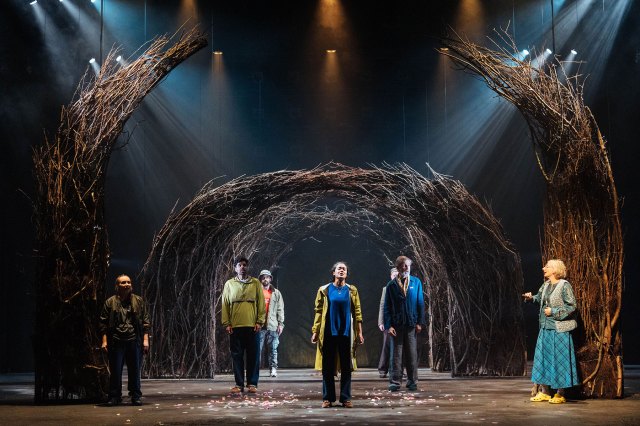
The cast, meanwhile, are uniformly strong and frequently the reason the evening remains engaging even when the adaptation begins to lose momentum. Hanora Kamen – long term Wardrobe Ensemble performer – continues her progression into leading-role territory with a beautifully observed performance. There is a quiet uncertainty to her work, a sense of somebody trying desperately to make sense of a world that increasingly refuses to behave according to familiar rules. Kamen has always possessed a remarkable ability to ground heightened material in emotional truth and that instinct serves her well throughout.
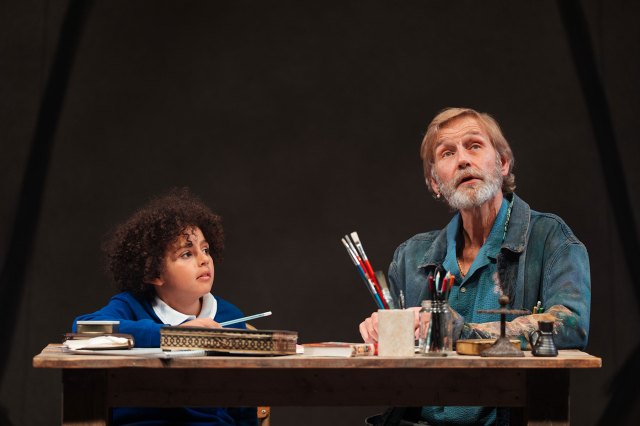
Raj Bajaj brings an understated solidity to the father, while Richard Cant delivers the evening’s most affecting performance as Pete, an artist whose position on the edge of village life allows him to see things differently from those around him. Cant captures both the generosity and vulnerability of the character, ensuring he remains painfully human rather than merely symbolic.
Amanda Lawrence once again demonstrates an almost supernatural ability to make every line she speaks more interesting. At this point, I would happily watch her read the phone book. Whether appearing as Peggy or one of the village’s many eccentric inhabitants, she continually supplies the production with flashes of invention and humour. Rose Wardlaw is equally impressive across a gallery of sharply observed cameos, creating distinct and memorable personalities from what could easily have become caricatures.
The real discovery, however, is Lucian Thomas. Making his professional stage debut, he gives a remarkable performance in the title role, possessing that rare quality of seeming entirely natural whilst simultaneously feeling touched by something more mysterious. He lights up the stage whenever he appears and carries a sense of possibility that the production itself occasionally struggles to sustain. It is a hugely promising debut.
Which leaves Lanny as a frustrating evening, because almost every individual ingredient works. The cast are excellent, the direction is accomplished, the music often enchants and the design team deliver work of real quality. As Bristol Old Vic’s flagship production to mark its 260th year, there is much here to admire.
Yet adaptation is not simply the business of transferring a story from one medium to another. It is the search for a theatrical equivalent to whatever made the original special in the first place. Porter’s novel felt alive with voices, rhythms and images that seemed to emerge from the landscape itself. This production occasionally gestures towards that achievement but never truly captures it. The story survives the journey to the stage. The spell does not.






source on Google
Related Articles
See all
Related City Guide

Latest Reviews
See all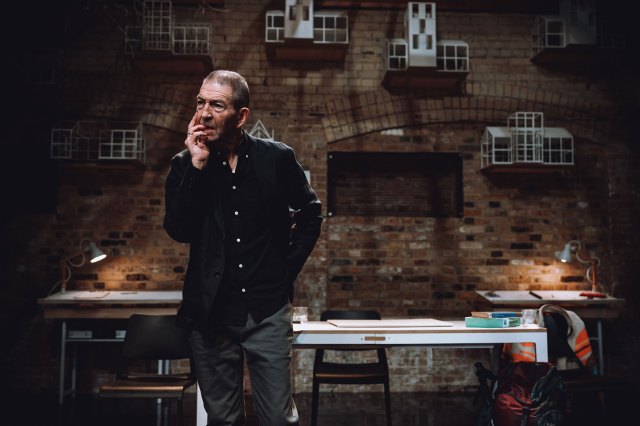
Latest Videos
Disney’s High School Musical opens in London and the stars take a trip down memory lane
Bopping to the top at Troubadour Wembley Park Theatre!