
Girls at the Young Vic – review
Theresa Ikoko’s drama, directed by Ewa Dina, runs in the Maria Studio until 21 November
 |
London
|
28 October 2026
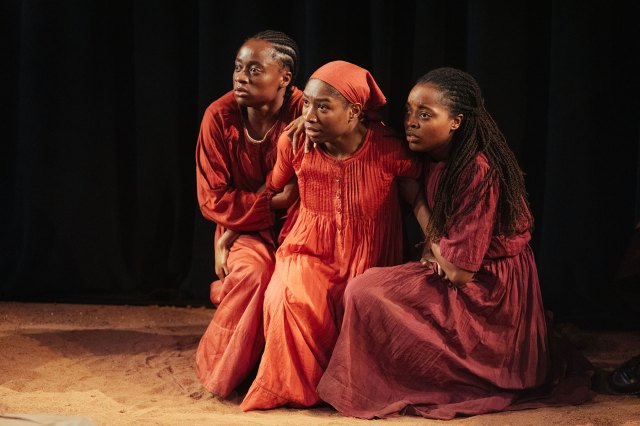
Theresa Ikoko’s Girls does well to show both the terror of the 2014 Chibok schoolgirl abductions, and the schoolgirls themselves. The plot is sparsely paced, but there are moments of brilliance throughout.
We meet Tisana (Hannah Akhalu), Ruhab (Sewa Zamba) and Haleema (Tara Tijani) days into their kidnapping. Hidden in a jungle with little to no food and no shelter, they distract themselves with chat about sex and boys and TV shows, simply waiting for someone to come and save them. But after some time, they realise that they’ll have to save themselves, either by running away, or by submitting to their kidnappers.
Ikoko makes room for us to get to know the girls: Tisana is the youngest, shy and conservative, Ruhab is charming and beautiful, and Haleema is feisty and rebellious. As director Ewa Dina says in her programme note, these girls risk being defined by their tragedy. But Ikoko does well to give them their own identities, to carve out time for them to be themselves away from the constant fear and terror of their circumstances.
That said, there are also plenty of political discussions, about both the Nigerian government’s response (or lack thereof) and the Western world’s reaction: “Bad things are supposed to happen here”, Haleema shrugs. “It’s not terrorism when we all look the same.” It’s an uncomfortable truth that these kidnappings have been largely forgotten in Western news, despite women continuing to be abducted in Nigeria, let alone the still missing girls from the 2014 kidnappings.
Akhalu, Zamba and Tijani have a comfortable chemistry, bantering at bullet speed, accidentally slipping into a more serious argument about their situation, only to back cautiously away again, singing schoolgirl songs and performing for one another.
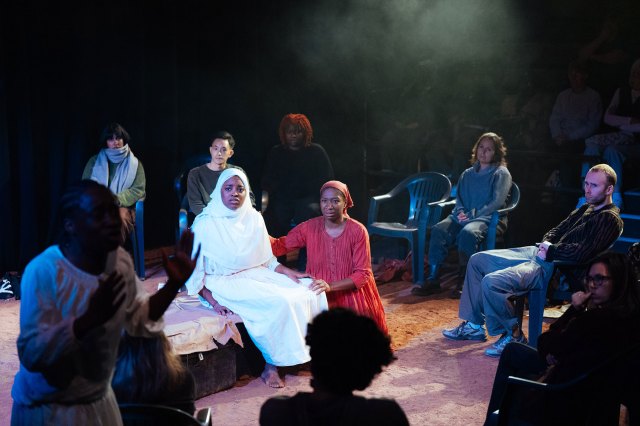
Raphaé Memon’s design is a mixed bag: metal toolboxes covered with cotton sacks sit atop a sandy dirt-covered stage. In moments of chaos, the floor kicks up into hazy dust clouds, and we wait to see where that dust and the girls have necessarily settled.
Ten little TV screens adorn the back wall, showing a combination of abstract shards and scenes in black, white and red, filmed behind reeded glass. It’s all so obscure that it ends up looking largely like a screensaver. The only moment in which they serve an obvious purpose is at the end when they show the photos of the actual girls kidnapped in 2014.
Dina’s idea to have audience chairs directly on the stage is an interesting one. No doubt it’s an intense experience for those sat right in the action, but the rest of the audience also finds themselves watching them for their reactions, seeing barrelling laughter catch suddenly in their throats; wiping tears away as their laughter returns. It’s a powerful tool, assuming the audience reacts in the way Dina would hope.
If the aim is to raise awareness of these kidnappings, and to point out the lack of resolution, then Girls is a major success. No doubt any audience members, who were previously unaware, have been sent home with plenty to research and think about. But as a playscript, there just isn’t enough plot for two hours straight through.






source on Google
Featured In This Story

Related Articles
See all





Latest Videos

The cast of The Haunting of Hill House on jump scares, spooky stories and Halloween costumes
It’s time to go trick or treating at Hill House…