
Ceilidh the Musical at Shoreditch Town Hall and on tour – review
Created by Scott Gilmour and Claire McKenzie, the piece is directed and choreographed by Tony Award winner Sam Pinkleton
 |
Tour
|
30 October 2026
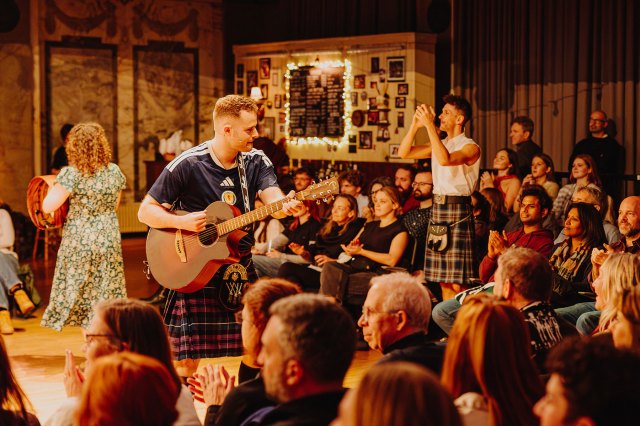
The addition of the word “musical” to any show title can be a red flag, though it’s usually coupled with a well-known piece of IP. Here, it feels oddly tautological, following a form of activity that’s synonymous with music, alongside Scotland, fiddles and callers invoking you to do-si-do.
In some sense, that’s aptly reflective of Scott Gilmour and Claire McKenzie’s show, which wraps a loose musical theatre structure around what is, in essence, a community folk dance. It’s difficult to pin down whether this is a party pretending to be a show, or vice versa. But niggling over form is to miss the point; in the end, it’s about celebrating the art of celebration itself.
There are kilts, bagpipes, even whisky and haggis, aplenty. The audience – at least those sitting on the ground floor of the cavernous Shoreditch Town Hall – are invited to participate at regular intervals, though routines are kept as simple (and short) as ceilidh custom allows (the dance floor is too crowded to make every routine entirely workable).
But there is poignancy too, with a narrative that centres on the passing of the art of calling from one generation to another (including a stand-out number, “Something Like This”, about the evolution of the dance steps over the years), and how toe-tapping numbers like “Strip the Willow” and “The Dashing White Sergeant” have come to symbolise a thread through time.
Gilmour himself plays Ramsay, son of legendary caller Leo (David Rankine), who’s hoping to pass the torch – or, more accurately, microphone – and help his son find his, drumroll please, calling.
The production has some heavyweight talent behind it. It’s directed and choreographed by Sam Pinkleton, who won a Tony for the maverick Oh, Mary!, and co-produced by Alan Cumming, artistic director of Pitlochry Festival Theatre, where it premiered earlier this month (Cumming was, I’m pleased to report, an enthusiastic participant on press night).
It’s unapologetically nostalgic, even tipping into mawkishness by the finale mass rendition of “Auld Lang Syne”, as we hold hands in a circle. But given it was conceived during lockdown (it’s easy to forget such a gathering would be unthinkable just a few years ago), this feels more than forgivable. Plus, you don’t come to an event like this – granted, there aren’t many – for the subtlety.
And it’s delivered by a multi-talented 17-strong ensemble who feel like a cross between the best ceilidh band you could find for your wedding and a stellar cast of actor-musicians. The playing is of the highest order, including a scintillating pair of duelling fiddles from Rori Hawthorn and Charlie West and some stonking vocal performances too, not least from Kirsty Findlay as Leo’s English (shock!) love interest Euna and George Drennan as “Older Man”.
In the end, your enjoyment level will probably boil down to your fondness of the form itself. I grew up not far from Scotland, and ceilidhs were very much a childhood fixture (we even learnt the dances at school). So, I was always likely to be a shoo-in. But even for the totally uninitiated, it’s just a straightforwardly fun night out that feels both life-affirming and quietly anti-zeitgeist. If you’re going to fiddle while the world burns, may as well do it in style.






source on Google
Featured In This Story

Guide
Related Articles
See all

Latest Reviews
See all

Latest Videos
Win a bundle of theatre-themed trick-or-treat goodies
Enter, if you dare!