
Man to Man with Tilda Swinton at the Royal Court – review
Stephen Unwin’s revival will also be staged at the Traverse Theatre in Edinburgh, before heading to Berlin and New York
 |
Edinburgh | London
|
|
Edinburgh | London
|
13 September 2026
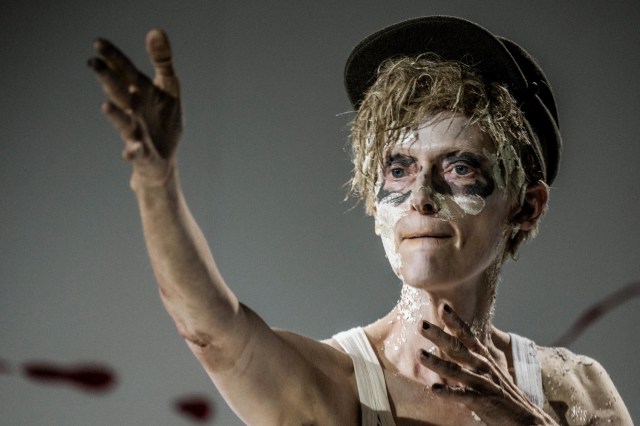
It’s 39 years since Tilda Swinton was last on stage. Her performance as a woman who imitates her husband in Manfred Karge’s Man to Man at the Traverse and the Royal Court in 1987, attracted the attention of the film director Sally Potter who cast her as the gender bending Orlando.
The rest is history. Swinton went on to become one of the most distinctive cinema artists in history collaborating with filmmakers such as Derek Jarman, Joanna Hogg, Wes Anderson and Pedro Almodóvar. Not to mention playing David Bowie’s doppelgänger.
To see her back at the Royal Court in the same play is in itself a treat – but the energy and intensity she brings to this monologue is something else again. There’s more than a hint of Bowie, in fact, in the laddish persona she lends to her imagining of Ella/Max, a widow who puts on her dead husband’s clothes in Weimar Germany and then continues to adopt different characters in her attempts to survive.
The play is both a study of endurance and a warning of the dangers of the Far Right; Karge has updated his text to include both the fall of the Berlin Wall – represented by a piece of red gaffer tape that Swinton pulls up off the floor – and the rise of the AFD. This has the effect of pointing its relevance but weakening its momentum.
Yet Swinton’s understated yet fierce performance carries you through. The key team assembled around her is the same as before. Bunny Christie provides a white cube of a room, scattered with objects that place period and conjure lives: a battered transistor radio, a fridge from which Swinton pulls the beer cans she swigs and spurts around the stage, a cushion that becomes a longed-for baby, a black and white TV on a stand, a Christmas tree.
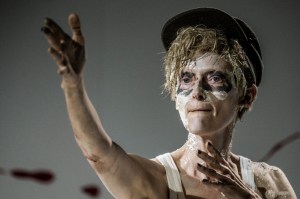
In this space, Swinton in red Y-fronts, string-vest and big boots, and smeared with white paint and what looks like a fried egg, swaggers, staggers and sits, sometimes speaking into a microphone, sometimes standing or sitting quietly, as she impersonates the many characters and types she encounters in her tale.
She pulls on Max’s trousers to avert starvation by taking his job as a crane driver after he dies of cancer; she imitates his hands getting weaker, his body folding. Initially, she keeps Ella’s identity intact, and preserves her identity card under the mattress, before giving it away in a gesture of compassion.
The rise of Hitler is marked by chanting on Elena Peña’s soundtrack and grainy film images by Matt Powell that are projected onto the walls, which Max smears with ketchup, like blood. Thereafter she has to shape shift to exist, proving she isn’t Jewish by forcing down pork, proving her manhood by stuffing a cloth down her underpants and bullishly drinking beer and schnapps. She marks out the space of a cell that condemns a prisoner to stand all day before she reveals, with throwaway insouciance, that she was an SA officer. “How else was I to avoid the medical?”
Stephen Unwin’s direction of the 28 short scenes is clear and driving, and the text (translated by Anthony Vivis) a compelling mixture of the raw and the poetic. When Ella/Max thinks of her past life as a woman she sees herself in terms of Snow White, pale as snow. Swinton’s wistful delivery of those lines is just one of the inflections of a performance that captures the contradictions of a divided life, at once pitiful and revolting, admirable and disgusting.
Her sense of alienation from herself and from the times in which she is living is like a warning cry. A play written in the 1980s speaks loudly today and makes another fine addition to the Royal Court’s 70th anniversary season.






source on Google
Featured In This Story

Related Articles
See all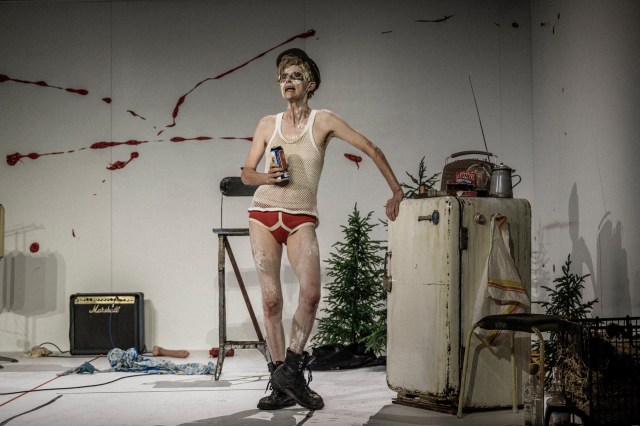

Latest Reviews
See all




Latest Videos

Into the Woods: Children will listen – West End cast and creatives regale us their theatrical childhood stories
Careful the things you say…