
By royal invitation: artistic director David Byrne on thrilling the Royal Court’s sold out audiences
The writer’s theatre has had a bumper year – with more to come!

 |
London
|
28 October 2026

David Byrne can count on one hand the last time that audiences at the Royal Court haven’t been sold out over the last year.
“I think we’re playing at something like 96 per cent capacity at the moment,” he begins ahead of the announcement of his new season, detailed here. “It is brilliant, especially since the work we’re putting on is complicated, difficult, experimental work that might traditionally be seen as something that might be hard to attract crowds to come and see.”
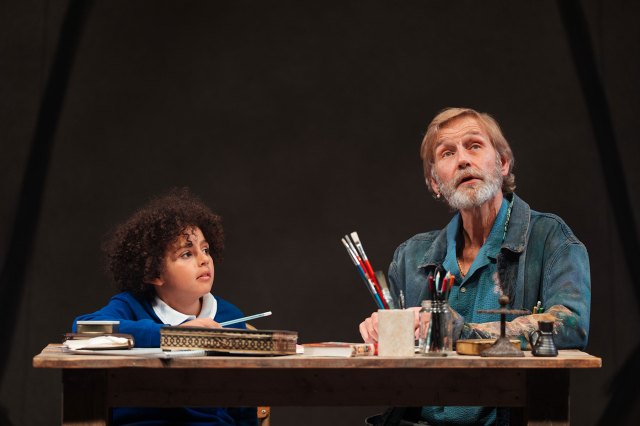
It has been quite the year for theatre. While celebrating its 70th anniversary season, the Court has been jam-packed, staging award-winning hits including Guess How Much I Love You? and John Proctor is the Villain, alongside Man to Man with Tilda Swinton, and will be concluding celebrations with Ryan Calais Cameron’s The Afronauts.
The artistic director observes that every play has had its own unique audience, and this isn’t just by chance but by design, as they precision engineer target audiences. “A big part of our energy is going out and finding that audience for each play,” Byrne explains. “I know there’s sort of a truth in the theatre that you sort of want a regular audience, but actually that’s the opposite of what we want at the Royal Court.”
Instead, he says: “What we want is to be able to fill the auditorium every night with an audience that is primed to hear the words that are going to be spoken by that writer through that production. I think that’s the sort of bound of energy you have to have around new work. It is being able to pick your feet up and go out and find those audiences every single time.”

It works because he cares. Byrne looks back on his time at the New Diorama Theatre, where his biggest successes could be considered Operation Mincemeat and For Black Boys Who Have Considered Suicide When the Hue Gets Too Heavy. He compares the two: “Both [are] original pieces of work, and both really infectious to audiences, especially those who want to have new experiences in the theatre and want to have that adventure.”
There are works, he says, that when pitched, people wonder how – or indeed, whether – it will work: “Over time, people do come to trust you. Once you get that wind behind you, it becomes easier to sell things that initially might raise an eyebrow.”
The eclectic programming isn’t the only thing that both venues have in common. Both have the same strategy spearheaded by Byrne to make new work feel admissable. Of the newly announced season, he says: “All of these plays are brilliant propositions, and it’s our job to make sure that the house is full with the people who are most excited about being in that room to see that story.”
The season is “meaningful in lots of ways,” for Byrne. It was always going to have to be a big one to follow the anniversary celebrations, but he is certain he has nailed it by programming six world premieres, and one major Broadway transfer – Branden Jacobs Jenkins’ Purpose – in its European premiere. “I think these playwrights have really given us the key and given us a solution to that. We’re really thrilled and excited by it.”
While audiences may differ from piece to piece, Byrne observes the similarities: “I think the one thing they’ve got in common is that they are absolutely brilliant bits of theatre and we’ve done the best we can to bring a team around them who love these pieces of work and we’re all advocating for them so strongly. Enthusiasm sort of reverberates out of the organisation and sort of is quite magnetising to audiences.”
He continues: “I think when you’re an artistic director, the whole game is momentum. What all of those audiences have in common and have had in common over the last couple of years is that there is that crackle every night, every single person in those seats, there is nowhere else in the world they would rather be than in that theatre about to sort of experience that sort of alchemy moment of that play meeting their first audiences in those world premiere productions.”

The Court is known as the writer’s theatre and this season features writers who were programmed first during his tenure in the Upstairs space and are now moving Downstairs: “It feels like we’re really capturing a new generation of core writers.” Nourishment continues with Nina Segal, as associate playwright at the venue. Her new piece, Afterbirth, will receive its world premiere, with a central turn from Oscar winner Jessie Buckley.
Byrne recalls: “I read this play and I thought there was nobody in the world who would play this quite like Jessie would. Jessie is one of the best actors of her generation. This part has the perfect balance of an absolute five-course meal of a performance, but also a certain level of experimentalism and abstractness, and the play is a beautiful equilibrium of those things.”
It feels as though there is a mutual respect between Byrne and the writers he welcomes into the Court. “There’s always a moment where we’re programming, I ask the writer permission to do the play,” he explains. There are emotions involved, too. “You’re trying to work out what emotionally and artistically feels right in the collection, and this feels absolutely right… It’s a huge privilege to be able to offer audiences the chance to be surprised and thrilled by experiencing something new through the programmes that you present and put together and hopefully this one will be no exception.”




source on Google
Related Articles
See all











Latest Videos

The cast of The Haunting of Hill House on jump scares, spooky stories and Halloween costumes
It’s time to go trick or treating at Hill House…