
The Story with Letitia Wright at National Theatre – review
The UK premiere of Tracey Scott Wilson’s drama, directed by Clint Dyer, runs in the Olivier until 24 October
 |
London
|
|
London
|
4 September 2026
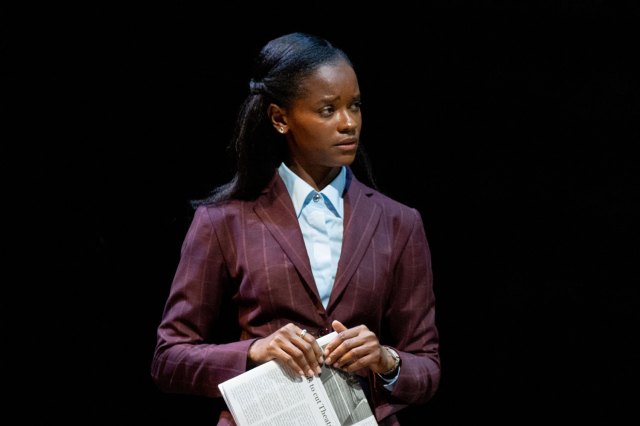
Tracey Scott Wilson’s play about journalists and the truth was premiered in 2003 but has never had a full production in Britain. Yet it fizzes with ideas that are still relevant about the way the news is pursued and delivered.
Structurally, it unfolds in unbroken, quickfire scenes, rapidly changing perspective as it tells the story of Yvonne – played by Black Panther star Letitia Wright – an ambitious reporter who joins a US newspaper and is pigeon-holed into the Vanguard section, which is committed to writing positive stories about the Black community, fighting racist preconceptions community centre opening by community centre opening.
But her desire to succeed, her middle-class contempt for her activist boss Pat (Lorraine Toussaint), battle-scarred and resistant from her own fights with the establishment, leads her into murky waters when she starts to investigate the story of a white teacher shot in a Black neighbourhood.
The story was inspired by the famous case of the Washington Post reporter Janet Cooke who won a Pulitzer for her reporting of the case of a nine-year-old heroin addict. Both story and her CV turned out to be untrue. But Scott Wilson holds the veracity of Yvonne’s reporting in more doubt, and in the first half in particular, the play has the qualities of a thriller, a headlong, impassioned debate about who has the right to speak and what they have the right to say.
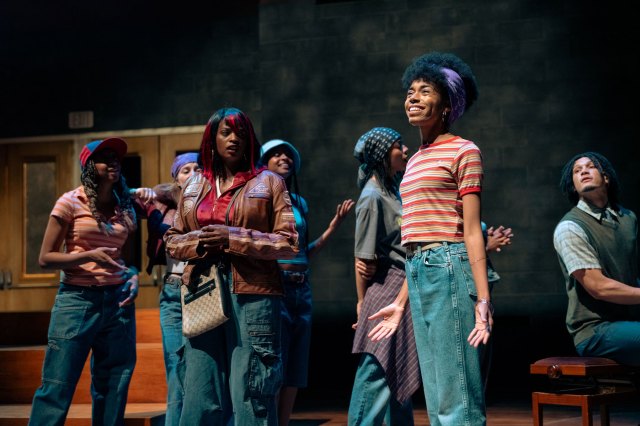
As it progresses, it loads in too much weight, too many unanswered questions, and it takes all of Clint Dyer’s skill as a director and all the Olivier’s resources as a theatre to keep its spinning narrative clear. But Dyer’s direction is superbly confident, and beautifully realised as characters speak and argue in parallel scenes, the ensemble morphing (with the help of Lucie Pankhurst’s movement direction) into disaffected schoolgirls, cynical cops, and hectoring reporters as the moment needs.
Designer Anna Fleischle sets the story in a faded school gym, with bleachers and a score board, a neutral space into which desks and furniture can be wheeled in, and above which Gino Ricardo Green and Tai Yarden’s videos, and Paul Anderson’s lighting effects can change the mood and move the action. Benjamin Grant’s score and sound design provide an edgy undertone.
The jittery scenes are impassioned, particularly when Yvonne is arguing with her trust fund boyfriend and newspaper heir Jeff (Wilf Scolding) while Pat takes on Ashley Thomas’s doubtful reporter Neil, who distrusts the truth of what Yvonne is saying and believes it is destroying the wider community. The restaurant encounter between Yvonne and Neil, when each tries to sound the other out, is a mini-masterpiece of comic timing. The questions of how Black journalists should write and work in the face of prejudice and distrust are genuinely pressing.
But on the whole The Story sprawls when it should tighten; it feels like a series of point paragraphs rather than a narrative. Wright is energetic and wired as Yvonne but her motivations – with a melodramatic explanation – never quite convince, and the fractured nature of the telling makes it hard to care about her. In the end, it is Toussaint who holds it all together, fierce and unbending and heartbreakingly destroyed by sacrificing her principles in a world and in an industry that makes it very difficult to succeed.






source on Google
Related Articles
See all

Latest Reviews
See all


Latest Videos
New musical Nero releases first listen with Andrew Barth Feldman
It is from the writers of Spring Awakening