
Some Woman with Anne-Marie Duff at the National Theatre – review
Helen Edmundson’s world premiere play, directed by Blanche McIntyre, runs in the Dorfman until 21 November
 |
London
|
|
London
|
16 October 2026
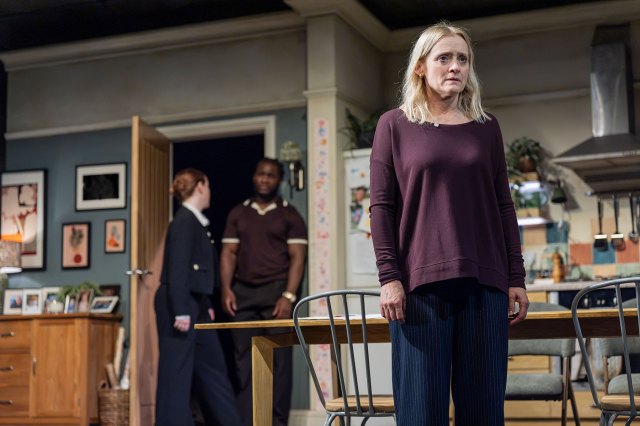
A woman stands on a station platform, waiting for her train. A jeering schoolboy comes up to her, asks the time and insults her. She’s shaken and shocked and decides to complain. What happens next derails her life.
The setup of Helen Edmundson’s new play is very simple. Its twists and turns, however, draw gasps from the audience as Anne-Marie Duff’s Julie, an ordinary woman living an ordinary life, suddenly finds herself at the centre of a legal and emotional maelstrom.
Its plot is part of its pleasure, so it’s a shame to give too much away, but suffice it to say that Julie quickly moves from being victim to being accused in a court system that allows manipulation and injustice to thrive. In this, Edmundson’s writing has something in common with Suzie Miller’s Prima Facie and Inter Alia, plays that threw light on the unfairness of the law as it applies to women.
What gives Some Woman its particular quality, though, is Edmundson’s interest in the way that women of a certain age become ignored. Julie’s reaction to what happens to her is in part because she is tired of being invisible, putting her needs last. She wants, as she says, people to look at her and to see her.
The character is a brilliantly nuanced creation, and she is embodied with rich conviction by Duff. At one point, she cries: “I can’t believe this is my life” and both the writing and production emphasise its mundanity. Robert Jones’ versatile design conjures the cluttered suburban kitchen in the family home she is being forced to sell after divorce from her bullish husband Richard (a marvellous Geoffrey Streatfeild), all designer trainers and bluster.
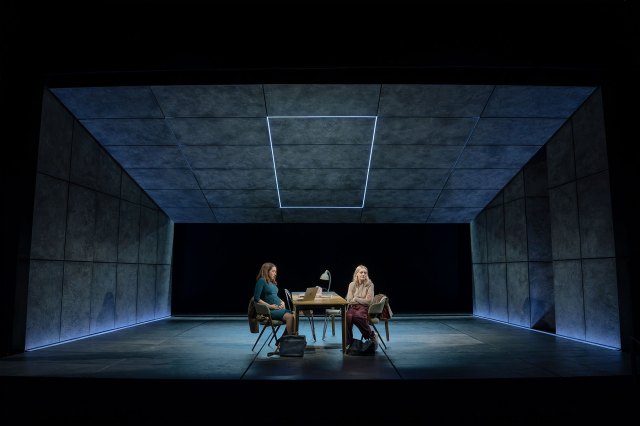
He’s off with his new woman and plans for a new family, while Julie cares for their vulnerable younger daughter Ginny (Grace Doherty), holds down a dead-end job, and absorbs the aggression of her older daughter Kate (a biting and fiery Hannah Onslow) who regards her mother and her life with contempt.
It is these circumstances, beautifully suggested in a series of sharply-written, impactful scenes, that make Julie feel so impotent and so overlooked. She wants to take a stand about something and as her complaint about the boy’s behaviour unravels her life, so her relationships with her family come increasingly under the spotlight.
There is one scene of confrontation with Streatfeild where, under Blanche McIntrye’s taut direction, both actors stand almost still, facing one another as a whole world of bleak sadness and incomprehension runs across their faces. At another moment, with Natasha Chivers’ lighting and Ben and Max Ringham’s soundtrack evoking a wintery garden, Julie sits bleakly with Kate, finally talking, but still miles apart, the daughter’s disdain for her mother’s choices overriding the love both of them feel. Beaten by life, Duff conveys an intensely convincing mixture of shrinking into herself while finding strength for a fight; she seems to grow before our eyes.
In a strong cast, Tobi King-Bakare does a lot with not much as the kindly, irrepressible boyfriend and Stephen Wight makes one terrifyingly smooth intervention as the narrative reaches its surprising and effective conclusion.
Some encounters end abruptly and some veer towards the melodramatic. But it’s a tense and engrossing evening and a wonder to spend it with Duff, the kind of actor you could watch forever.






source on Google
Featured In This Story

Featured Artist

Related Articles
See all

Latest Reviews
See all



Latest Videos
New musical Nero releases first listen with Andrew Barth Feldman
It is from the writers of Spring Awakening