
The King’s Speech at Barn Theatre Cirencester and on tour – review
Loveday Ingram’s revival of David Seidler’s historical drama runs until 7 November, before touring from 13 January
 |
Tour
|
|
Tour
|
14 October 2026
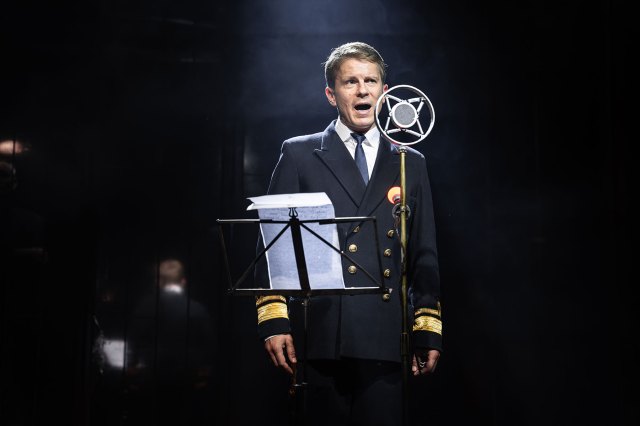
A global crisis. A monarchy at war with itself. Royals who never asked to be royal… Perhaps it’s no surprise that Cirencester’s Barn Theatre – known for its confident, good taste – is staging a new production of David Seidler’s play The King’s Speech, ahead of a nationwide tour in 2027.
On 3 September 1939, King George VI stood in front of a ribbon microphone, about to announce to the nation that Britain was at war. A King who didn’t want to be king, giving a speech no one would choose to have needed. Would the stammering, nervous Bertie (as his intimates knew him) manage to get through this address with dignity and professionalism intact?
The story of The King’s Speech is both complex and simple, as the opening scene – directed by Loveday Ingram – demonstrates with humorous buoyancy. Bertie (an excellent George Rainsford) is getting up: an act that involves raising his arms as courtiers slickly slide a shirt over his shoulders, and lift him to put on his trousers. The man who one day will help lead a nation cannot even dress himself.
Looking presentable is one thing: sounding it is another. Bertie has a stammer – a problem his father does not tolerate or understand. George V (Tim Hudson) is big on love for his public; short on affection for his sons.
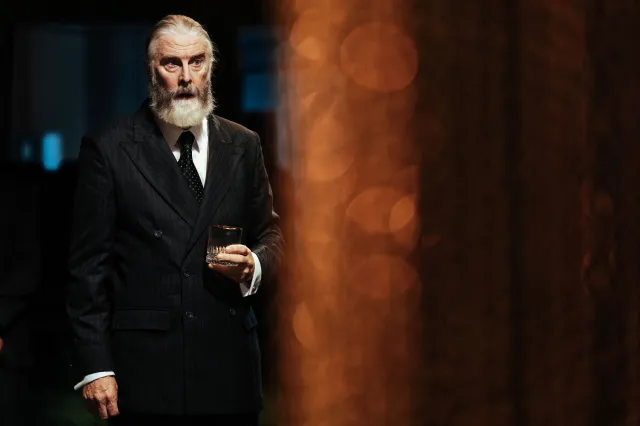
Enter Lionel Logue, Australian speech therapist and failed actor; a man with no time for royal protocol: professionalism, playfulness and posturing that Stefan Dennis delights in capturing. And it is a delight, watching the two men together: a series of chess matches where Lionel continuously checkmates Bertie’s temper and pomposity with casual Antipodean gameplay.
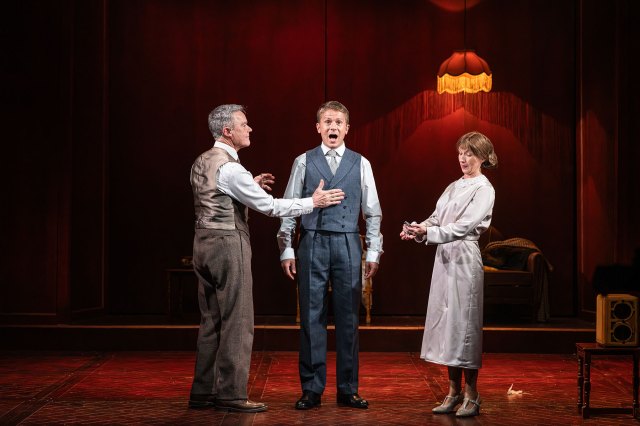
This is a play that doesn’t shy away from life’s Gordian knots; from the labyrinth of history. We get bursts of Hitler’s commanding diction juxtaposed with Bertie’s stuttering lack of confidence; flashes of Churchill’s support for heir-to-the-throne David (Mark Hammersley) despite the latter’s Nazi sympathies. We see that Lionel, solver of others’ problems, has some of his own: his wife, Myrtle (Lucy Bromilow) is desperate to return home. Bertie’s supportive wife Elizabeth (Rosanna Miles) firmly believes in him; while the pompous Archbishop of Canterbury (Ian Kirkby) fights him: surely he, as spiritual leader, should be directing the country.
The difficulty, at times, is that the very nature of the play means those complexities can seem a whistle-stop tour. Nevertheless, this production is sincerely and beautifully done. Partnering with CIC Stammers Matter, it asks eternal questions with humour and humanity: how do upbringing, unasked-for problems, and external judgement define us? Where do we find courage to show the world who we feel we really are? The Barn’s minimalist set means there’s little distraction from the central theme of relationships; perhaps, too, it functions as a symbol or a reminder that a king stripped down to bare basics is merely a man.
The slickness of film lends beauty to this story. The immediacy of theatre gives it an echoing edge. An edge that cuts to the core of a messy period in history. A real-life act made for the stage.






source on Google
Related Articles
See all

Latest Reviews
See all

Latest Videos
New musical Nero releases first listen with Andrew Barth Feldman
It is from the writers of Spring Awakening