
Blood of My Blood at the Royal Court – review
Joy Nesbitt’s drama, directed by Tatenda Shamiso, runs at Jerwood Theatre Upstairs until 7 November
 |
London
|
|
London
|
12 October 2026

This play from the American-born, UK-based playwright Joy Nesbitt is thrillingly original. Part ghost story, part social history, and entirely gripping, it announces her as a writer to watch and enjoy.
It’s set on a former plantation in Southern California, where Tallulah, a Black British woman, has arrived at an Airbnb in the unlikely setting of a former slave cabin. The current owners of the place are renting out every part of the husband’s ancestral home to capitalise on the fashion for all things antebellum.
“We had one wedding recently where it was a mixed couple getting married and it was weird because it was Gone with the Wind-themed,” says Nora, nervous wife of James. “And she dressed in this ballgown like she was Scarlett O’Hara and he dressed in shackles for the wedding pictures.”
This discomfort, with its echoes of Jeremy O Harris’s much more confrontational Slave Play, underpins proceedings that were inspired by Nesbitt’s discovery of her own past. But she has fashioned her play into something troubling in different ways, an examination of enslavement that seeks to grapple with all kinds of complexities.
Her protagonist Tallulah (Jodie Campbell) knows she is an ancestor of the enslaved woman Ginnie Good, who once lived in this place, and had five children with the white Doc, younger son of the plantation owner. She has come to South Carolina to use ancient rituals to conjure her back for advice on her own modern dilemma.
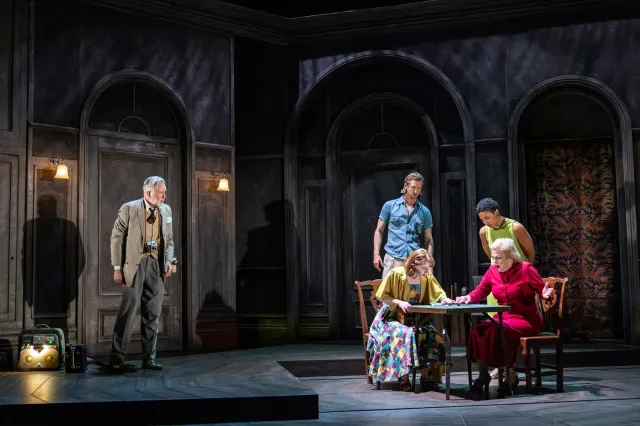
The play is consequently set in two periods, in 1862 on the very eve of the abolition of slavery at the end of the American Civil War, and in the present day when its shadow still taints every action. Both are cleverly evoked on Natalie Pryce’s set, which puts the audience into traverse, either side of a bare shack and a garden with a tree.
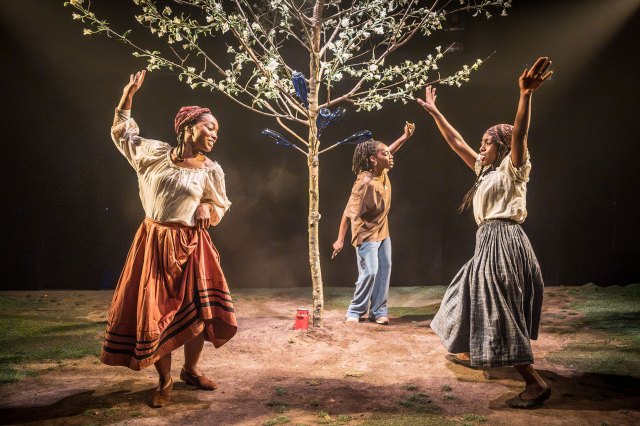
The ground beneath our feet is the same as the actors walk on, as history bleeds into the present, implicating and involving everyone in the story. In the same way, under Simisola Majekodunmi’s glimmering lighting, and with the help from Kayodeine’s often startling soundscape, scenes seem to take place in two periods simultaneously, ghostly shadows half-sensed through doorways, past and present becoming merged.
Tatenda Shamiso’s direction is taut and purposeful, making the action unfold with clarity, sensitively matching the play’s tonal shifts. It is often very funny as Tallulah, with her British sensibilities, encounters her hosts; Hannah Morrish gives Nora a frightened niceness, an anxious desire to please and never to say the wrong thing. As Amanda, mistress of the house in 1862, she is monstrous in her cruelty.
Patrick Vaill as her historian husband, giving speeches about the way that Irish migrants righted historic oppression by coming to America, buying plantations and owning slaves superbly slips between time frames. In the past, he is the father of Ginnie’s children through a decade-long relationship, which he describes as love, even though she still calls him master. Vaill and the superb Ronkẹ Adékọluẹ́jọ́ as the dignified Ginnie, finding her way to decisions she can live with, play the difficult beats of this complicated relationship with involving uncertainty.
Somehow Vaill manages to suggest two different men (one blinking nervously, one hitting his face in agonised self-loathing and despair) who both believe they are good, yet share a similar blindness and venality.
The cast is rounded out by Karene Peter, convincing both as Ginnie’s friend and as James’ student, clear-sighted in both periods about the repercussions of slavery and its effect on the South.
Blood of My Blood isn’t perfect; it overcomplicates Tallulah’s motivation and over-explains Ginnie’s ultimate decision-making. Nevertheless, it is refreshingly unwilling ever to simplify. These people, spanning history, are brought to life in this production just as effectively as Tallulah communes with her ancestors. It’s a bold, moving play of extraordinary impact.






source on Google
Featured In This Story
Related Articles
See all


Latest Reviews
See all





Latest Videos

Gaten Matarazzo and the cast of Rent on living “La Vie Bohème” in the musical’s 30th anniversary year
Luke Sheppard’s West End revival is now officially open at the Tom Stoppard Theatre!