
Margaret Atwood’s The Penelopiad at York Theatre Royal – review
Juliet Forster’s revival of the feminist reimagining of Homer’s The Odyssey runs until 31 October
 |
York
|
|
York
|
15 October 2026
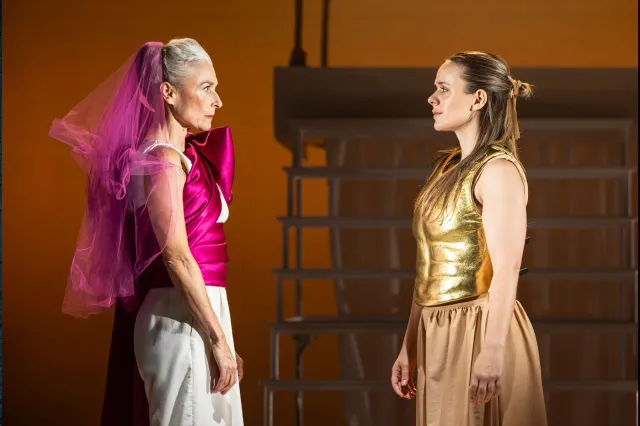
Margaret Atwood’s feminist retelling of The Odyssey inverts the events of Homer’s Greek epic, telling them in retrospect from the perspective of Odysseus’s wife Penelope, played by a captivating Amelia Bullmore, as part of an all-female cast and creative team.
We are in present-day Hades, where Penelope has been since her death. Others who have arrived here have taken the opportunity to wipe their memory by drinking from the River Lethe so they can be reborn and live again. Penelope has remained. “Now that I am dead, I know everything”, she says, and this is her chance to reclaim her story from her husband’s narrative.
She begins with her birth and her father’s attempt to have her drowned based on an interaction with a prophesying snake. After being saved by a flock of ducks, Penelope’s father takes her survival as a sign from the gods that she should not die after all. From there we see a short-legged Odysseus dishonestly win her hand in marriage before taking her to Ithaca. We watch him leave her there and head to Troy, and so begins Penelope’s 20 years of suffering at male hands in his absence.
Through Penelope, Atwood also gives voice to the maids who were ruthlessly hanged on Odysseus’s return. It’s their story as much as Penelope’s. They act as an eight-person chorus and give life to the characters Penelope recalls. Among them, Pena Iiyambo is excellent as the vain Helen of Troy, all sickly posturing, vanity and side-eyes; Penelope suggests she would flirt with a dog. Helen haunts Penelope in life and death, inescapable even in moments of supposed joy that follow her marriage to Odysseus and the birth of her son.
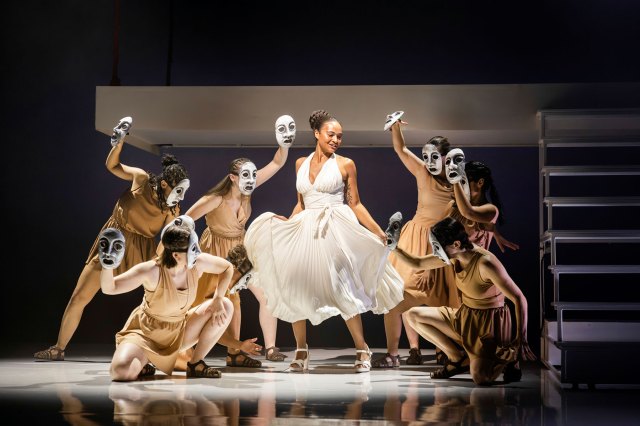
Sara Perks’ white marble stage sets off the blood-red ropes that dangle from the ceiling or pull through the floor like intestines unfurling from a wound, auguring future events. Deborah Mingham’s masks, Michelle Edwards’ movement direction and Alexandra Stafford’s lighting provide physical and shadow puppetry that bring Penelope’s recollections to life.
The play has grown since its debut: the 2007 co-production between the Royal Shakespeare Company and Canada’s National Arts Centre clocked in at 140 minutes. It now approaches two and a half hours in director Juliet Forster’s hands, and although the early pacing is a little uneven, it soon finds its stride.
Kate Marlais’ compositions are presumably the cause of the expanded running time, but they are a welcome addition, giving the production emotional heft. Following a scene of shocking male violence, lo-fi-accompanied soft choral singing washes over us in a beautifully bittersweet moment of reflection. Earlier, a wordless, staccato vocal melody became a gentle earworm as the women weave a shroud together.
The music somewhat offsets Atwood’s tendency, in adapting her own 2005 novella, to fall into the author’s trap of retaining too much exposition. Luckily, the task of delivering this falls to the wonderful Bullmore, whose measured, and often wry, delivery matches Atwood’s text. Her Penelope is as complex as Odysseus: they are both liars. She has the youthful exuberance of a young bride and the careful countenance of a woman experienced in survival. And though Bullmore is worth the admission alone, it’s the chorus who grab you at the end with their final haunting howl of righteous feminine anger.






source on Google
Related Articles
See all


Related City Guide

Latest Reviews
See all





Latest Videos
New musical Nero releases first listen with Andrew Barth Feldman
It is from the writers of Spring Awakening