
Back to the Future musical on tour review – The power of nostalgia
The WhatsOnStage Award-winning musical has launched at 88mph at Bristol Hippodrome
 |
Tour
|
|
Tour
|
16 October 2026
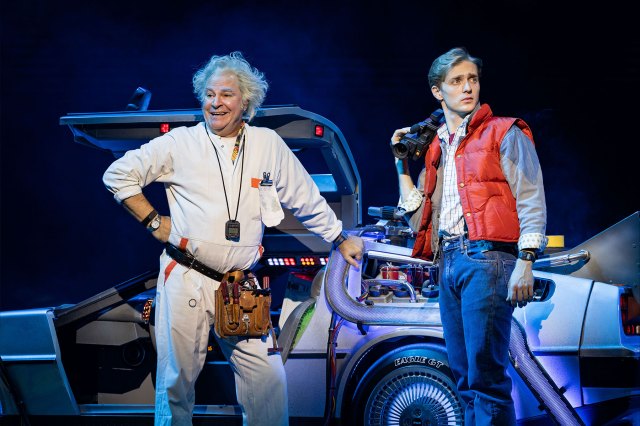
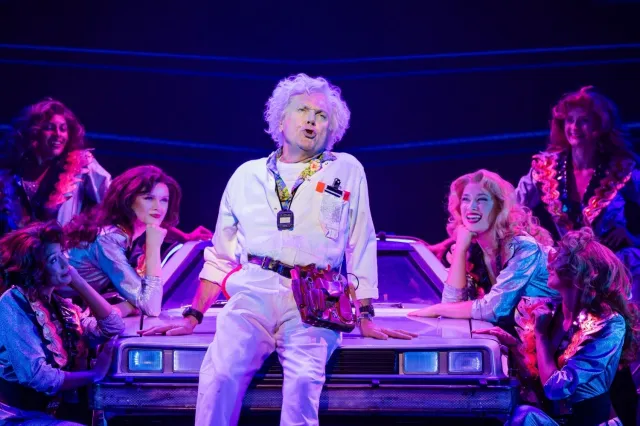
Great Scott! Before you’ve even entered the Bristol Hippodrome, Back to the Future has already made its sales pitch. On press night, the DeLorean is sat parked proudly outside the theatre, with fans queuing to take photographs beside it before heading inside. It was probably the most spectacular moment of the evening, because let’s be honest: the DeLorean is the star of the show. Not Marty McFly, not Doc Brown, certainly not the score.
The car remains one of cinema’s most iconic pieces of design and it is the image that continues to sell this musical around the world. The production itself seems perfectly aware of that fact. After all, when a show’s publicity boasts of a DeLorean that “defies the laws of theatre”, it knows exactly what audiences are coming to see. That presents a challenge. The original 1985 film isn’t simply beloved, it’s close to perfect. Robert Zemeckis and Bob Gale’s screenplay is one of Hollywood’s great pieces of popular entertainment, a script constructed with such precision that every setup eventually finds its payoff. Audiences don’t arrive hoping this musical will improve upon it. They arrive hoping it won’t mess it up.
Thankfully, this adaptation is smart enough to know where its strengths lie. Rather than radically reimagining the story or searching for hidden depths, it simply places the film on stage in a slick, highly efficient and hugely entertaining way. Each scene arrives like a postcard from the movie. Here’s that gag. Here’s that reveal. Here’s that moment with the skateboard. Here’s that stunt with the clocktower. Tick it off and move onto the next one. Normally that might feel dramatically limiting. Here it proves oddly satisfying. Like revisiting a favourite holiday destination, the pleasure often comes from knowing exactly what’s around the corner.
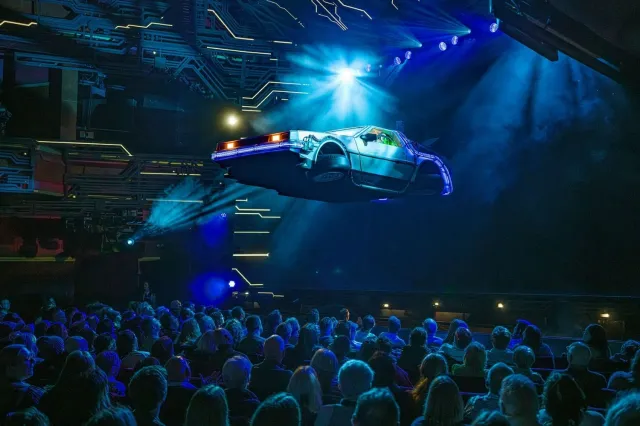
The DeLorean itself remains the evening’s great destination point. Inevitably, some of the jaw-dropping spectacle that accompanied the original West End production has softened slightly in the transition to the road. A touring production can never entirely replicate the scale of something created for a permanent home, of course. Yet, when the car finally gets its showcase moment, the audience reaction suggests nobody leaves feeling short-changed.
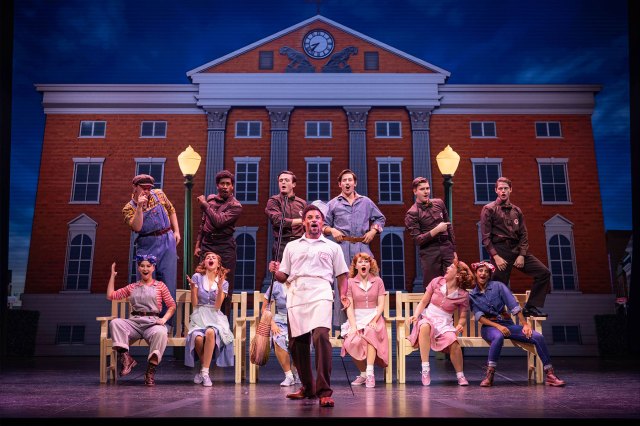
The score is less successful. Alan Silvestri and Glen Ballard’s 17 original songs perform their narrative duties perfectly well, but few linger in the memory afterwards. This is perhaps inevitable. They find themselves competing not only with “The Power of Love” and “Johnny B. Goode”, but with decades of audience affection. Wisely, the musical doesn’t even really attempt to challenge them. The new songs are workman-like rather than spectacular, efficient pieces of storytelling that keep everything moving without ever demanding centre stage.
What elevates the evening is the technical team. Tim Hatley’s design, Gareth Owen’s sound, Finn Ross’s video work and the lighting by Tim Lutkin and Hugh Vanstone combine to give the production a glossy cinematic sheen. The result feels less like theatre borrowing from film than theatre dressing itself in film’s clothes. Locations glide into place with remarkable smoothness, projections expand the world beyond the stage and effects arrive with blockbuster precision. Under John Rando’s direction everything moves with the confidence of a production that knows exactly where it’s heading and never misses its mark.
Leading the company, Axel Duffy makes for an enormously likeable Marty McFly. Having originated the role in the Australian production, he wisely avoids falling into the trap of impersonating Michael J Fox. Instead, he creates his own version of the character, closer to a traditional musical theatre leading man than a cinematic recreation. He brings warmth, energy and a terrific voice to the role, carrying the evening with considerable charm.
The evening’s MVP, however, is Roger Bart. It remains slightly surreal to see a Tony Award-nominated performance appearing in a UK tour. Having originated Doc Brown in Manchester before taking the role to the West End, Broadway and Sydney, Bart possesses complete ownership of the character. Occasional echoes of Christopher Lloyd’s vocal mannerisms remain, but this is no impression. Instead, Bart brings his own comic instincts and star quality to the role. Every entrance feels like plugging the production directly into the mains.
Elsewhere, James Oliver makes an endearingly geeky George McFly whose awkward sweetness never becomes cloying. Danielle Rose captures both Lorraine Baines’ flirtatious confidence and her underlying sweetness, while Brandon Lee Sears nearly stops the show with “Gotta Start Somewhere”, comfortably the strongest of the musical’s original numbers and one of the few songs that genuinely fights its way into the memory after the curtain falls.
I had a terrific time with Back to the Future. Frankly, it would have been more surprising had I not. The source material is a masterpiece and this adaptation is smart enough to know it. Whether that makes it a genuinely great piece of musical theatre is more debatable. The original songs rarely achieve lift-off and the production is often content to faithfully recreate rather than reinterpret. Yet there is also something admirable about a show that knows exactly what it is. Rather than trying to reinvent the wheel, it simply keeps it spinning.
After all, the audience hasn’t come in search of theatrical revolution. They’ve come to see a DeLorean hit 88 miles per hour and disappear into a burst of theatrical wizardry. This production understands that better than anyone. To borrow Doc Brown’s immortal advice: “If you’re gonna build a time machine into a car, why not do it with some style?”






source on Google
Featured In This Story
Related Articles
See all
Latest Reviews
See all

Latest Videos
New musical Nero releases first listen with Andrew Barth Feldman
It is from the writers of Spring Awakening