
Triumph review – Caryl Churchill has pitch-perfect prescience with her Almeida micro-play
Kate O’Flynn returns to the stage as part of the 15-minute play
 |
London
|
18 October 2026

Caryl Churchill is a woman with her finger on the pulse. Her plays have consistently had prophetic powers, painting pictures of a world on the verge of apocalypse and chaos, about the abuse of power, about forces both sinister and ignored. Her warnings have only become truer with the passing of time.
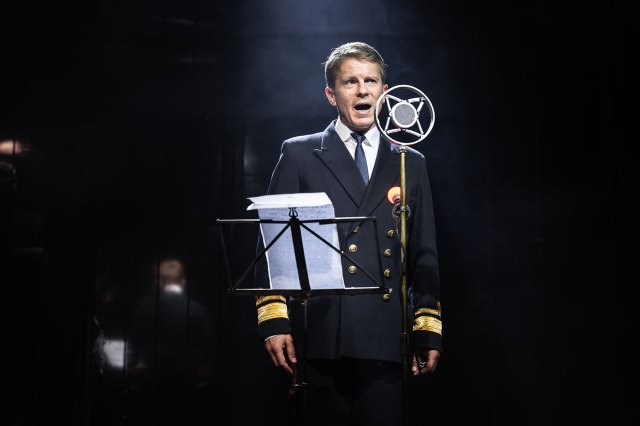
At 88, her clairvoyance is just as clear. On the day the sinister Triumph premiered at the Almeida Theatre, President Trump’s latest blonde press secretary Katie Zacharia left her job after just five days. Which made its portrait of a press secretary in a blonde wig announcing the achievements of the Emperor to a waiting world all the more telling.
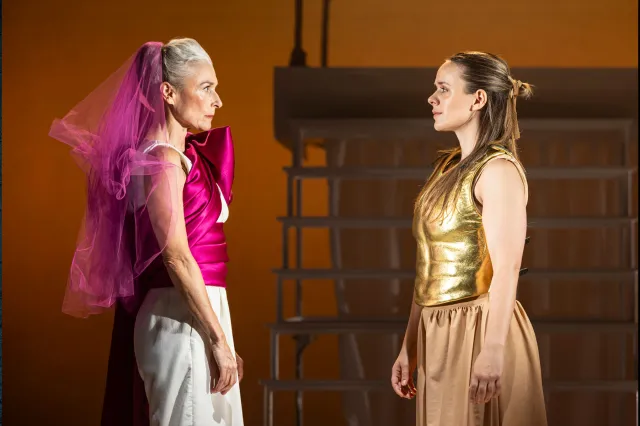
Triumph isn’t quite a play. At just over 15 minutes, you’d call it a jeu d’esprit, or a sketch, except that fails to describe its utterly chilling quality. Churchill has taken the words the Roman historian Suetonius used to describe the cruelty of emperors from Julius Caesar to Domitian and put them into the mouth of a modern-day media manipulator. All the words used to describe the tyrant are from Suetonius as a panel on Miriam Buether’s red-hued set announces; all the echoes are for us to find.
This dark study begins, though, with a kiss between Iris (Widow’s Bay’s Kate O’Flynn) and Marcus (Matthew Beard) who turns out to be one of the journalists standing at the back of the room as she takes to the podium and announces to a waiting nation the Imperial triumphs – the marble statues, the golden throne, the gladiatorial spectacles of combat between armies “500 a side and 20 elephants”.
When they are in bed together, he begins to list the truth behind the gloss: the woman raped by their executioners so they can be legally executed (a practice of Tiberius according to Suetonius), the ruler’s liking for dressing up in animal skin and attacking the groins of men and women bound to stakes (one of Nero’s games) and for cutting opponents in half or imprisoning them in cages where they could not stand (two of Caligula’s favourite forms of torture.)
Directed with crisp straightforwardness by James Macdonald, Triumph makes its point by using sheer excess of Suetonius’s descriptions. This gory cruelty is historic, yet it speaks utterly to the dangers of anyone seeking absolute power. It doesn’t spell anything out, yet there’s just enough to suggest parallels with a modern world where a US Secretary of War can suggest streaming the execution of a man in a wheelchair live, or where a triumphal arch is under construction. Or indeed any leader who puts their own desire for power and adoration above the impulses to be humane or the betterment of humanity.
The most sobering moment comes towards the end, where O’Flynn breaks down and begins to go off script. She is sure she will be brutally killed; in fact, ratings rise. People love spectacle.
It’s at once simple and yet incredibly strong. O’Flynn is entirely convincing both in her half-smiling, half-joyful public persona, with her announcement voice firmly in place, and in troubled private. Beard and Sargon Yelda as her minder Rufus lend intense support.
Most of all Triumph is a reminder of the power of Churchill’s imagination: the way her mind makes dramatic leaps and forges links that most people do not see. The National is about to revive Cloud Nine and the Almeida has just announced three more short plays to be presented together early in the New Year. Both are causes for celebration.cEven for 15 minutes, her voice needs to be heard.






source on Google
Related Articles
See all


Latest Reviews
See all





Latest Videos

New musical Nero releases first listen with Andrew Barth Feldman
It is from the writers of Spring Awakening