
Twelfth Night at the Crucible Theatre – review
Jamie Glover’s production, featuring the repertory cast who recently completed their run of King Lear at the venue, continues until 31 October
 |
Sheffield
|
19 October 2026
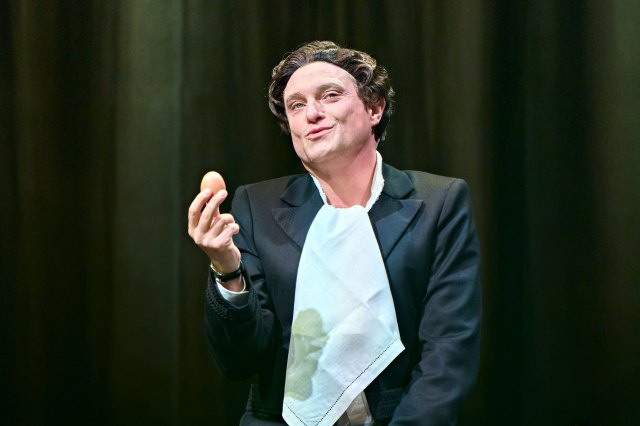
Sheffield Crucible’s programme warns us that Shakespeare’s comedies “were not necessarily humorous”, so the opening of Jamie Glover’s production seems ominous: Feste enters, slowly and quietly begins to sing, “When that I was and a little tiny boy” and on “The rain it raineth every day”, up goes his umbrella, off go the lights and we move into a dramatic re-enactment of Viola and Sebastian’s shipwreck, with evocative use of ladders to keep their heads above water.
But, in fact, the production that emerges is intelligent, perfectly balanced between humour and the serious side of life, with nothing that is controversial and plenty to provoke laughter, for lovers of wit and knockabout equally. And, incidentally, the umbrella returns at the end, giving the play the dying fall that surely Shakespeare intended.
Twelfth Night in Elizabethan times was an important festival, the end of 12 days of misrule, and this production makes clear that, if the inmates have taken over the asylum temporarily, sanity is about to reassert itself: Malvolio will get justice and those nobles who gave way to wild infatuation will settle down with partners of opposite genders.
Twelfth Night depends upon the misidentification of twins of different sexes: in Shakespeare’s time it must have been pretty easy with boy actors playing female parts, but the Crucible’s Harry Redding and Bebe Sanders are considerably more convincing than most these days. In fact, Sanders’ remarkable performance is the key element in the production’s success. By playing it absolutely straight (and more than a little confused), but holding to her own love of Sebastian and Orsino, she convinces as both Viola and Cesario.
The main plot concerns a rather unusual triangle: Duke Orsino is wildly in love with Olivia, but she will have nothing to do with him as she is mourning her brother; Viola is shipwrecked and goes to serve Orsino as the cross-dressing Cesario; (s)he is used as messenger to Olivia and inevitably falls for Orsino as Olivia falls for him/her. Fortunately, unknown to her, her twin Sebastian also survived, so one can see a happy ending on the horizon.
Meanwhile we have the domestic comedy around Olivia’s drunken uncle, Sir Toby Belch, who is busy fleecing Sir Andrew Aguecheek by persuading him he has a chance with Olivia. Malvolio, the delusional steward, is the victim of the Toby gang by being famously conned and then humiliated. The play could be said to pivot into post-Christmas sobriety as Sir Toby becomes sick of the humiliation, but there is a final riposte from Feste, the clown who, like foolery, “does walk about the orb like the sun”, and nails Malvolio as the man who put him out of favour with Olivia.
Sanders’ performance opens the door for Justina Kehinde’s Olivia to strike attitudes until undone by her love for Cesario: there is a stunning costume change when she changes from her habitual black to an elegant green number for Cesario’s second visit. So much for her resolve to mourn! Fode Simbo’s Orsino makes rather less impact, but he, too, is poised between nobility and folly.
The crazy world of Olivia’s household is headed by Mathew Horne‘s Malvolio. Unsuitably costumed at first, he is gloriously blissful in his reaction to the letter he assumes is from Olivia and then in his appearance before Olivia as a rather unlikely Morris dancer. It’s a strength of the production that Horne can treat these scenes as comic “turns”, then appear as a malignant Lear-like figure with complete conviction.
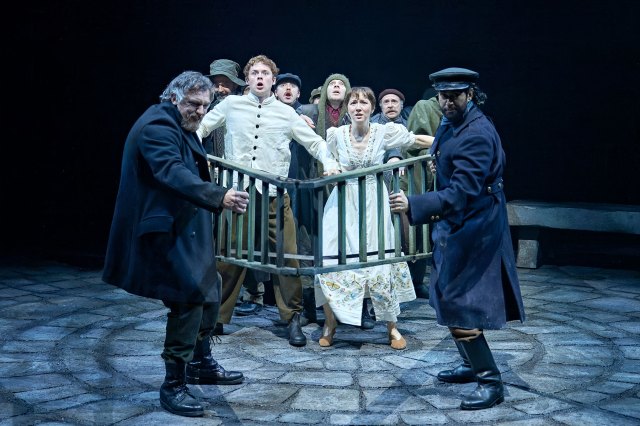
Milo Twomey may not have the girth of the traditional Sir Toby and is perhaps a class or two below his niece, but he is very funny, as are James Chetwood, wonderfully droll as Sir Andrew, and Katie Wimpenny, spectacularly animated as Olivia’s servant Maria.
And then there’s David Birrell whose Feste convinces us that he walks alone, an oddly dignified figure in an elaborate costume that is one of the triumphs of Amanda Stoodley’s sometimes odd costume choices. Her simple set, dominated by a great sun that disappears during Malvolio’s imprisonment, works well, as does Genevieve Dawson’s Scots-inflected music, played by a trio of (bass) clarinet, violin and guitar.
Painlessly cut and played at a cracking pace, this production validates Twelfth Night‘s position as the finest of Shakespeare’s comedies.






source on Google
Related Articles
See all
Latest Reviews
See all

Latest Videos
New musical Nero releases first listen with Andrew Barth Feldman
It is from the writers of Spring Awakening