
Present Laughter at Theatre Royal Bath and on tour – review
Tracy-Ann Oberman plays Geri Essendine in a reimagined version of the Noël Coward classic
 |
Tour
|
|
Tour
|
3 September 2026
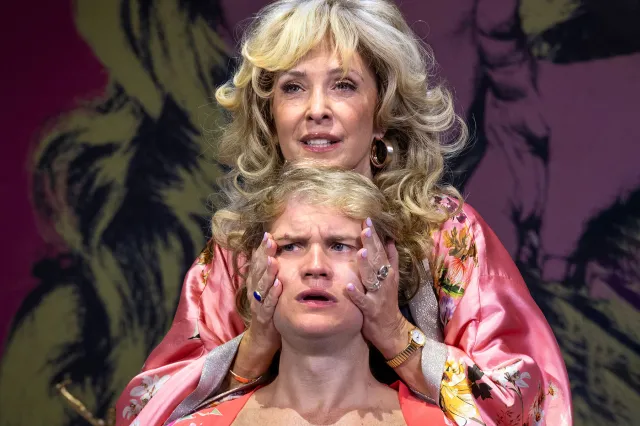
There is something undeniably smart about relocating Present Laughter from the world Noël Coward knew to late-1970s Manhattan. In Lindsay Posner’s production, the glamorous actor Gary Essendine becomes Geri Essendine, an expatriate British star who has crossed the Atlantic in pursuit of celebrity. What initially sounds like a gimmick proves surprisingly effective. The play’s obsession with fame, narcissism and the people who feed off both feels entirely at home amid the Studio 54 era’s culture of excess.
The gender switch does more than simply modernise the play. Tracy-Ann Oberman’s Geri exists in a world where everyone seems intent on telling her how to live. Managers, producers, lovers and friends all pull at her from different directions. As a result, Geri feels considerably more vulnerable than Coward’s original creation. The leech-like quality of those surrounding her becomes sharper, and moments that might once have played as comedy acquire a faintly sinister edge. When Johannes, here gender-flipped and played by Kit Young, brusquely instructs her to sit down, it lands less as flirtation than control.
Oberman is tremendous in the central role. She possesses the larger-than-life quality the part requires, moving effortlessly between diva-ish theatricality and flashes of genuine loneliness. It is very much a star vehicle, and Posner wisely allows his star to drive it. There are interesting echoes too of Oberman’s acclaimed recent performance as Shylock in The Merchant of Venice 1936, where she transformed another traditionally male role into a woman fighting to retain autonomy against forces seeking to define and diminish her. In both performances, she finds vulnerability beneath the bravado and a defiant resilience beneath the wit.
The problem is that Present Laughter has never been one of Coward’s deepest plays. It is expertly constructed and often very funny, but beyond its central character, there is precious little flesh and blood. Geri spends much of the evening being accused of overacting, which feels rich when almost everyone around her is operating at the level of caricature. These are cartoons orbiting a fully realised human being.
The supporting cast do what they can. James Dreyfus leans heavily into Monty’s camp exasperation through a series of arched eyebrows and wounded pouts. Adrian Lukis brings plenty of charm to Geri’s former husband, although occasionally appears to lose hold of Coward’s slippery dialogue. Seb Carrington fares best as the besotted young admirer David, embodying exactly the right mixture of earnest devotion and awkward persistence.
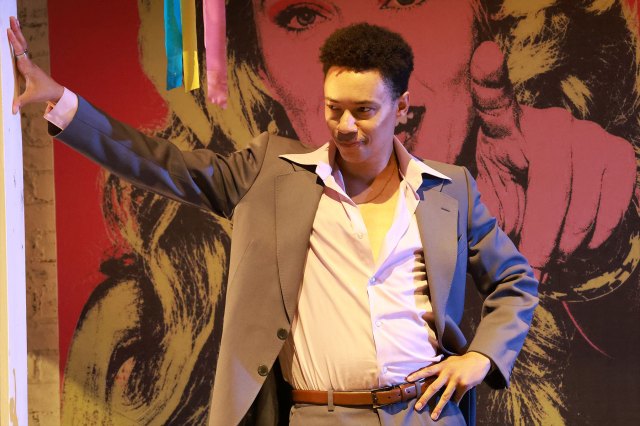
The various gender switches also bring out a queerness already lurking beneath the play’s surface. Relationships become more fluid, attractions less rigidly defined. Johannes in particular appears willing to work their way through virtually anyone available, giving the production an appealing sense that desire here is gloriously indiscriminate.
Yet Posner’s production struggles with pace. The dialogue is constantly fired out at machine-gun speed, chasing Coward’s celebrated wit. Initially that energy is enjoyable, but as the evening progresses, it becomes monotonous. Few lines are allowed to breathe and few moments are given space to land. What starts as pace eventually feels like rushing.
Visually, however, the production is a treat. Peter McKintosh’s design beautifully evokes an impossibly stylish Manhattan existence. The apartment walls adorned with Warhol-esque portraits of Geri instantly establish both her celebrity and self-obsession, while a parade of immaculate dressing gowns, jumpsuits and shimmering gowns ensures Oberman looks every inch the star.
Ultimately, this remains an average Coward play receiving a competent rather than inspired production. What elevates it is Oberman’s wonderfully detailed performance and a conceptual rethink that allows the play to feel closer to its authentic queer self. Without her, the evening might float away like so much champagne froth. With her, it remains entertaining company, even if it never becomes anything more substantial.






source on Google
Featured In This Story
Related Articles
See all

Latest Reviews
See all







Latest Videos
New musical Nero releases first listen with Andrew Barth Feldman
It is from the writers of Spring Awakening