
Fences at Leeds Playhouse and on tour – review
Headlong’s revival of the August Wilson classic is directed by Daniel Bailey
 |
Tour
|
17 September 2026
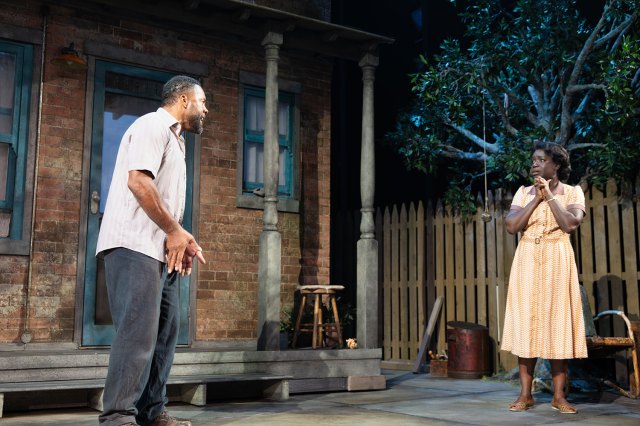
Forming part of a ten-play cycle about the African-American experience across the 20th century, August Wilson’s 1987 Pulitzer Prize-winning play Fences gives us an unsanitised view of family life in the white-dominated 1950s, with the Civil Rights movement having just begun.
In Daniel Bailey’s music-infused production, our first meeting with Troy Maxson (Ray Fearon), a washed-up, failed baseball player turned garbage man, is firmly in that context. It’s payday, and he’s drinking in his front yard with his friend and colleague Bono (Everal A Walsh), recounting how he challenged his boss on why only white employees drive the garbage trucks while the Black employees do the physical work. He’s had this before: a talented baseball player, he was unable to make it to Major League Baseball because of the colour of his skin. He dutifully passes his pay packet to his wife, Rose (Madeline Appiah).
Fearon brings intense physicality to Troy. He’s permanently grimacing, his face and lips taut to reveal his teeth as if he may bite at any moment – and he often does. Though Fearon’s performance can lack nuance, his Troy, with his wounded male ego, makes sense in Bailey’s production, which tactfully resonates with current debates around masculinity. It shows, too, the impact of generational trauma and cycles of violence. A victim of domestic abuse by his father, Troy passes it on to his own children even when, in the case of Cory (Josh Tedeku), he only seeks to emulate the man he has lived in fear of for so many years. There is no hint of compassion as he shoots down Cory’s dream of college football and undermines Lyons’ (Michael Ahomka-Lindsay) passion for music.
In Lily Arnold’s stage design, the house revolves to show us that home can be a facade. It’s surrounded by Wilson’s symbolic fence – as subtle as Troy’s baseball metaphors. “Some people build fences to keep people out… and other people build fences to keep people in”, Bono tells Troy, but the fence that Troy has been building around the family home to keep death at bay already exists in the barrier he has built around himself. It’s not just the symbolism that weighs the play down; Wilson’s writing can be prolix. Bailey does little to offset the heaviness in the storytelling as the production drags beyond the three-hour mark.
The production’s success is in Appiah’s understated performance as Rose, which pivots the narrative away from these men to the sole woman. We see how, in this male and misogynistic setting, it is a woman who holds the family together while bearing the brunt of men’s insecurities.
There is a wonderful cameo from child actor Aita Mushuku as Raynell, whose performance defies her age, and Simon-Anthony Rhoden is excellent as Troy’s brother Gabriel, whose Traumatic Brain Injury has left him in childlike innocence. His appearances lift the play with warm humour and pathos in a role that could too easily be played for laughs. He silences the family and the auditorium as he blows rasping air through his note-less trumpet, calling out for salvation for Wilson’s anti-hero.






source on Google
Featured In This Story

Related Articles
See all


Latest Reviews
See all



Latest Videos

Keira Knightley, Luke Thompson and Stephen Dillane on surveillance and kindness in uncertain times – The Lives of Others opens in the West End
Robert Icke’s stage adaptation of Florian Henckel von Donnersmarck’s Oscar-winning film is running at the Adelphi Theatre