
A Month in the Country with Sophie Okonedo at Donmar Warehouse – review
Brian Friel’s adaptation, directed by Lyndsey Turner, runs until 3 October
 |
London
|
|
London
|
3 September 2026
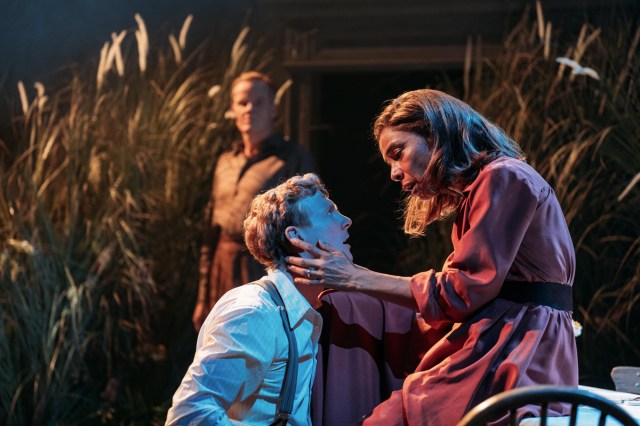
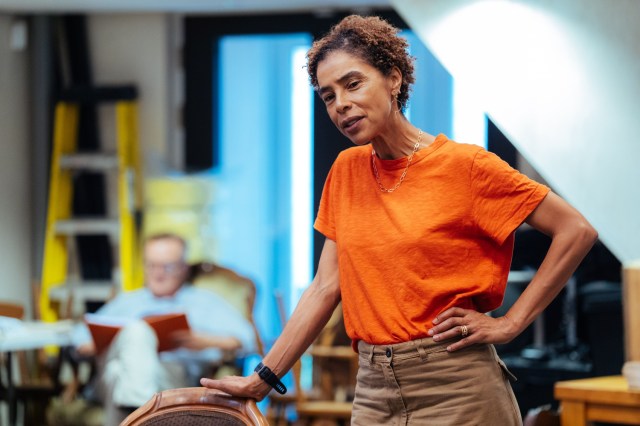
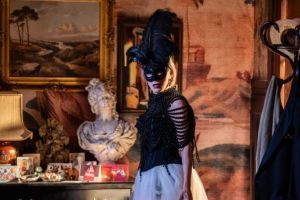
The stage is surrounded by a cube of glass and a thick, dark green bay hedge. In the opening moment of Lyndsey Turner’s production of Turgenev’s classic play, Sophie Okonedo’s face suddenly appears amidst the leaves, pushing her face against the surface like a goldfish, gasping for air.
As the action begins, the cube rises and she is revealed in a drawing room covered with grass (designed by Leslie Travers), putting roses in a vase and stripping off the leaves as if she wants to murder them. “I want, I want, I want,” she intones restlessly. “I’m sick of gloomy, airless and constricted rooms.”
This is the key to Okonedo’s wonderfully febrile and totally compelling portrayal of Natalya Petrovna, dissatisfied wife of a rich man Arkady, whose life and that of those around her is utterly unmoored by her sudden passion for her son’s young tutor Aleksey (Patrick Gibson). She is both a tragic figure, failed by her circumstances, and a comic narcissist, whose desire becomes the focus of her entire life.
The play was written in 1872 and was regarded as mysteriously action-free at its premiere at the Maly Theatre. Now, looking back through the telescope of the transformative work of Chekhov, it feels like an accurate portrayal of people’s ongoing capacity to ruin their lives by placing their affection in the wrong place.
The great Brian Friel’s poetically robust translation makes sure that these characters are not historical curiosities, but men and women whose hopes and aspirations we can constantly recognise. Each presents an image of themselves to the world; each in the course of the drama is forced to acknowledge a different truth which they must accommodate to.
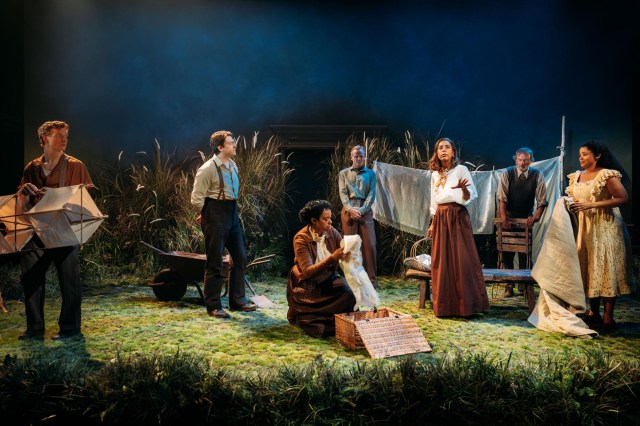
Turner’s focused direction and Travers’ designs, which dress the characters in costumes of rich flowing silks and pressed linens, at once historic and contemporary, heighten that sense of psychological insight. Tim Lutkin’s unobtrusive lighting and Max Pappenheim’s sound also help to create a space that is at once abstract and convincing. The play grips because it is so acute and empathetic.
It is also superbly acted by the entire cast, each taking their character on a journey of the soul, whether it is Gibson whose open-faced and open-hearted tutor learns that love is not always a joy but is sometimes a trap or Alistair Petrie, who turns Natalya’s admirer Rakitin into a man who has lost all self-respect because of his subservience to his notion of passion. “Love is a catastrophe,” he says, as he describes the “endless process of despair” that characterises his existence.
The comic confusions of the play – the way that Arkady constantly gets the wrong end of every stick, the interruptions of every scene of passion – are underpinned by a darkness. Natalya’s malicious and irresponsible treatment of her 17-year-old ward, Vera, who also loves Aleksy is particularly shocking and Rachelle Diedericks registers every blow that takes her from happy, carefree youth to adult calculation within a matter of hours, her face a constant mirror of her feeling.
Even the minor characters such as Daniel Rigby’s apparently jovial doctor have moments of revelation. He shows the “bitter, angry, cunning peasant” beneath the subservient surface in a marvellously practical marriage proposal to Amanda Wilkin’s equally pragmatic governess, while Susan Brown’s mother Anna gently reveals the disappointments behind her own hard-won wisdom. Ironically, in the end – as Okonedo’s stricken face reveals – it is Natalya who is left with least from her summer adventure.
It’s a gloriously rich play, wonderfully realised in a production that holds its contradictions gently in its hands and just lets its subtleties reveal themselves. It ends on a surprising note of tenderness. A gem.






source on Google
Related Articles
See all
Latest Reviews
See all


Latest Videos
New musical Nero releases first listen with Andrew Barth Feldman
It is from the writers of Spring Awakening