
George Orwell’s 1984 at the Citizens Theatre and on tour – review
Chris Hannan’s new stage adaptation, directed by Dominic Hill, opens in Glasgow and goes on to visit Dundee, Aberdeen and Edinburgh
 |
Tour
|
|
Tour
|
4 September 2026
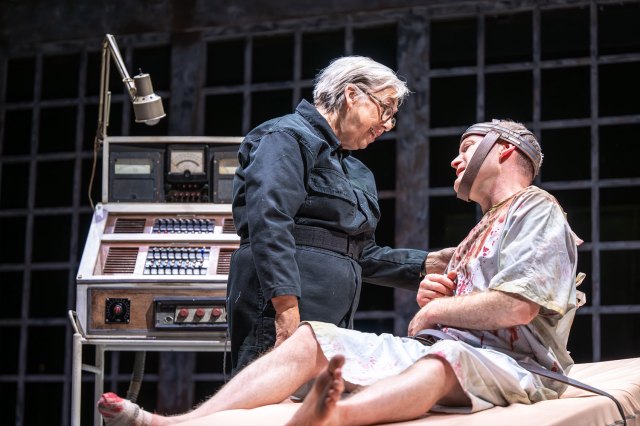
George Orwell wrote 1984 on the Isle of Jura, and while he was working on it, he travelled to Hairmyres Hospital near Glasgow for treatment for the tuberculosis that would kill him only seven months after the novel was published. The clever thing about Chris Hannan’s adaptation for Glasgow’s Citizens Theatre is that it puts Orwell himself at the centre of the story and explores how Orwell’s life experiences gave him the material to write his great novel.
Orwell’s time fighting in the Spanish Civil War – with his experience of left-wing purges and news stories rewritten to support a new truth – gave him a horrible insight into how Big Brother’s government would run Oceania. What’s more, one of the doctors who treated Orwell in Hairmyres fought on the fascist side of the war, and Hannan’s script is at its strongest as it explores their experiences and how they fed into 1984.
Jack Tarlton plays both Orwell and Winston Smith, and in both he inhabits the character’s vulnerability and brokenness, making it rather remarkable that Winston manages to survive his ordeal in the Ministry of Love for as long as he does. Jessica Hardwick’s vibrant Julia is every inch his match in charisma, and they head a strong ensemble cast which brings to life with troubling conviction Orwell’s dystopian vision of a totalitarian future, making real the desperate terror, boiling frustration and the palpable absurdity of life in Big Brother’s regime.
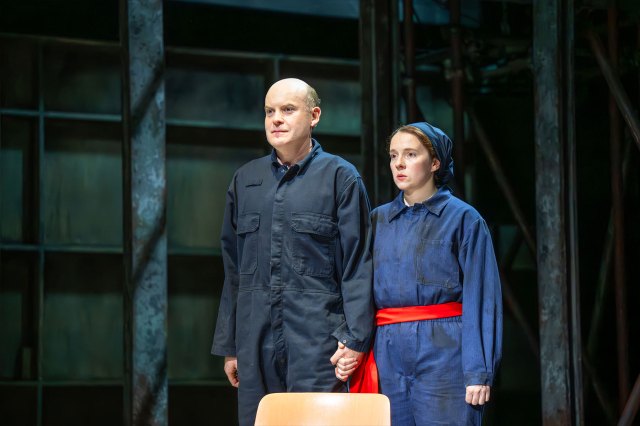
In this, they benefit from Dominic Hill’s expert direction, which makes the ensemble scenes grimly believable. The appearance of the Thought Police at the Newspeak scene is genuinely unsettling, as is the raw barbarism of the Two-Minute Hate. Furthermore, Tom Piper’s marvellous sets underline the awful drabness of everyday life and punctuate it with occasional splashes of colour when Winston and Julia get to escape, holding out fragmentary hope which is cruelly dashed.
As the play reaches its climax in the cells of the Ministry of Love, the torture scenes are realised with vivid brutality and some remarkable physical acting, both from Tarlton and his tormentors, led by Irene MacDougall’s implacable O’Brien. At times, however, it feels like the play lingers on these scenes a bit too much.
Orwell’s intention in the novel, after all, is to warn, not to rub our noses in the horror, and the play is at its most interesting in the conversational scenes that explore the ideas that could produce this world. Orwell’s discussion with his doctor about left-wing facts and right-wing facts feels very current, and the point is made long before the trauma of the prolonged torture scenes. Some judicious trimming might have tightened the ending considerably.
Still, this is an engrossing evening, leading up to the pressure cooker of the ending, and the wistful, final return to the framing device lends the play a surprisingly thoughtful air on which to finish.






source on Google
Related Articles
See all

Latest Reviews
See all




Latest Videos
New musical Nero releases first listen with Andrew Barth Feldman
It is from the writers of Spring Awakening