
Electra/Persona with Cate Blanchett and Nina Hoss at National Theatre – review
The world premiere of Benedict Andrews’ new play sees Blanchett and Hoss alternating roles throughout the run
 |
London
|
|
London
|
2 September 2026
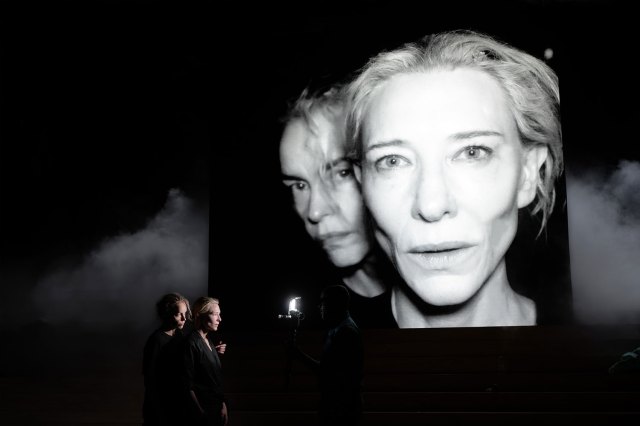
A Greek tragedy, a film by Ingmar Bergman and two compelling performances from Cate Blanchett and Nina Hoss are the raw ingredients of this peculiar theatrical mash-up. What it lacks in intellectual coherence, it more than makes up for with its sheer star power – which is appropriate enough since one of its multiple themes is acting itself.
In fact, the evening draws attention to its own innate theatricality by starting with Blanchett and Hoss, their blonde hair pulled back in fierce buns, and dressed in black shirts and trousers, walking into the Lyttelton’s auditorium and asking an audience member to toss a coin. The outcome determines what parts they will subsequently play.
Blanchett wins and choses to play Clytemnestra, mother of Electra and subject of her murderous rage for her own murder of her father. This means that in the play’s second half – broken only by a pause where the actors remain on stage – she will play Alma, the nurse, who becomes subsumed by the personality of her silent patient Elisabet in Persona. Hoss puts on white face powder – the first of many masks assumed – utters a ferocious scream of grief and the acting begins.
Director and writer Benedict Andrews has previously given British audiences a gimmicky version of Chekhov’s The Cherry Orchard (also starring Hoss) and a production of A Streetcar Named Desire which featured a revolving set that meant the action was viewed through the bathroom furniture. He is not an unseen hand. Here he yokes a fairly radical version of Sophocles (where Electra morphs into her own brother Orestes) onto a reasonably faithful approximation of Persona, which slightly softens some of its harder blows.
His justification, presumably, for the conjunction is that in the film, Elisabet, who is an actress, falls silent during a production of Electra. We see that happen here, as Hoss stops mid-vengeance and Persona begins with the stage crew emerging to clean the stage, and the two actresses applying their makeup.
There are other thoughts floating around: the two works share characters who are driven to try to control their environment by extreme acts; both share themes of guilt, ideas of impersonation, and a sense that characters mirror one another. It is however, one thing to notice some similarities and another to make two works, radiant and revolutionary in themselves, shine light on one another.
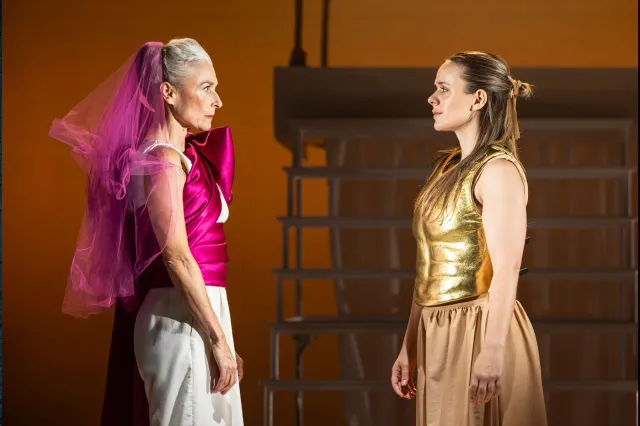
In the end, it’s probably best to give up trying to make total sense of everything and just sit back and enjoy a sophisticated production, played on Magda Willi’s steep, pine steps, lit by Jon Clark to conjure everything from thunderstorm to pageant.
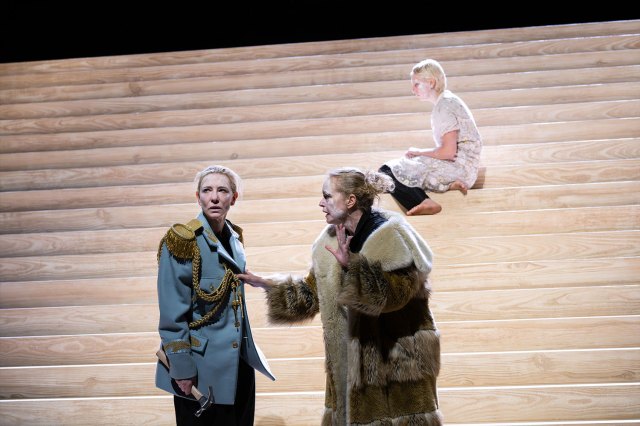
The staging is full of stylish moments. In Electra the characters underline the ongoing cycle of blood for blood with Blanchett and Hoss matching each other’s movements, running up and down the stairs in unison. The reflective nature of their relationship becomes even more intense in Persona, where a screen descends for most of the action, showing Hoss’s face in silent close up, letting their images blur and merge as they manipulate the camera. It’s a tribute to Bergman’s cinematography as well as his idea of two women locked in combat for their own souls.
Hoss and Blanchett, so convincing in their previous performance opposite one another as a couple in the film Tár, relish every moment. As Electra, Hoss’s purposeful walk, her downturned mouth, and rising fury perfectly suggests a woman in the grip of mania, exuding “the holy stench of grief.” Her ability as Elisabet to reflect thought and feeling while staying utterly still is riveting; her strength and vulnerabilities are both delicately charted. As Clytemnestra, Blanchett is imperious and frightening, as Alma, needy, ingratiating and slightly terrifying. Ella Lily Hyland and Patrick Robinson make up the onstage quartet, in unrewarding but necessary roles.
Watching these two great actresses strut their stuff is never less than dazzling. It’s an odd night of theatre, but their presence makes it a thrilling one.






source on Google
Featured In This Story

Related Articles
See all

Latest Reviews
See all




Latest Videos
New musical Nero releases first listen with Andrew Barth Feldman
It is from the writers of Spring Awakening