
‘You understand, right?’ Pearl Mackie on Baby and the realities mothers face in prison
Baby continues at Brixton House until 31 October
 |
London
|
22 October 2026
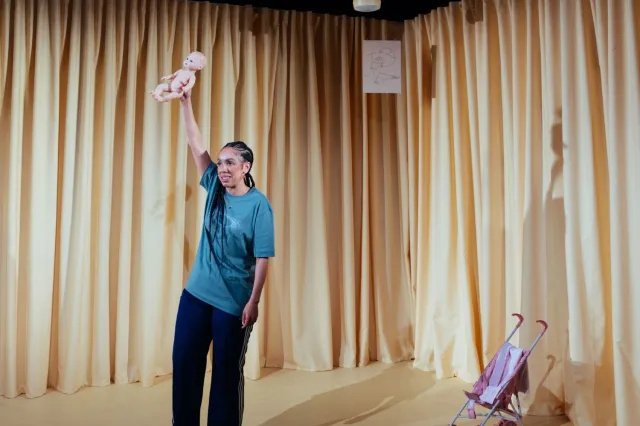
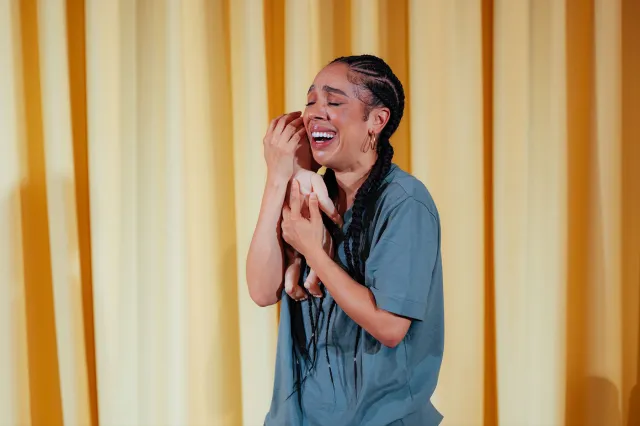
Gurpreet Kaur Bhatti’s play Baby, running at Brixton House, asks you, the audience, to help advocate for its central character and provide a character statement in her defence.
We meet Baby alone in the present day. We know she has done something terrible, but that she is desperate to keep her baby. The audience is her final plea.
“She mentions that people are coming soon to ask her some questions and that they probably won’t spend enough time actually with her to understand the whole gravitas of the situation,” says Pearl Mackie, who stars in the show. “Baby asks the audience to help her through by understanding how she got where she is.”
As a solo show, Mackie explains, the production “reflects how Baby has nobody to turn to, which is the reality of many women.”
Baby has brought Mackie “home” to the London district where she grew up, although she hasn’t lived there since she was in her 20s. It is a place where she previously never felt alone, surrounded by family and friends. She even recently bumped into her cousin who lives in America after his friend complimented her hair.
“Brixton will always be Brixton,” the actress says, “That’s what I love about it.”
The production is presented by Brixton House and Clean Break, a theatre company that works with women with lived experience of the criminal justice system or at risk of entering. One evening, some of the members were in the audience. Mackie recalls with a laugh: “In the play there are a few points where Baby’s like, ‘Oh, you’re with me, right? You understand.’ And some of them were like, ‘Yeah!’ It was amazing.”
Bhatti’s previous play, Scenes from Lost Mothers, examined the imprisonment of pregnant women, and Baby continues the exploration. The works came after Bhatti delivered workshops at HMP Styal, on a mother and baby unit. In preparing for the role, the charity armed Mackie with statistics about women in prison and women who have been separated from their children through the legal system.
Among the starkest figures: pregnant women in prison are seven times more likely to suffer a stillbirth (The Observer), while nearly 60 per cent of women in prison report experiencing domestic abuse at some point in their lives (Prison Reform Trust) and 82 per cent of women in prison report mental health problems (HM Inspectorate of Prisons). An estimated 17,000 children are separated from their mothers by imprisonment each year (Howard League for Penal Reform), and 95 per cent of children whose mothers go to prison have to leave their family homes (Prison Reform Trust).
The figures anchor Mackie during each performance. Her anger at the injustice is palpable as she discusses Holloway, a documentary about the former Holloway prison. It follows six women who had previously been incarcerated and return years later to confront the time with a therapist. “They talked about their shared experiences of trauma in childhood and a lot of domestic abuse, things that appear to be prevalent across women’s experiences who then end up within the legal justice system. I just find it really unfair… It has filled me with rage and frustration.”
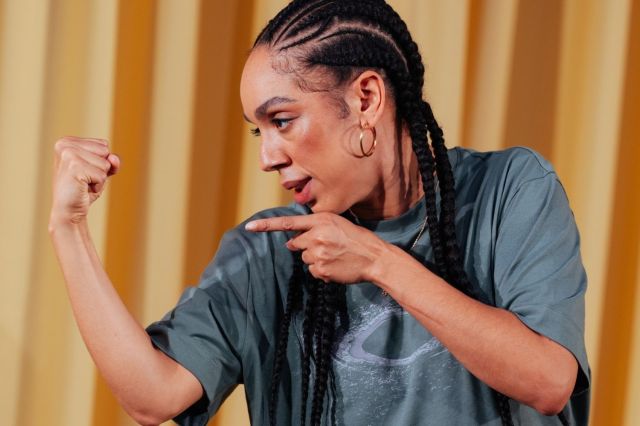
The separation of mothers and children, in particular, is something that Mackie found very confronting while preparing for and performing as Baby. She explains: “I felt a real urge to tell this story truthfully and honestly and hopefully change perspectives,” adding: “I don’t know how [a mother] is expected to continue their sentence and not be aware where their children are.”
Working with director Milli Bhatia, Mackie says that the two came to an agreement. “I don’t think that you should ever spoon-feed your audiences. I think you have to trust that they understand what they’re watching and that they are clever people.”
When Mackie first read the play, she found some aspects of Baby’s life relatable. “The importance of this story is that she’s just a human being. There are so many women who experience trauma in their lives and who have had to fight against a lot of things that I think that the importance of Baby is that she is all of us.”
She continues that one of the main reasons for doing the play is “to help to bridge that gap so that we see ourselves in her and we see that at the end of the day, it boils down to luck… I just think that we all need to recognise that essentially the differences between us are far smaller than our similarities.”




source on Google
Related Articles
See all
Latest Reviews
See all


Latest Videos

Disney’s High School Musical opens in London and the stars take a trip down memory lane
Bopping to the top at Troubadour Wembley Park Theatre!