
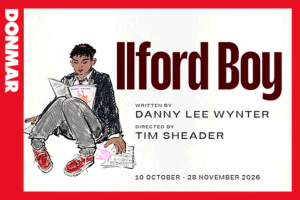
Ilford Boy at Donmar Warehouse – review
The world premiere of Danny Lee Wynter’s play, directed by Tim Sheader, runs until 28 November
 |
London
|
21 October 2026

Danny Lee Wynter sure can write. His second play, Ilford Boy is an autobiographical piece full of confusion and love, with words that pop off the page and into the mouths of a talented company of actors to bring the playwright’s Essex upbringing into vivid life.
It’s so heartfelt, it’s not quite a play in some ways, meandering its way towards the close, but its truthfulness and humour make its flaws forgiveable.
The hero is Ted (Leo Whitfield Harris making a gently impressive stage debut). It’s 1995, and he’s 14, unhappy and uncertain, and at his grandmother Elaine’s funeral, surrounded by a noisy family of sisters – his mum Tillie, bossy Jackie, laid-back Ann – who love one another but sometimes have strange ways of showing it.
Around their orbit swing various men, pictures of different models of masculinity: Ted’s semi-absent Black father Ken, who wants to bond with his son over boxing, ambitious, traditional Raj, and henpecked but happy Trevor. Then Tillie’s childhood best friend Patrick arrives, a Black gay man in a sequined velvet suit with a handbag across his shoulder.
The action, such as it is, evolves from there, with the story spinning at moments back to 1980, when relationships were forged. Peter Mckintosh’s clever black and white home setting, with an upstairs balcony, is lined by lighting designer Ryan Dawson Laight in glowing yellow neon which takes the family back to the past.

There we see how both Ken (Gershwyn Eustache Jnr) and Patrick were forged by brutal fathers and watch the relationship between them sour. In 1995, Patrick and Ted form a bond, as they go to see Stephen Sondheim’s Company at the Donmar, starring Adrian Lester as Bobby. This bit of meta theatrics, sends Stein’s appealing Patrick – both waspish and vulnerable – off into a show-stopping tap routine to “Don’t Rain on My Parade”.
But because it is 1995, all his friends are dying and Patrick too has AIDS, with all the prejudice and othering that terrible disease caused. The play ends with another funeral and with Ted’s growing realisation of who he is and how he wants to live.
Wynter crams too much into his narrative, and the play never escapes its sense of being a therapeutic outpouring. But it is wonderfully vital in its portrayal of Ilford life – and sobering in its depiction of just how hard it was to be a Black gay man in this context. The sisters are wonderfully drawn and very convincing in their relationships to each other.
Jodie McNee as the sharp-tongued Jackie, hiding grief beneath toughness, magnificently vers between the perfect delivery of knockout aphorisms – “You can’t turn a dog into a chair and if you do, it won’t be comfy” – and a haunting sense of a life that disappoints. Her virtually silent relationship with Cary Crankson’s delicately played Trevor is wonderfully subtle.
Meanwhile as Ann, Charlotte Jaconelli cleverly suggests another woman damaged by male opinions, hiding behind a laconic front and as Tillie, Ria Zmitrowicz is a bundle of misplaced emotion, constantly trailing behind a man who is reluctant to commit. “Even that fella off the Milk tray ad stuck around longer,” remarks Jackie, acerbically.
The writing is full of that kind of period detail – the music, the smell of satsuma moisturiser from Body Shop, the seduction of Thatcher’s right to buy your own home. The dialogue crackles, and Tim Sheader directs the whole with energy and warmth. It doesn’t travel quite as far as it might, but it’s a hugely entertaining journey.






source on Google
Featured In This Story
Related Articles
See all


Latest Reviews
See all






Latest Videos

New musical Nero releases first listen with Andrew Barth Feldman
It is from the writers of Spring Awakening