
Murder in the Cathedral with David Suchet – review
Orange Tree Theatre’s site-specific revival of the T S Eliot classic at St John the Divine Church in Richmond, directed by Tom Littler, will also be staged at Theatre Royal Bath
 |
Bath | Richmond
|
20 October 2026
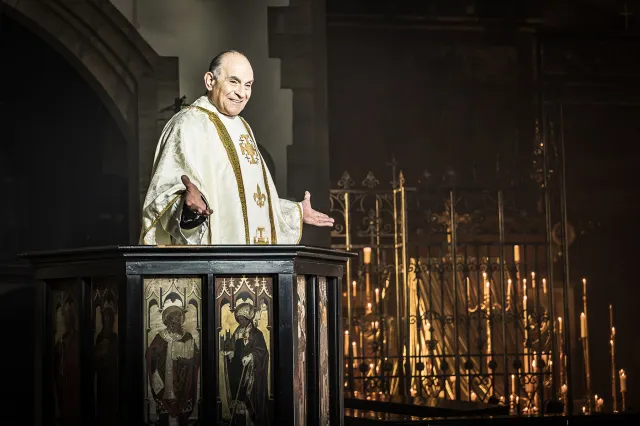
T S Eliot’s 1935 play about the events surrounding the death of Thomas Becket, Archbishop of Canterbury, isn’t often performed. It’s mainly in verse, for one thing, with a Greek style chorus of the women of Canterbury intoning Eliot’s deepest thoughts on faith, life and suffering.
It assumes a certain knowledge of the history of 1170 to follow exactly what is happening as Thomas returns from exile in France after falling out with his former friend, King Henry II, over some excommunicated bishops, knowing that in doing so he will probably face death. And it switches tone violently from the stylised to a sermon, to the conversational breaking of the fourth wall when the four knights who kill Thomas explain their motives.
Its balance between liturgy and drama is a difficult thing to pull off. But this performance, directed by the Orange Tree Theatre’s Tom Littler with associate director Francesca Ellis, and starring David Suchet is an absolute triumph. If you’re ever going to see this haunting oddball of a play, this is how to do it. Every decision the directors have taken add to the power and impact of the work.
The setting, amidst the Gothic Revival splendour of St John the Divine, certainly helps. The Orange Tree is being renovated, so necessity has dictated a season of plays on the move, but designer Robert Jones has transformed it into more than a convenience with a gleaming steel walkway down the aisle, and clever use of both altar and pulpit. At one the altar end, a spare, modern frame makes the world seem both historic and contemporary.
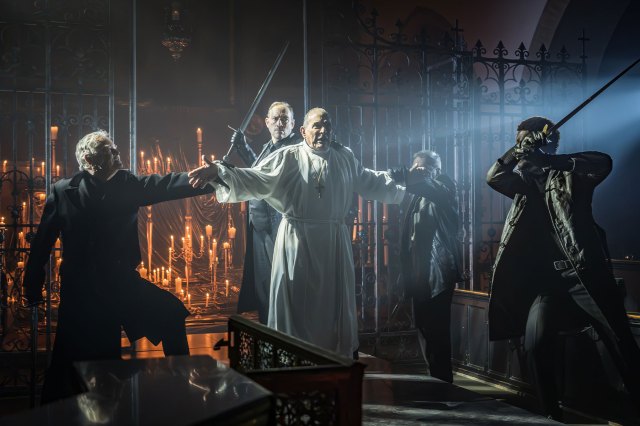
Lighting designer Peter Mumford illuminates that frame with different colours, depending on who is walking through it. He fills the church with banks and lines of candles, made hazy by incense, and with startling spotlit effects in different colours from both inside and outside the space. When the knights arrive to slay Thomas, accompanied by Max Pappenheim’s echoing sound design of them hammering on the door, the church is filled with red, a fiery premonition of the blood and martyrdom to come.
But the real strength of the production is its confidence of the handling of the text. Composer Orlando Gough brilliantly sets the words of the chorus – in the shape of a community-recruited choir – partly to atonal, atmospheric music while leaving part of it as spoken, chanted text. This both heightens the poetry and simultaneously sweeps it along, letting some of its repetitions – “Shall the bird’s song cover, the green tree cover, what wrong/Shall the first earth cover?” – emerge in song.
Meanwhile, as Becket, Suchet is both remarkably imposing and interestingly human. He turns Becket’s Christmas Day sermon on the merits of martyrdom into a chatty homily, a man revealing himself as he interprets the words of God. His attitude to the four tempters, who attempt to seduce him with different dreams is both dismissive and – finally – troubled.
When he greets the four knights, he does so with almost unbelievable delicacy – “Now, what’s the matter?” – before dismissing the priests who seek to protect him with a gentle delivery of one of Eliot’s loveliest lines: “I have had a tremor of bliss, a wink of heaven, a whisper/And I would not be denied.”
The tempters and knights are played by the same actors – Jyuddah Jaymes, Ben Caplan, Nick Sampson and David Yelland – and all find the same excellent balance between the naturalistic and the poetic. It is their verbal battles with Becket that make the play consistently relevant.
The questions asked about ways of resisting tyranny, about the balance between personal conscience and the state, were written in 1935 when Eliot was already aware of the rise of fascism and the dangers of a longing for “strong government”. Murder in the Cathedral isn’t just a history play: its complex arguments about the dangers of doing the right thing for the wrong reason, and about humanity’s desire to shy away from confronting reality are held beautifully up to the light by this luminous production.






source on Google
Related Articles
See all
Related City Guide

Latest Reviews
See all

Latest Videos
New musical Nero releases first listen with Andrew Barth Feldman
It is from the writers of Spring Awakening