
Martin Guerre review – a compelling case for a musical with a complicated past
The show will be Matthew Warchus’ final as his programme as artistic director at the Old Vic comes to an end
 |
London
|
21 October 2026
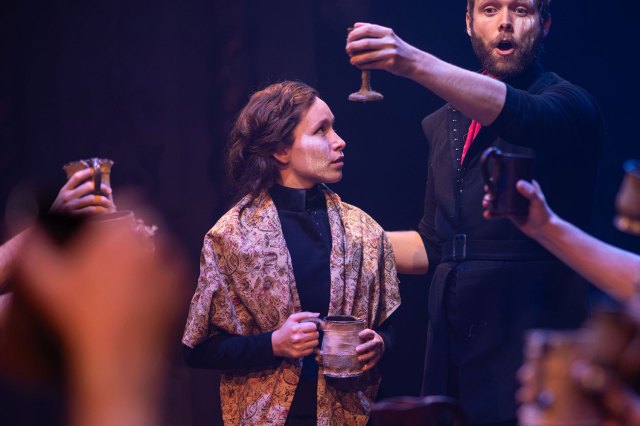
What a strange, slippery story is that of Martin Guerre! Grounded in the true events of a 16th-century Pyrenean village, it’s a tricksy, ambiguous musical that, from the looks of things, proactively decides to leave as much on the table as possible.
Originally penned by Claude-Michel Schönberg and Alain Boublil, joined for this new run by co-lyricist Annabel Mutale Reed, it feels almost more akin to a Lorca play or Arthur Miller’s The Crucible than it does any of Boublil and Schönberg’s other major works (like, you know, the one with the barricade).
Musically, Les Misérables fans may spot a few similar strains in Schönberg’s score, but narratively, Martin Guerre is a far more claustrophobic offering. Whittled down to a punchy, no-interval 90 minutes, this version bears very little resemblance to its bloated previous incarnations, a testament to how Boublil and Schönberg have long viewed the show as unfinished business, perpetually reworking it in search of its ideal state. This iteration definitely feels like it’s getting close.
Set in the isolated and drought-ridden village of Artigat during the French Wars of Religion, it hinges on an outcast boy, Martin, who returns home after a seven-year absence to claim his property and a neglected, yet oddly devoted, wife Bertrande. His sudden reappearance triggers a volatile wave of uncertainty, relief, and rampant superstition among the locals. Oh, and rain.
Presented in the round, Rob Howell’s minimalist staging creates an immediate sense of intimacy, effectively turning the audience into complicit members of the insular community – one where local politics involves a mix of land disputes, opportunism and religious fervour.
Small, character-driven scenes prove far punchier and more cohesive than the larger ensemble moments, where crowd mentality turns on a dime. Yet Lizzi Gee’s choreography successfully captures this mob fervour, unleashing a whirling chaos of almost aggressive movement from the townspeople, especially when Bertrande is vilified for her husband’s absence.
Really, though, the chief reason to see the show is as a showcase for star Liv Andrusier. Boublil and Schönberg once confessed in an interview that they could easily have named the musical after Bertrande rather than Martin, and she truly is the anchor of the piece.
Delivering a performance of remarkable moral and emotional complexity, Andrusier plays Bertrande with an impressively impenetrable poker face, leaving us constantly guessing whether she is genuinely deceived or willingly complicit in the events of the second half of the tale. She backs it up with an utterly arresting vocal performance; her delivery of “Someday” stands out as a genuine Schönberg earworm, up there with an “I Dreamed A Dream” or “On My Own”.
She is supported by an excellent surrounding cast, with standout turns from Caroline Sheen as Bertrande’s conflicted mother and Aaron Lee Lambert as a commanding judge, alongside Adam Pearce, who brings a ferocious intensity to the role of Father Dominic. Across the board, vocal performances are spotless.
Directorially, there are striking, powerful images throughout, not least the stark circularity of the opening and closing tableaus, which linger long after the curtain call. The tension also builds adeptly to the Guerres’ final revelations and deeds.
While one might wish the production leaned even further into the grim consequences of a community gripped by paranoia and fear of outsiders (as well as, perhaps, explicitly explaining the religious isolation of this community, and why it makes them so fearful of strangers), this trimmed-down revival makes a compelling case for a long-misunderstood work.






source on Google
Related Articles
See all


Latest Reviews
See all






Latest Videos

New musical Nero releases first listen with Andrew Barth Feldman
It is from the writers of Spring Awakening