
Nero musical at Southwark Playhouse Elephant – review
Steven Sater and the late Duncan Sheik’s new musical, directed by Lindsay Posner, runs until 5 December
 |
London
|
9 November 2026
When a show is described as being 23 years in the making, a few alarm bells start ringing, even when its creators are as venerated as Steven Sater and the late Duncan Sheik, best known for their work on the multi-award-winning sensation Spring Awakening.
Though the subject of Nero has obvious resonance in the age of Trump, it was in fact inspired, says Sater in a programme note, by George W Bush and his infamous “Mission Accomplished” moment amid the invasion of Iraq. But the result falls well short of searing satire, either of that age or this, feeling more akin to a half-baked musical revue.
Nero is painted as an initially innocent young man, whose growing combination of narcissism, sadism and Oedipal obsession with his mother Agrippina (Sally Dexter) leads him down an infamous path to destruction (for him and many of those in his orbit). Far from the bearded figure we see in bust form, the version portrayed here by American rising star Andrew Barth Feldman is more of a faintly androgynous teen, who tells us he’s more interested in Greek theatre than Roman politics.
Sheik’s music has a distinctly MTV Unplugged vibe about it, leaning heavily on acoustic guitars, bass and, fittingly, a harp (the band, led by musical director Ben McQuigg, sit across an upper platform). It’s jazzy and atmospheric, but there’s a notable lack of standout tunes, save perhaps for the climactic “And Now He Hounds the Night”, while Sater’s lyrics feel hackneyed and lacking in nuance (eg: “Shall we feed the plebs their kibble / while we play our golden fiddles”).
The exposition-heavy, Shakespeare-quoting dialogue also disappoints, though there are some fun character interpretations including Stephen Carlile‘s campy Seneca, who sings “Quelle Surprise” with an enjoyably vampish husk (while sporting a striking combination of toga and office shoes), and Rhianne-Louise McCaulsky‘s scheming seductress Poppea. Nero’s mute young wife Octavia (Nabi Brown), meanwhile, is only heard through song, notably her ethereal refrain “The Winter Wind”.
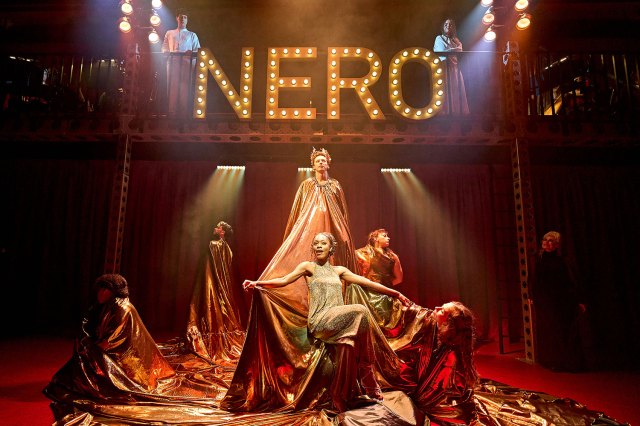
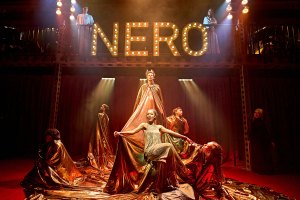
Director Lindsay Posner is an experienced pair of hands, but fails to inject much energy or dynamism into proceedings. For a show about one of the most colourful and storied characters in all history, it feels surprisingly flat. Georgia Lowe’s design, featuring a giant illuminated Nero sign at its centre, nods to something punky but never quite sees it through, while the choreography by James Cousins is playful but perfunctory.
It has its moments, including a costuming coup when Nero appears in a giant, Joseph-esque golden coat during “Golder by the Day”, or when he finally realises his power outstrips his mother’s during a showdown with her lover Tigellinus (Waylon Jacobs). But these are far too few and far between and the overall impression is of a production that is less than the sum of its talented parts. It feels odd to suggest a musical with more than two decades of development could do with a little more workshop time, but I’m afraid that’s the reality. In the meantime, it’s a thumbs down.






source on Google
Featured In This Story
Guide

Related Articles
See all
Latest Reviews
See all


Latest Videos
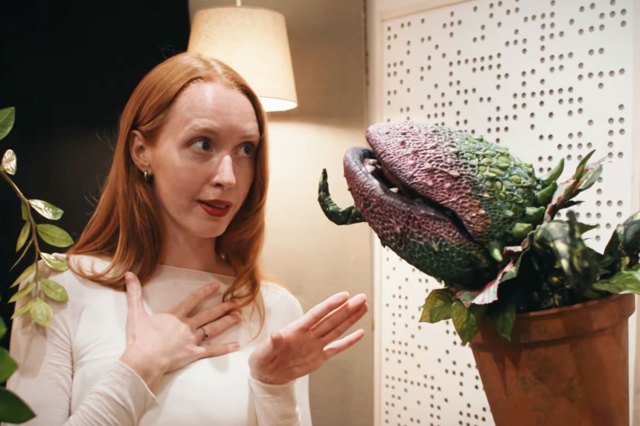
Jessie Elland performs “Somewhere That’s Green” from Little Shop of Horrors
From Manchester to Liverpool!