Edinburgh Fringe blog: What happens when you blend theatre and conspiracy theories?
Olivia Zerphy, co-artistic director of Voloz Collective, compares the two
 |
Edinburgh
|
|
Edinburgh
|
16 July 2026
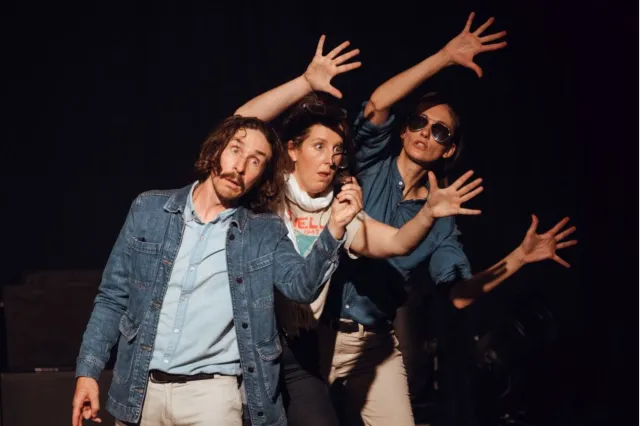
Redacted: The Cover-up of a Cover-up of a Cover-up, the latest show from Voloz Collective, is set in 1970s Roswell. It draws inspiration from the many conspiracies and mythologies surrounding alleged alien and UFO sightings.
We spent countless hours down conspiracy theory rabbit holes exploring Roswell, Area 51, and alleged unreleased files documenting alien encounters and UFOs. Beyond the wilder stories lurking at the edges of the internet, we found ourselves drawn in as much by the structure as by the content of the wild stories, and we began to recognise the inherent theatricality of conspiracy theories themselves.
This connection stretches far before the first UFO sighting in Roswell. The words theory and theatre share a common Greek root meaning “to look at” or “to behold.” Theatre is a place where people gather to watch, and a theory is a way of looking at the world. They both are derived from the act of observing events and trying to make sense of them.
I don’t think it’s any coincidence that conspiracy theories often borrow the language of performance. We read of staged events, crisis actors, scripts, masks, and hidden directors. Their narratives unfold like dramas, with hidden figures orchestrating events from the wings. In form and content, theatre and conspiracy theories are uneasy cousins: both understand the power of a convincing narrative.
The theatrical world has long attracted conspiracy theories of its own. Perhaps the most famous is the Shakespeare authorship question. For centuries, Anti-Stratfordians have argued that Shakespeare could not possibly have written the plays attributed to him. The “real” author, they claim, was Francis Bacon, Christopher Marlowe, or even Queen Elizabeth I. I think this theory endures partly because it is irresistible theatre: a hidden genius, a secret identity, and a cover-up spanning centuries. What a plot!
This same dramatic impulse appears elsewhere in theatre history. Consider the story of John Wilkes Booth, the actor who assassinated Abraham Lincoln in a theatre. After being tracked down, Booth was cornered in a burning barn and killed before he could stand trial. Why did he do it? Who helped him? What exactly happened? The public never received a satisfying final! Decades later, theories emerged claiming the man killed in the barn was actually a lookalike and that Booth had escaped to live to a ripe old age in Oklahoma. Despite eyewitness identifications and evidence pointing elsewhere, the possibility of a more dramatic and nefarious explanation was impossible to resist.
The power that stories have to shape public opinion has also made theatre itself a target of conspiracy thinking. During America’s Red Scare, artists were accused of secretly promoting communist ideas through their work. Hallie Flanagan, director of the Federal Theatre Project, was hauled before Congress and accused of advancing a political agenda through theatre, becoming a main character in a national conspiracy narrative. The very thing that makes theatre powerful, its ability to offer alternative ways of seeing the world, can also make it suspect.
Voloz’s own research led us somewhere somewhat unexpected. The more we read about crashed saucers, secret military bases, and government cover-ups, the less interested we became in faithfully reproducing the theories themselves, and the more we began inventing our own. The emotional truths we wanted to explore in Redacted were not always easily contained within the historical record. In creating Redacted, we found echoes of the Shakespeare authorship debate, Booth mythology, and Red Scare paranoia. The historical evidence provided one story, but our narrative desires and dramatic sensibility pulled us in a different direction.
This raises an uncomfortable question: Are theatre-makers conspiracy theorists too? In the theatre, a group of strangers gathers in a room and agrees to believe in a shared reality. We know it is not literally true, yet for a moment it becomes emotionally true. Conspiracy theories and theatre reveal the same human desire, to move beyond a simple intellectual understanding or explanation in order to find a story that makes sense of the world in all its emotional complexities and existential mysteries. The difference, perhaps, is that theatre admits, and even revels in, making things up.
So the one thing I can promise you about Redacted is that it is 100 per cent fiction, and that’s the truth.
Redacted plays at Pleasance Dome (King Dome) from 5 to 30 August (not 12, 19, 24) at 13:55.



source on Google
Guide

Latest Reviews
See all
Latest Videos
New musical Nero releases first listen with Andrew Barth Feldman
It is from the writers of Spring Awakening