
I Can Die Too at Pitlochry Festival Theatre – review
Frances Ruffelle, Sally George and Alan Cumming’s new musical runs in the Studio until 2 August
 |
Pitlochry
|
|
Pitlochry
|
16 July 2026
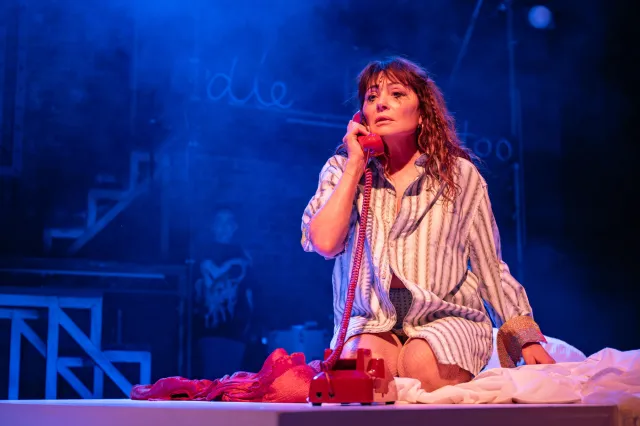
The convention of the play-within-a-play is almost as old as theatre itself. Through the centuries, dramatists have used it to explore what happens when the boundary between reality and artifice begins to fracture, and so I Can Die Too, the new musical at the Pitlochry Festival Theatre’s studio space, builds on a strong heritage as it does something similar.
At its heart is Lily, an actor rehearsing a version of Cocteau’s La Voix Humaine, his famous one-woman play about the breakdown of a romantic relationship. The show’s title, in fact, is drawn from Cocteau: when he heard that his friend Edith Piaf had died, he said, “La Piaf is dead. Now I can die too” (and promptly did so).
We see Lily struggling with her lines, with the French accent and with her director, and there’s a nagging sense that Lily’s greatest days as an actress might be behind her. However, we learn through snippets that Lily’s private life is almost as troubled as that of the woman in the play, and aspects of her past return to haunt her as her life bleeds into that of her character’s.
It’s a conventional enough device, but it’s realised energetically through a script that was collaborated on by three writers, one of whom being Alan Cumming, Pitlochry’s new artistic director. Of all of the shows in this, his first season, this is the one into which he has had the most direct input so far, and his experience shows in the pizzazzy, theatrical naturalism of the dialogue. The first quarter is too lazily reliant on F-bombs for shock comedy value, but it settles down as the characters deepen, and it pulls a nice denouement out of an unexpected place as the show reaches its climax.
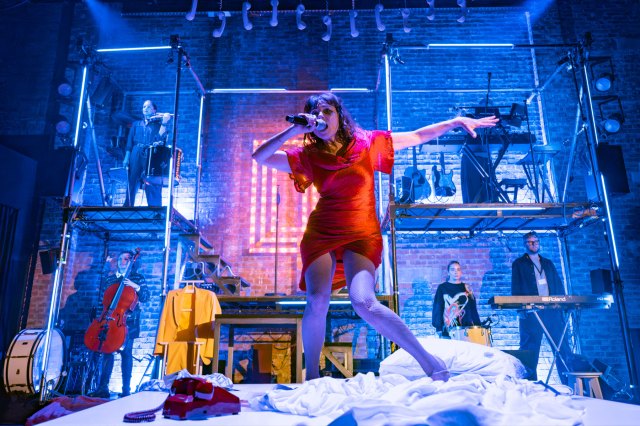
What really makes it worth watching, however, is the performances, most notably that of Lily herself, who is played by none other than West End royalty, Frances Ruffelle. She pours all of herself into Lily in one of those performances that seems so invested that you struggle to take your eyes off her. She runs through an extraordinary host of emotions in the show’s short run-time, and she’s also one of the writers, so, entirely fittingly, the aforementioned blurring of the line between artifice and reality feels very real.
The rest of the cast bounce off her very effectively, particularly Stephen Ashfield, her exasperated director, and Flora Spencer-Longhurst, her supportive but long-suffering floor manager.
I’m not 100 per cent convinced that it had to be a musical, however. The songs themselves are all appealing, mostly with a rocky power-ballad feel to them. But with the extraordinary sum of 11 people credited in the programme with writing them, there’s understandably a degree of variety in the approach. I’m not sure they added much to the story that the spoken dialogue didn’t, and they feel like more of an optional add-on than an intrinsic part of the piece.
In what has become a Pitlochry speciality, however, the instruments are all played by the actors, and Simon Kenny’s set scaffolds them nicely into the overall stage picture. Furthermore, Bill Buckhurst’s direction makes the most of Pitlochry’s cosy studio space, and there’s a lovely, surprising visual moment as the drama reaches its final resolution. At only 75 minutes without an interval, it’s a condensed hit of drama, but it works very effectively and, for Ruffelle alone, it’s worth travelling to see.






source on Google
Related Articles
See all

Latest Reviews
See all



Latest Videos
The cast of Trainspotting The Musical choose to be ‘gallus’ on West End opening night
The world premiere production is now officially open at Theatre Royal Hatmarket