
The Cherry Orchard with Kenneth Branagh, Helen Hunt and Bill Pullman at the RSC’s Swan Theatre – review
Tamara Harvey’s star-studded revival of the Chekhov classic, adapted by Laura Wade, runs until 29 August
 |
Stratford-upon-Avon
|
|
Stratford-upon-Avon
|
22 July 2026
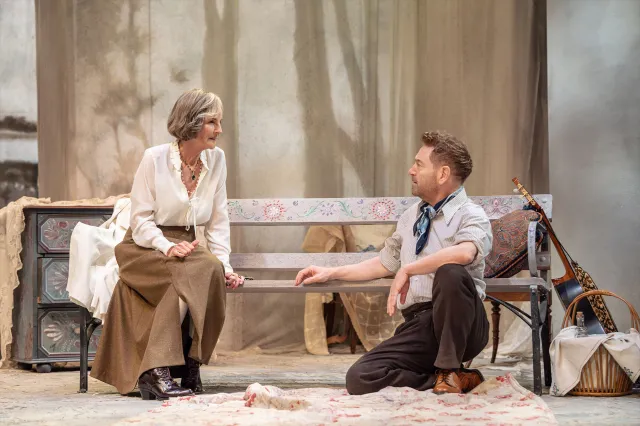
Some directors seem to have a symbiotic relationship with certain playwrights, and vice versa, which brings out the best in both the works and their interpretation. It’s safe to say by now that Tamara Harvey and Laura Wade are one such pairing. So, when Harvey asks Wade to write a new adaptation of one of the great classics of European literature, and the writer automatically understands that the director will not only get her vision but build on it, the result is likely to be something exciting.
This Cherry Orchard at the Swan Theatre – a companion piece to The Tempest, which recently ran in the main house next door – has been billed as the second part of Kenneth Branagh’s return to the RSC after 30 years. But to think of it in those terms is to do a disservice to everyone involved, not least Branagh himself.
Rather than the star billing and leading man hierarchy to which he is surely entitled, he opts instead for an unflashy, grounded place in a fine ensemble that works intelligently together to mine the complexities of Wade’s – and, to be fair, Chekhov’s – layered script.
That’s not to say Branagh’s performance is in any way subdued or less than superb. In fact, delivered in his native Northern Irish accent, it brings a depth and insight to the character of the merchant Lopakhin, whose unasked-for intervention over a fading aristocratic family’s cherry orchard and crumbling estate in pre-revolutionary Russia leads inexorably to the play’s unsettling conclusion.
But neither is it overpowering; instead working generously with his fellow cast members to show off the play, with all its shades of comedy alongside a trenchant aching for a past that is rapidly collapsing around the family and their entourage. All the characters are given decent stage time, and there’s an equality about their handling, both in Wade’s lines and in Harvey’s direction, which feels refreshing and vital.
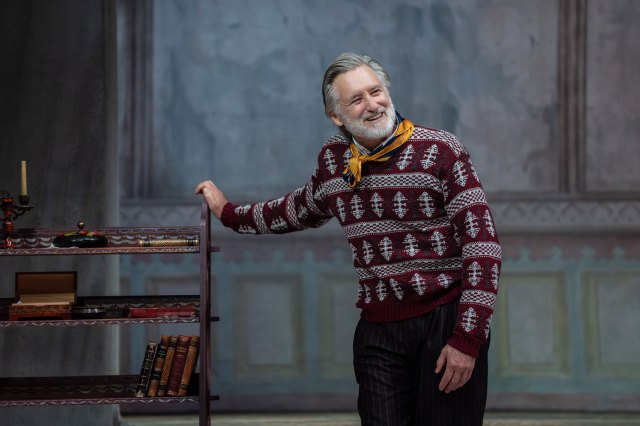
Helen Hunt’s Ranyevskaya is convincingly brittle and stoical simultaneously, and her relationship with Bill Pullman as her brother is constantly interesting and tender. Alfred Enoch is delightfully earnest and gawky as the proto-revolutionary student Trofimov, Guy Henry and Andy Rush make the most of the comedy in their roles, while Esther Smith delivers a heartbreaking Varya, on the receiving end of Lopakhin’s vacillating suitor whose real affections clearly lie elsewhere.
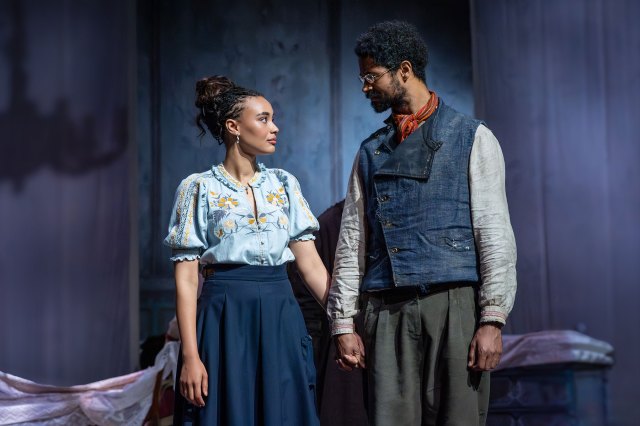
Wade and Harvey’s regular design collaborator, Anna Fleischle, has created a set and costumes that convey decaying grandeur, while Laura Rossi’s accompanying music feels both authentic to the time period and appropriately timeless, and it’s always a joy to hear live musicians performing the score in real time, high above the Swan stage.
Just how much Chekhov was yearning for a vanishing social order or heralding the imminent arrival of a revolutionary new one will doubtless go on being debated. This production gives us both, empathetically and even-handedly, without pushing one particular agenda: what’s coming is coming, regardless of how you feel about what’s been lost along the way. What you do with it is up to you.






source on Google
Related Articles
See all

Related City Guide
Latest Reviews
See all




Latest Videos
The cast of The Haunting of Hill House on jump scares, spooky stories and Halloween costumes
It’s time to go trick or treating at Hill House…