The Oresteia at the Bridge Theatre – review
Simon Stone’s contemporary spin on the Greek classic runs until 19 September
 |
London
|
|
London
|
15 July 2026
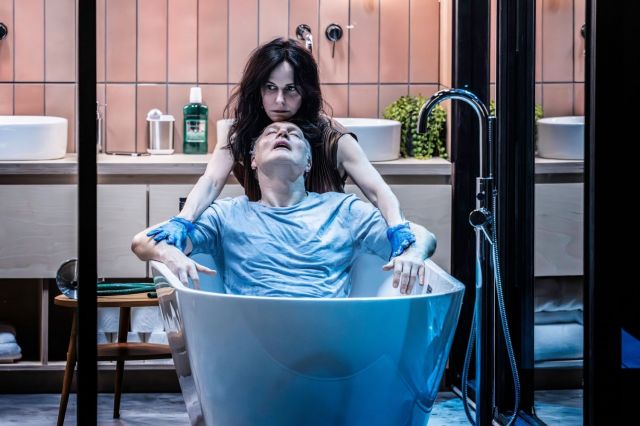
The second act of Simon Stone’s The Oresteia is one of the most gripping, visceral and biting hours of drama you are ever likely to see on stage. It is literally impossible to look away as events of heavy weight and terrifying impact unfold, each twist following inevitably from the last.
The rest of the production – very much after Aeschylus and others – is also a supreme act of confidence, a superbly staged and performed piece of theatre. But odd though it is to say after a production that lasts more than three and a half hours with two intervals, Stone almost needs to allow himself more time to tell this epic and resonant tale.
For those who have seen Stone’s other work, such as his devastating Medea or Yerma with Billie Piper, he is playing to a familiar pattern. He takes Aeschylus’s cursed Greek family, destroyed by a father’s decision to sacrifice his daughter, and makes it very much contemporary and recognisable.
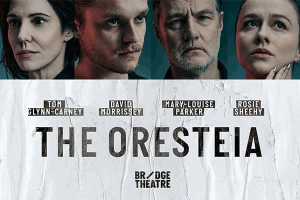
Agamemnon becomes Christopher (a towering David Morrissey), not a general or a prince but a 21st-century arms dealer looking after the family business. Clytemnestra, his wife, played by Mary-Louise Parker, is Montie, dissatisfied and spiky, even before she takes the decision to kill her husband with her new lover Jerome (after Aegisthus, portrayed by John Macmillan) as a willing accomplice. Their children, Alice (Rosie Sheehy) and Augy (Tom Glynn-Carney), are initially spoilt and dissatisfied late-millennials, “kicking against the pricks”, as much as tortured avengers.
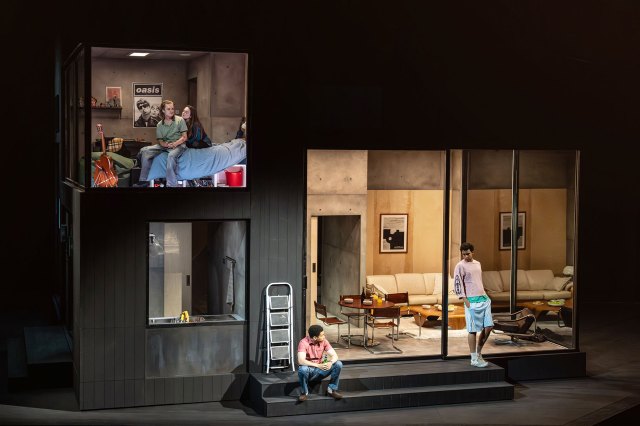
Their story takes place within Lizzie Clachan’s whirring glass box, a smooth palace that spins thrillingly whenever bloodied bodies (of which there are many) are discovered. Nick Schlieper’s lighting frames each scene in a disturbing glow while Peter Rice’s soundscape underpins the tension.
Their dialogue is fast-paced, overlapping, and convincingly real. Stone plays with the timeframe, darting back and forwards through events over a decade from 2016 until 2026, turning them into a thriller as much as a tragedy.
There are no gods, no furies, no fates controlling these people – just a terrible sense of doom as they make decisions that wreak havoc with their lives. People don’t stand up for what they believe, or if they do – like Isabel or Chandra (an agonisingly gentle Cassandra-like Rakhee Thakrar) – they are destroyed or driven mad by the self-interest of others.
Protest is necessary but pointless. The vision is bleak but convincing. This is a society that is tearing itself apart by valuing the wrong things. Christopher’s fatal weakness is shown in the first scene when he announces that “Bollinger is fine for the servants”. It’s a world out of joint, and chaos will follow.
Stone’s writing is entirely cogent until the concluding act, which crams too much in; it simply isn’t as rigorous as the others. Alice is particularly poorly served; she is a misfit, socially awkward, never quite sure of her place in the story, which feels a waste of Sheehy’s wonderful comic timing and capacity for suffering.
But his direction is impeccable, constantly ratcheting up the pressure while allowing the characters space to breathe. Montie has a wonderful moment where, torn from her American home, she dreams of returning across the sea. Parker seizes it with trance-like delicacy, bringing sympathy for a character who elicits little. Morrissey too finds the sorrow beneath Chris’s bullish exterior, suggesting his melancholy with a little stoop of the shoulders, a raise of the head.
As Augie, a man with a mission, Glynn-Carney is both overwrought and frightening, yet intensely vulnerable in his scenes with Archie Madekwe’s Lorenzo. There’s a lot of humour amidst the wreckage, particularly from Macmillan’s guilt-addled Jerome.
By the end, the sense of waste is overwhelming. There is – in contrast to Aeschylus’s dramatic arc over his trilogy of plays – no resolution, no forgiveness or justice. Stone’s stripped-back, brutal version strands us with the overwhelming sense of chaos that violence, compromise, and constant war bring. This is Greek tragedy for an age of insanity.






source on Google
Featured In This Story
Related Articles
See all


Latest Reviews
See all


Latest Videos
New musical Nero releases first listen with Andrew Barth Feldman
It is from the writers of Spring Awakening