
Catarina and the Beauty of Killing Fascists at the National Theatre – review
Tiago Rodrigues’ production, marking his National Theatre debut, is performed in Portuguese with English surtitles and runs in the Dorfman until 26 September
 |
London
|
22 September 2026
Catarina and the Beauty of Killing Fascists is a play designed to make you react. It’s provocative and troubling but its message is relatively simple: fascists are bad. Now what do you do about that?
You are meant, I think, to walk out; to scream, shout and whistle, storm the stage in protest. That’s what has happened as Tiago Rodrigues’ unsettling parable has played in theatres across the world since its premiere in 2020. On press night, the British audience let out the odd whistle and wriggled uncomfortably. But they mainly laughed as a populist politician took to the stage and spewed his message of hate. Which might say something about how hard it is to fight extreme opinions with tolerance. Or it might simply describe just how difficult it is to subvert the conventions of theatre to provoke a response.
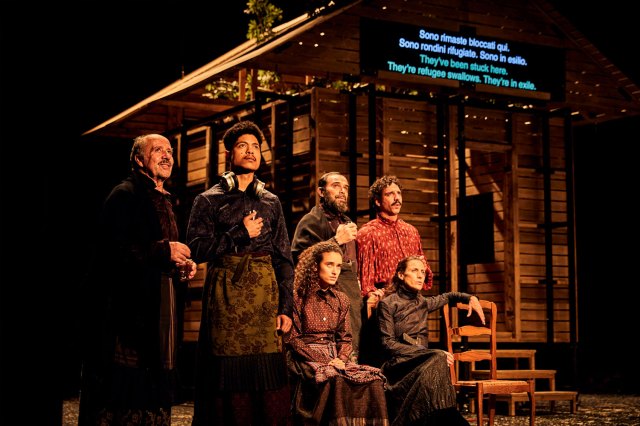
The structure of this punishingly long drama – more than two and a half hours played without interval in Portugese with surtitles – is classically threefold. The action is set in a country house in the south of Portugal in 2028, evoked by F Ribeiro’s cool design of a cork-walled dwelling, with a long table set for lunch.
Its first section shows a family group assembling for an annual ritual. They talk about the past, tease the youngest about her veganism, wax lyrical about the pig trotters they are about to eat. A father and a son watch the swallows gathering – refugee swallows who no longer migrate because Africa is too hot and Europe is at war. Another man constantly quotes Brecht.
Then they explain the reason for the gathering: every year, they kill a far-right politician “in the name of the women who are oppressed.” That woman is called Catarina – they all adopt her name, and sing a rebel song in her honour – and her story is based on the true case of Catarina Eufémia, a striking worker killed in 1954 under the Salazar dictatorship.
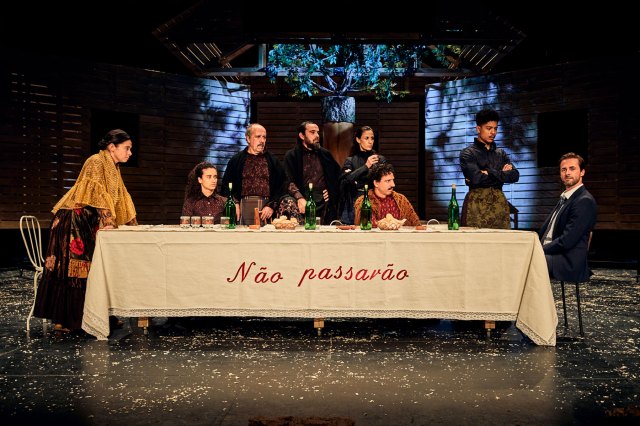
The second section, prompted by the doubts felt by the chosen shooter (played with quivering intensity by Beatriz Maia), is a long, complicated debate about whether it is ever right to kill, even in the name of justice. Can democracy fight the rise of evil? Does liberal tolerance have value faced with populist certainty and hate? They are pressing questions in uncertain times, delivered naturalistically by a cast who entirely inhabit their roles.
In the final section, the politician who has been picked to be slain, gets his moment centre-stage. Up until this point he has been cowed, pathetic, pitiable, terrified of his approaching end. But given a platform, he rises up and delivers a frightening speech, deploying all the usual tropes against minorities, women, and homosexuals.
The speech, delivered by Romeu Costa with truly terrifying reasonableness, is utterly sobering. All the arguments of the central section about opposing violence with violence are suddenly set into context by the sheer clarity of his narrative – horrifyingly more familiar now than when the play was first performed six years ago – about the need to get rid of the constitution to deliver results, bring back the family, outlaw difference and argument in the name of patriotic freedoms. It is chilling. But it is essentially a theatrical device. Somehow it doesn’t cut through into the real world.
I think this is the reason that a British audience are so uncomfortable. They don’t quite know how to react, because they know that the man is an actor saying lines; he is not a politician changing lives. The entire theatricality of the set-up – powerfully written and beautifully staged though it is – undercuts its force.
This is a play that, particularly in that long central section, asks difficult questions. It is never dull and always challenging. But there’s an uncomfortable sense that by setting out to trigger a reaction, it is a little too sure of its own importance.






source on Google
Related Articles
See all
Latest Reviews
See all






Latest Videos

Jessie Elland performs “Somewhere That’s Green” from Little Shop of Horrors
From Manchester to Liverpool!