
Angels in America at King’s Theatre – Edinburgh International Festival review
The UK premiere of the Internationaal Theater Amsterdam production is directed by Ivo van Hove
 |
Edinburgh
|
|
Edinburgh
|
19 August 2026
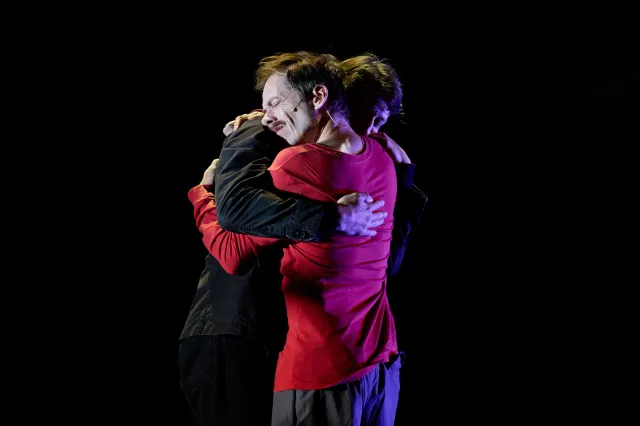
When it comes to epic theatre, in Dutch, dealing at the Edinburgh International Festival with vast contemporary themes and dreadful personal trauma, Ivo van Hove and Internationaal Theater Amsterdam have form. Not everyone loved their take on A Little Life at the 2022 festival, and it would be a stretch to say that I “enjoyed” it, but it was an all-engulfing theatrical experience that, over its four-hour duration, made it impossible to think about anything outside of the auditorium, so tight was the drama and so intense the performances.
So at least I had a flicker of what to expect from their take on Angels in America, a play so epic that in its previous iterations it took place over two evenings. Not here: in this production for the EIF, both parts (Millenium Approaches and Perestroika) take place in one five-hour long span, including a merciful interval between them for the audience to regroup.
And they need to. Tony Kushner’s play remains a powerfully immersive experience, still the definitive play about the AIDS crisis of the 1980s, and one of the USA’s most important contemporary state-of-the-nation plays, mixing very human stories with flashes of the supernatural and the hallucinogenic.
Kushner has said that van Hove’s condensed, one-night version is his favourite version of his own play, and the first half moves remarkably quickly in setting up the characters and scenes, though it feels like we get to crisis point with the main relationships a little too rapidly. No sooner have we met Harper and Joe than we are plunged into the wrecks of their marriage, and Louis and Prior’s relationship seems to flounder before we’ve even got to know them.
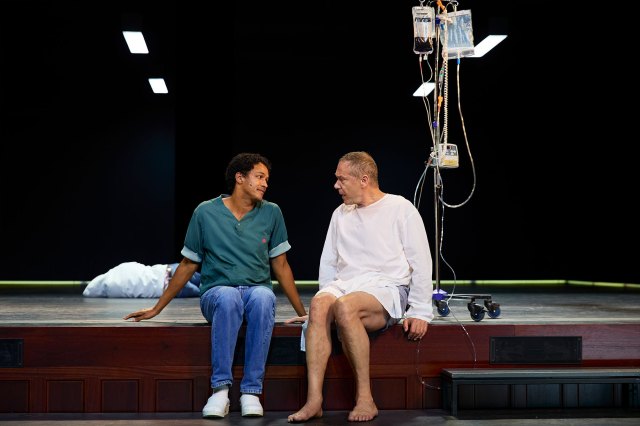
Still, that’s in keeping with van Hove’s production which is all about the essentials. The stage is almost completely bare except for a sound system which belts out David Bowie at various points. The visual focus is poured into the performances and the language, the actors performing in Dutch with the English supertitles.
When the text is laid out for you to read, you can’t help but notice that some of the monologues come precariously close to speechifying, and the philosophising of the Angel scenes is too wordy for its own good. Furthermore, the play’s politics come across as rather clumsy – they’re not much more complex than “Republicans are bad“ – and any knowing hints that the production gives (admittedly gently) comparing Reagan’s America to Trump’s feel heavy-handed.
The production works at its best as a drama of human suffering and relational pain, and the acting ensemble bring it to life grippingly. Finest of all is Hans Kesting as the powerful lawyer Roy Cohn. Kesting transforms himself from the aggressive lawyer who seems to rule Manhattan, into the frail broken man who dies of AIDS in a lonely hospital room.
Next to him, Marieke Heebink plays four different parts with total distinctiveness, transforming herself physically as she shape-shifts magically into each role. The younger actors all portray characters who are in some way lost or adrift, and the ending satisfyingly refuses to tie up all the loose ends and reminds us that life goes on in all its messiness. In this vision of the modern world, the angels might be there, but they’re not going to help us.






source on Google
Guide

Latest Reviews
See all



Latest Videos
New musical Nero releases first listen with Andrew Barth Feldman
It is from the writers of Spring Awakening