
Who Killed Marilyn? with Pixie Lott at the Emerald Theatre – review
Sharleen Cooper Cohen’s new play, directed by Philip Wm. McKinley, runs until 29 October
 |
London
|
|
London
|
21 August 2026
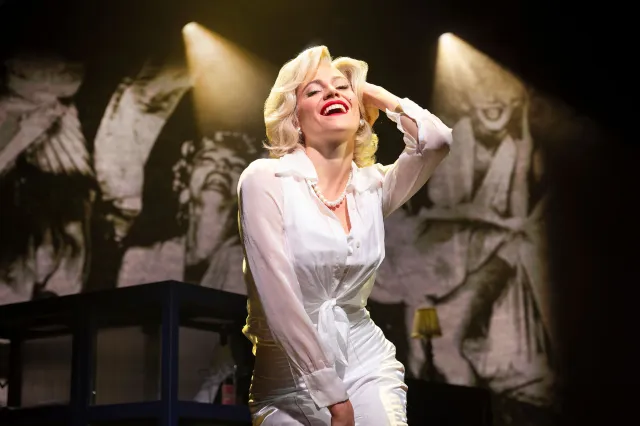
A decade ago, popstar Pixie Lott made her West End debut as Holly Golightly in Breakfast at Tiffany’s, a role immortalised by Audrey Hepburn in the film version, though author Truman Capote had wanted Marilyn Monroe for the part. Lott now returns to the stage as the world’s most famous blonde bombshell in Sharlene Cooper Cohen’s prurient play that has all the dramatic tension and emotional impact of a Wikipedia article.
The mythologisation of Monroe has long reached saturation point. Cooper Cohen provides a whistlestop tour through her short life combined with crime drama speculation as to the manner of her death at the age of 36. If ChatGPT were commissioned to write a play about Marilyn Monroe, it would probably look a lot like this.
There’s never any shortage of Monroe impressions on the cabaret scene or at fringe festivals and Philip Wm. McKinley’s wooden production is like a Monroe-themed Halloween pageant. Lott does her best with what she has to work with in her bouffant bobbed wig (physically, she would be more convincing as Princess Diana than Monroe), though there is overreliance on the breathy voice and coquettish mannerisms. Her lengthy final monologue to her psychiatrist is handled capably, granting her some dramatic dignity.
The multi-roling ensemble are lumbered with a parade of caricatures who do their little bit and then disappear – and of course objectify Monroe horribly. Ben Dilloway brings some gravitas to his turn as Arthur Miller, Monroe’s third husband who was the only one to give her some domestic stability, and Paul Kane is a suave Bobby Kennedy. The gangsters and FBI officers are a real low point, who collapse in grotesque territory through the incompetent writing and bumbling direction.
Cooper Cohen doesn’t believe that Monroe died by suicide or by an accidental overdose and argues that she was bumped off by the presidential Kennedy family because she knew too much about their mob activities (all written down in her little red notebook). Her actor friend Peter Lawford, who married into the Kennedys, is the worst villain of all. While Monroe was undoubtedly treated appallingly, the handling of these speculations is never more convincing than the peddling of pet theories.
The costuming by Jasmine Swan looks cheap. Lott is dressed in a white top and pedal pushers (alluding to that dress in The Seven Year Itch) made out of plasticky material and the men’s costumes are stained with paint or ink – possibly to allude to how corrupt and awful they all were, but it just looks untidy. The set design by Justin William, comprising a set of revolving bedroom furniture with projections on the back wall, is uninspired and there’s little sense of time or place.
The bodies of beautiful dead women, sadly, are all-too easy to monetise. Monroe tells us several times that she doesn’t want to be seen as a victim, but that’s exactly how she’s presented. Those wanting to learn more about Monroe or to celebrate her legacy in the year of her centenary would be much better served by a visit to the National Portrait Gallery for the exhibition “Marilyn Monroe: A Portrait”, running until 6 September.






source on Google
Featured In This Story
Related Articles
See all
Latest Reviews
See all

Latest Videos
West End vs Broadway: Paranormal Activity – Ami Okumura Jones and Cher Álvarez on transatlantic terror
‘Tis the spooky season, after all…