
Hay Fever review – Christine Baranski and Richard E Grant offer up a light and delicious West End confection
Emily Burns’ revival of the Noël Coward classic runs at Wyndham’s Theatre until 12 December
 |
London
|
|
London
|
1 October 2026
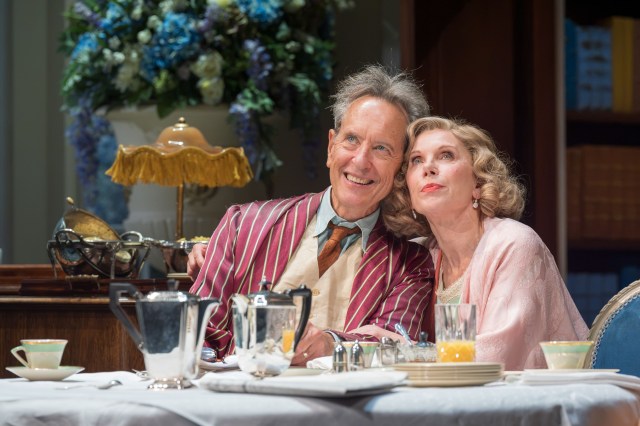
Noël Coward’s Hay Fever is a meringue of nothingness. Or rather, as his biographer Oliver Soden points out, it is “not so much artificial, as a commentary on artifice.”
In that sense, it is rather like the playwright himself, an impossible confection. It was one of four plays he premiered in 1924, making his name as British theatre’s brightest star. There is little trace of his own background of clinging on to shabby gentility, making his way in the world as a child star, or his first nervous breakdown after being called up for military service at the start of World War One.
Instead, he fixes his eyes on the fantastical and the theatrical, whipping up the impossibly ill-mannered Bliss family, who separately invite four guests to their country house, and then ignore them or abuse them, subjecting them to a peculiarly brutal mixture of inattention, bad food and incomprehensible parlour games.
The ill-matched party is centred around Judith Bliss, a just-retired actress of melodramatic tendencies, caught up in her own psychodrama of disappointment at her own fading glory. Dame Edith Evans used to get a round of applause when, faced with the accusation that she was never beautiful, she replies: “Nevermind; I made thousands think I was.”
This production, gently directed by Emily Burns, revolves around Christine Baranski as Judith, who adopts both an English accent and a more nuanced approach to the role; the former seems to soften the sharpness she has exhibited in her television roles in The Gilded Age and The Good Fight, but she retains instinctive comic timing and an ability to convey, with a raised eyebrow or a disappointed frown, her sense of life passing her by.
The problem for the actors playing the Bliss family – a shock-haired Richard E Grant as the egotistical novelist husband, Will Close as the posturing painter son Simon, and Ophelia Lovibond as the daughter Sorel – is that they are required both to be monstrous and adorable. It’s a difficult balance to pull off, though Simon in particular is gifted with some gem-like lines. His observation that “it’s so silly of people to try to cultivate the artistic temperament” while holding a paint brush and wearing a smock is a particular pleasure.
But the production, and the play, spring to life when the guests arrive on Frankie Bradshaw’s deliberately cluttered set, all elegant blues and creams and a rain-spattered flower garden beyond. It is the visitors who act as a foil to the Bliss’s deranged self-absorption and who provide the accelerating mayhem that powers the wit.
Each represents a type, but the economy of Coward’s writing gives each a distinct character, and the actors fill out the frame. As the suave diplomat Richard Gratham, Charles Edwards is wonderfully catatonic with embarrassment, picking at the furniture in distress, but constantly trying to find the polite thing to say, while Nancy Carroll as the socialite Myra Arundel is a polished whirlwind of sophisticated flirting and pent-up anger, furious that the rules of a game she is used to playing are being torn up.
Lucy Karczewski is equally delicious as the naïve flapper Jackie, constantly collapsing in shame, while Ash Hunter is suitably straightforward as Sandy, a young man invited to seduce the hostess who finds himself totally out of his depth. As the former dresser who is now the put-upon maid, Jo McInnes relishes an inventive moment of furious table-laying between the acts.
At its best moments, this production of Hay Fever works like a well-oiled clock, each of its comedic elements clicking neatly into place. It feels like a theatrical throwback, a drawing room comedy of “bad manners” (as Coward called it) that seeks only to entertain. But there’s something delicious about that. Meringues aren’t exactly filling, but they are fun to eat.






source on Google
Featured In This Story
Featured Artists


Related Articles
See all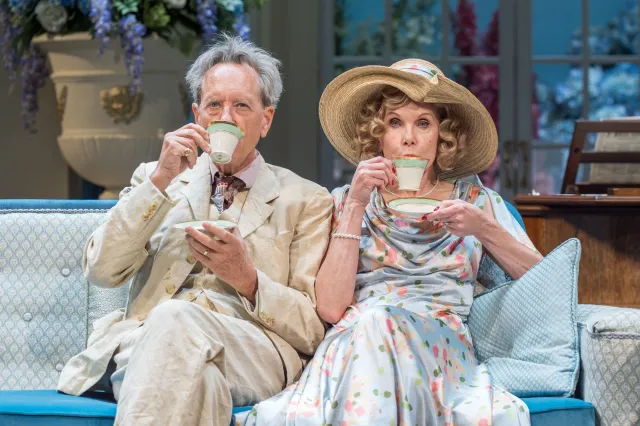


Latest Reviews
See all





Latest Videos
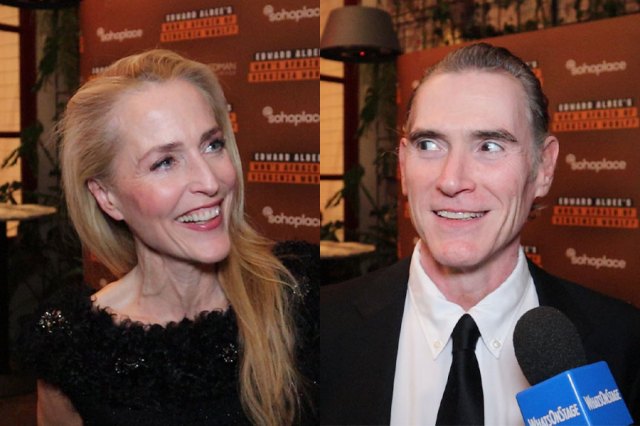
Gillian Anderson and Billy Crudup on staging a ‘boxing match’ in the round in Who’s Afraid of Virginia Woolf?
Marianne Elliott’s revival of the Edward Albee classic is running at London’s @sohoplace