
a small and quiet light at Chichester’s Minerva Theatre – review
Stephanie Street’s play runs until 12 September, before transferring to the Orange Tree Theatre in Richmond
 |
Chichester | Richmond
|
|
Chichester | Richmond
|
1 September 2026
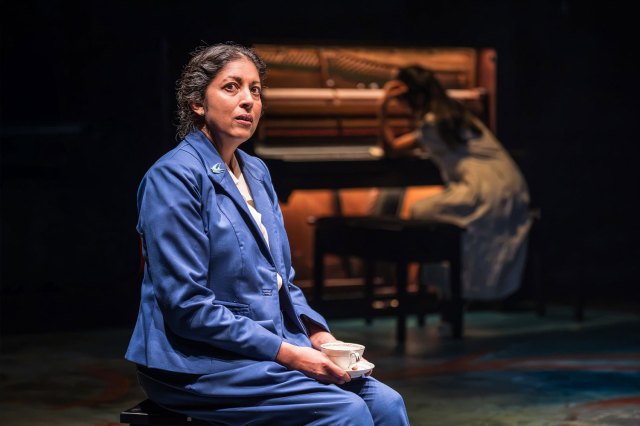
The story of Noor-un-Nisa Inayat Khan, a young woman of mixed heritage that played a heroic role in World War II as a wireless operator alongside the resistance in occupied France, is both a fascinating and criminally untold one. The average life of these brave men and women was just six weeks out in the field.
Khan was the first woman to be parachuted into France and was an unlikely candidate for the role. Quietly spoken and with a self-made oath to only ever tell the truth, she was guided by her own moral compass along with a loyalty to her adopted home of England. In an age where immigration and national identity is at the fore of the political and media conversation, Khan demonstrated a love and duty to her home whilst never forgetting her Indian roots.
The roles of women during the war are often pigeonholed when it comes to drama. Keeping the home fires burning and taking on farming and factory work are the well-covered tropes. David Hare’s Plenty springs to mind as being one of the few plays to applaud women, so it is refreshing to find Stephanie Street’s new play celebrating Khan and the work that would posthumously see her be awarded the George Cross.
Sadly, the clunky script and the frenetic time-hopping structure of Street’s writing make for a frustrating watch. Moreover, some of Elin Schonfield’s directorial decisions manage to entirely erase any kind of sense of time or place with Street’s already thinly drawn characterisations given such two-dimensional treatment. Overall, this makes it difficult to connect with anyone, and the decision to place additional seats on stage brings nothing but distraction to the whole piece.
An all-female company of seven play multiple roles, including those of men. Whilst this can work to great effect, on this occasion, it merely leads to some of the most unconvincing portrayals of army generals and Gestapo interrogators that I can possibly think of.
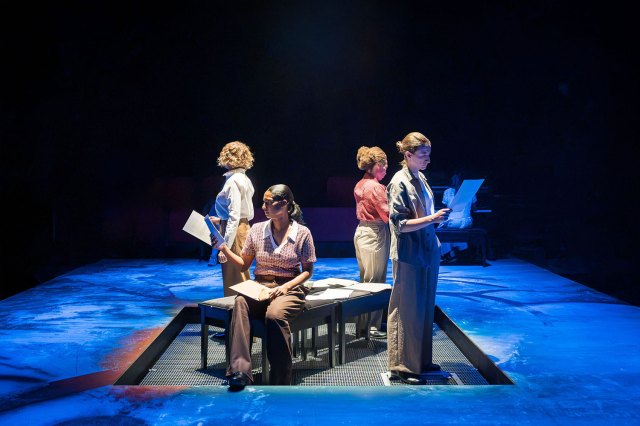
Anna Yates’ low key stage design creates no atmosphere into which we can dive into the story. Such is the rapidity of Street’s fleeting scenes that it is only by means of projected labelling on a flown gantry that we have any chance of knowing when or where we are.
The small cast are committed and all work hard. Caoilfhionn Dunne’s Vogt lacks any kind of menace as Khan’s interrogator whilst Kiah Arya is mostly silent as Young Noor other than some cleverly arranged playing of Debussy on a striped back piano. Paksie Vernon, Léa des Garets, Tripti Tripuraneni and Amanda Hadingue all try to keep the otherwise inert script moving as best they can.
Priyanga Burford is on stage throughout as Khan. Not entirely cohering in age with her character, Burford’s attempt at portraying Khan’s timidity results in her not being all that interesting. Whilst Khan was reported to be quiet and unassuming, there needs to be that glint of temerity and steeliness that is lacking in Burford’s too calmly measured performance.
As a kind of prologue to the race through Khan’s life, a collection of real-life writing is shared by the company in the form of letters and interviews with people that really knew her. It makes for the first genuinely poignant moment that brings home the bravery of Khan along with the sadness of her subsequent loss. Khan lasted much longer than the forecast six weeks despite the horrors that she would ultimately face. She was undoubtedly an extraordinary woman.
Her heroism should be remembered and her role as the first woman should be celebrated. Unfortunately, this play managed neither for me.






source on Google
Related Articles
See all

Related City Guide

Latest Reviews
See all





Latest Videos
New musical Nero releases first listen with Andrew Barth Feldman
It is from the writers of Spring Awakening