
Tim Crouch: ‘The most important people in a theatre are not on the stage’
Crouch’s Toto Kerblammo! continues at the Unicorn Theatre and will embark on a tour this summer
 |
Tour
|
|
Tour
|
19 May 2026
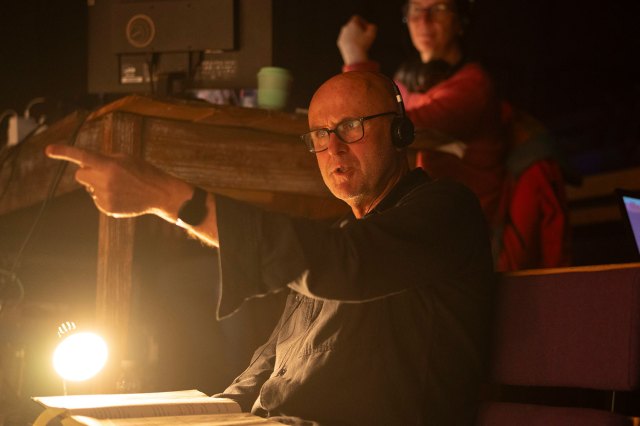
Tim Crouch is settling back into familiar territory.
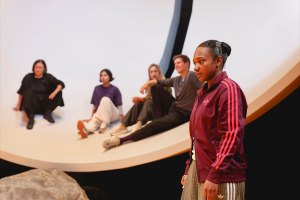
Having just completed a three-month run of The Tempest at Shakespeare’s Globe, the playwright and performer is shuffling down the Thames to the Unicorn Theatre for a second run of Toto Kerblamo!, a play that feels like a lighter lift this time around precisely because it has already proven itself with audiences during its initial 2024 staging. “Slightly less pressure on me,” Crouch notes over Zoom, “partly because the show has a track record… I haven’t sort of been freaking out about concept and words and form and stuff. We know the product works.”
The journey of Toto Kerblammo! to the stage has been exceptionally long, with the original idea sitting in development for two decades. Unlike the majority of Crouch’s concepts, which usually find an audience, Toto Kerblammo! remained unproduced for years. “It genuinely was my wife… who used to direct me in my 20s,” he explains. “She left directing and now writes novels for a living, but she has a good eye, and she knew that there was something in Toto that needed to be brought out into the daylight.”
Crouch reflects that the 20-year delay has ultimately benefited the piece: “I think it’s a better thing for having had that 20 years… the sensitivities around young people, difficult subjects, and mental health… I feel like the conversation is far advanced from what it was 20 years ago. So it feels like it sits in a better place.”
Even so, the script underwent some refinement between its original conception and its premiere. Crouch chose to soften some of the more overtly distressing details. “In the play, there is a girl whose mother has, I think in the original quite clearly, tried to destroy her family,” he says. “And now, I have gently hinted that she left a candle burning.” Similarly, original lines explicitly stating a character didn’t want to live were replaced with ambiguity. “It’s more interpretable, which I think is a good thing… some people can take it as there was an accident, and some people might see that there was some intention behind the events. But I don’t want to be explicit about that.”
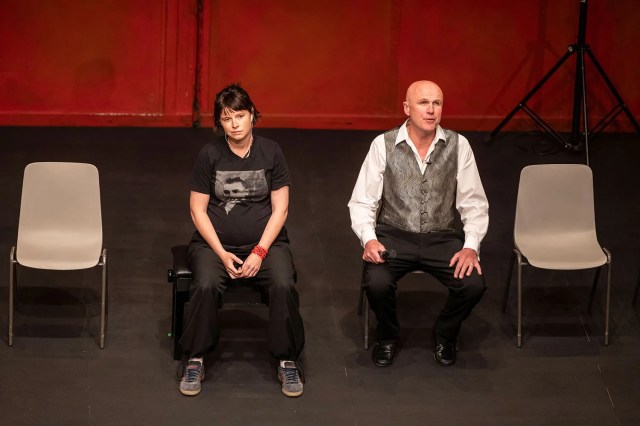
This careful calibration aligns with Crouch’s broader philosophy regarding theatre for younger audiences. He expresses a distinct, “pathological aversion to sunshiny children’s theatre,” adding, “There’s a place for it completely… but I’m excited to see how differently a story could be told.” Pointing out that traditional fairy tales were “as dark as dark can be,” he laments a “slow sanitisation around what children can cope with”. “We’ve done a lot of work with young people… and always felt that the adults were much more concerned than the children,” Crouch observes.
“Children can usually handle things much better than the parents.” Under its current artistic director, Rachel, the Unicorn is using Toto Kerblammo! to slowly increase its audience age range, programming 7pm shows that cater to a ten-to-twelve-plus demographic, alongside parents and independent adults.
The production has seen some cast changes, with original actors tied up with other projects, meaning Crouch has spent the recent rehearsal period integrating two brand-new performers. “There’s been a sense of starting from scratch, but on something that we already have tried and trusted,” he says.
The play itself relies heavily on audio, a remnant of its dual origins as a piece designed for both radio and the stage. Crouch recently attempted to persuade the BBC to record a version, but notes dryly: “You think theatre is in a dark place? Radio drama is an even darker place. It’s very hard to get an original piece recorded… everything has to be attached to a sort of IP.” While Toto Kerblammo! features striking visual work from designer Lily Arnold and lighting designer Will Monks, “the primary drive is to what we hear and what we see when we hear it.”
For those of us whose tastes in theatre were formed as nascent theatregoers – perhaps while navigating student productions at university and spontaneous, under-funded trips up to the Edinburgh Fringe (the left arm of a sofa was the first bed I was lucky enough to sleep on) – encountering Crouch’s work for the first time is often a formative experience.
My own introduction to his singular theatrical language began with An Oak Tree, a play that permanently expanded my understanding of what live performance could do. Years later, I found myself experiencing his practice from the inside out, speaking lines as an audience participant during a 2019 performance of Total Immediate Collective Imminent Terrestrial Salvation. With my heart in my mouth, surrounded by the country’s theatre critics on press night, I experienced firsthand the intense vulnerability and trust that Crouch demands of his rooms.
All three of the aforementioned plays focus on the relationship between sight, sound, and gaps in presentation, which is a definitive hallmark of Crouch’s wider career: “There needs to be something missing which the imagination can complete. And that’s usually the case in all my work.”
Remarkably, Toto Kerblammo! and An Oak Tree were written around the same time in 2004, a period Crouch admits was marked by a certain “morbid fascination” and “fixation” on road accidents – a thematic thread that connects the 12-year-old female protagonists across both plays.
His work also continuously interrogates the traditional boundary between the stage and the auditorium, trying to peel back what he calls the “screenification” of theatre. “The most important people in the room are not on the stage,” he states flatly. “So if something’s happening to the most important people in the room, then the stage should take a backseat for a moment and deal with what’s happening in the audience.”
It’s an interesting point – placing the audience themselves under a microscope during each production. One of Crouch’s earlier, most distinctive works, The Author, had audience members pitted on two sides, watching each other. The actors were seated within the audience. A similar trick was used in The Tempest, where seven of his eleven cast members were seated inside the audience during the show.
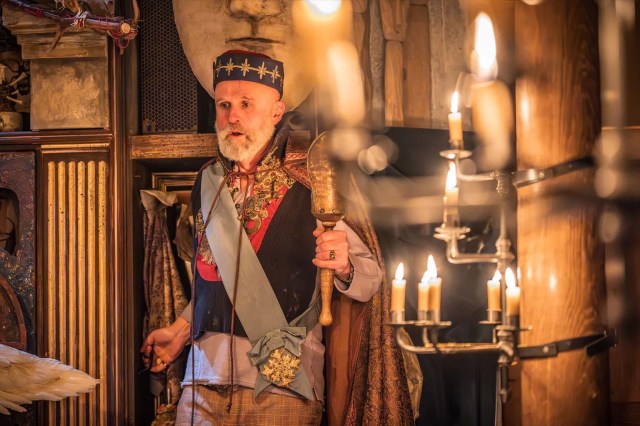
I recall watching a performance of Truth’s A Dog That Must To Kennell in Edinburgh back in 2022, where a critic sitting near me had a severe coughing fit. Crouch broke character naturally to ask if anyone had water – an intervention so seamless that many assumed it was part of the script.
When I bring this up, he smiles: “Welcome to the world of my work. Almost every play… things go wrong and people assume that’s planned.” This active responsiveness is engineered directly into the mechanics of An Oak Tree, where a different guest actor who has neither read nor seen the play performs opposite him each night.
“My job is to respond to however they’re responding. And that takes me into shapes and into places on stage that I would never have thought the play would go to.”
Crouch recalls a formative experience as a young man watching Hamlet at the Bristol Old Vic, where an elderly audience member slumped forward and effectively passed away in the stalls. As ushers carried her out, the production simply carried on with the scene. That moment left an indelible mark on his practice. “I sort of adamantly feel you should never make a piece of work where someone can die, and the play carries on,” he says.
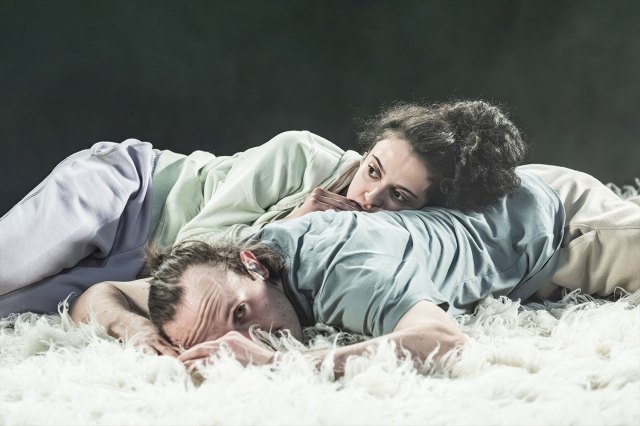
As Toto Kerblammo! opens this week, the production is also preparing for a slot at the International Children’s Festival in Edinburgh as part of a major tour. Crouch acknowledges the immense pressure currently facing the UK touring circuit, noting that touring work for young people is “really complex… unless it’s sort of like Julia Donaldson or Roald Dahl… to take an original story without famous people in it or a famous name.” Supported by funding from the Arts Council, the upcoming tour represents a significant commitment to original storytelling for families.
One final theme that Crouch has now discovered is a recurring motif – dogs. From the literal canine narrator in Toto Kerblammo! to the hidden dog Sandy in Beginners, and the highly stylised death of a pet in Adler & Gibb, animals are a constant fixture in Crouch’s imagination. “There’s something I think connected for me between the childlike play state and, I suppose, the animal state. A dog is an easy shortcut to ideas of authenticity.”
His relationship with dogs has recently turned personal; he now shares his Brighton home with Uncle, an Italian water dog who is his regular sea-swimming companion.
Ironically, Crouch didn’t actually own a dog when he first conceived Toto Kerblammo! 20 years ago, but the published script of the play features a very specific detail: it is dedicated jointly to Crouch’s grandson, and uncle.




source on Google
Featured In This Story
Related Articles
See all


Latest Reviews
See all


Latest Videos
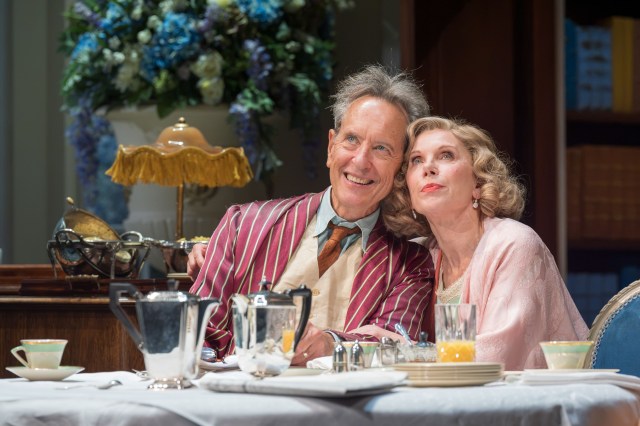
Christine Baranski and Richard E Grant on a blissful friendship, Anglophilia and onstage kissing – Hay Fever opens in the West End
The Noël Coward classic is back!