
An Ideal Husband at Lyric Hammersmith Theatre – review
Nicholai La Barrie’s revival of the Oscar Wilde classic will also be staged at Bristol Old Vic
 |
Bristol | London
|
|
Bristol | London
|
14 May 2026
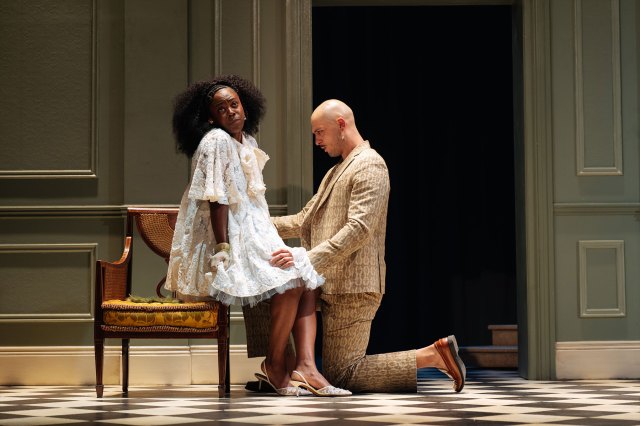
Oscar Wilde’s An Ideal Husband has always understood that respectability is often just scandal in better tailoring. At the Lyric Hammersmith, Nicholai La Barrie’s Caribbean British reimagining gives that idea a sharper cultural charge, placing Wilde’s world of political ambition, social performance and moral compromise within a community negotiating status, legacy and the long shadow of British colonial history. It is a clever fit. The airs, graces and carefully polished reputations all remain, but here they carry an added resonance: the desire to belong to the very establishment that has so often kept people at a distance.
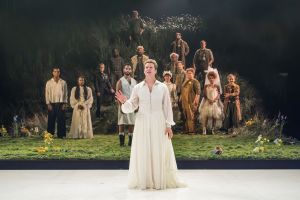
Visually, the production is a triumph, with Rajha Shakiry’s set and costume design emerging as the jewel in the crown. Every look lands with precision and intention, creating a world that feels both aspirational and intimately recognisable. For anyone with Caribbean heritage in the audience, the recognition runs far deeper than aesthetics. There is something quietly powerful about watching Wilde’s high-society archetypes refracted through a Black British lens. The airs, the graces, the exhausting choreography of respectability: all of it carries the full, unspoken weight of colonial history. The hunger to assimilate, to belong, to be received by the right people in the right rooms, hits very differently when it is your own community performing it.
Shakiry’s designs capture that tension beautifully, from immaculate tailoring to expressive flashes of colour and personality. These are people many will know, or at least recognise from family gatherings, church events, weddings and front rooms where reputation is its own currency. Zeynep Kepekli’s lighting adds polish and atmosphere, while the Lyric once again proves how confidently it can stage work that feels grand without losing its sense of place.
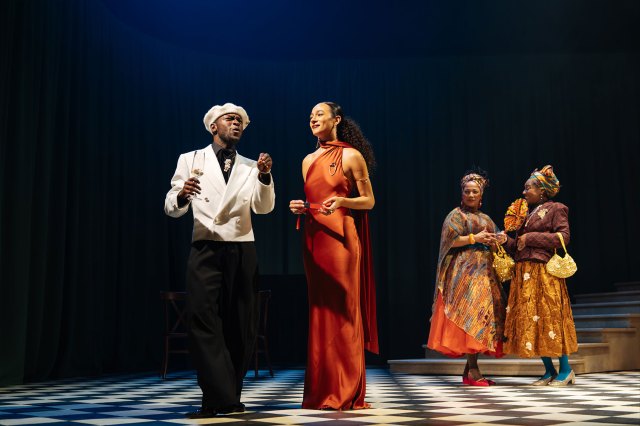
The production is at its best when Tiwa Lade’s Mabel Chiltern and Jamael Westman’s Lord Goring share the stage. Their chemistry is effortless, playful and properly charming. Lade brings wit, ease and brightness to Mabel, while Westman gives Lord Goring the right balance of elegance, mischief and emotional intelligence. Together, they give the evening its most alive and watchable moments. Their scenes have the rhythm and sparkle the production sometimes lacks elsewhere.
That inconsistency is the main issue. Some performances feel noticeably wooden, and the first half struggles to find momentum. Wilde’s dialogue should dance, but here there are stretches where it feels allowed to sit down for too long. Several scenes would benefit from sharper cutting, particularly where the dialogue begins to repeat ideas rather than deepen them. The production does pick up, but it asks for patience before rewarding it.
The sound choices are also a little too obvious in places. Holly Khan’s sound design has impact, but the production might have been richer had it drawn more boldly on Caribbean artists or local musical textures, especially to set against the British high society world Wilde is skewering.
Still, this is a stylish, thoughtful and often very enjoyable revival. It may not always be as sharp as Wilde’s best epigrams, but when it works, it has real flair. Like any ideal husband, it is charming, well-dressed, occasionally exhausting, and probably worth seeing again.






source on Google
Featured In This Story
Related Articles
See all

Latest Reviews
See all

Latest Videos

West End vs Broadway: Paranormal Activity – Ami Okumura Jones and Cher Álvarez on transatlantic terror
‘Tis the spooky season, after all…