Godot’s To Do List and Krapp’s Last Tape at the Royal Court – review
Gary Oldman tackles Samuel Beckett’s play while a Beckett-inspired short, Godot’s To-Do List, is penned by Leo Simpe-Asante
 |
London
|
|
London
|
12 May 2026
The Royal Court is full of memories as it celebrates its 70th birthday and few ring more strongly than the recollections surrounding this evening which deftly combines the old and the new: Gary Oldman returning to the place he last performed in 1987 (in Caryl Churchill’s Serious Money), in a play by Samuel Beckett whose early career the crusading theatre championed, combined with a Beckett-tinged duologue from the winner of the Court’s Young Playwrights Award. The combined affair is only 70-minutes long, but it’s rich in resonance and association.
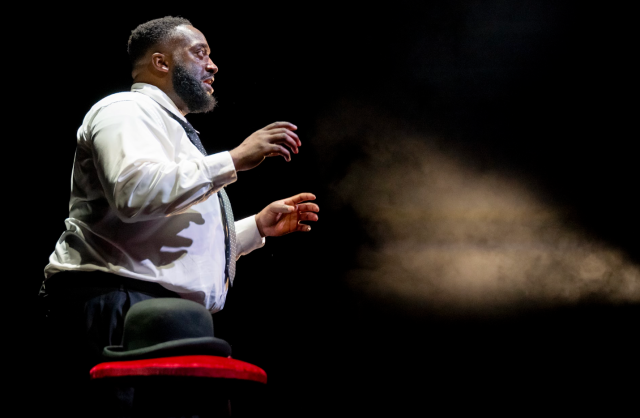
It opens with loud music and Shakeel Haakim ambling onto the stage to take his place on a bar stool, with skeletal tree beneath him, for Leo Simpe-Asante’s Godot’s To Do List. As a disembodied voice (Flora Ashton) barks orders at him from above, we begin to understand why Godot never got to his appointment with Vladimir and Estragon in Waiting for Godot.
He was unavoidably detained in a circle of light, fulfilling tasks of existential weight, ranging from the silly – “do the splits” – to the seemingly impossible – “work through your relationship with your father” – to the apparently simple “breathe”. It’s the last one that causes him the most difficulty, the anxiety of staying alive precipitating crisis.
Smart and original, it’s beautifully performed by Haakim, his accelerating panic and doubt underlined by his constant sense that he has somewhere else to be as Ashton’s voice, modulating from the fierce to the seductive, never gives him time for thought. Aneesha Srinivasan directs with aplomb.
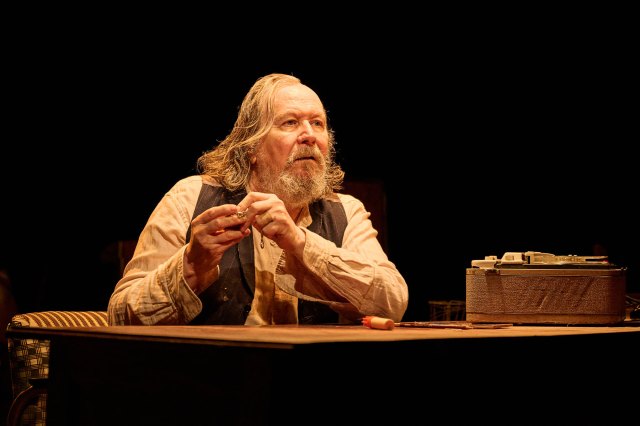
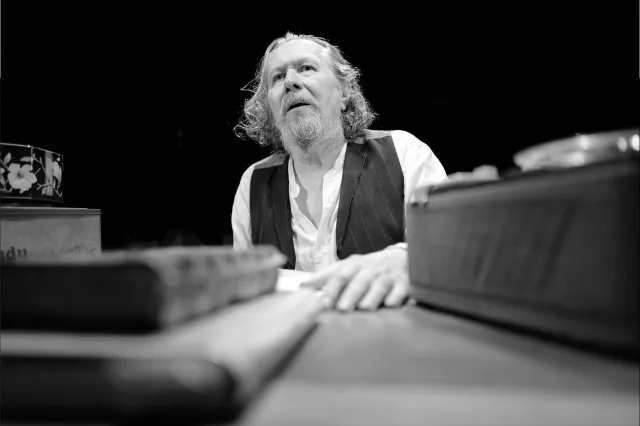
Then it’s Oldman’s turn to take the cluttered stage, which he has himself designed as a dusty loft full of rubbish, papers and books piled around a central table with an overhead light where Krapp, on his 69th birthday, slumps to listen to a tape he has recorded of himself 30 years earlier. Oldman is now best known for his film work and his performance as Jackson Lamb in Slow Horses, and to see him back in a theatre which did much to make his name is itself a pleasure. And there’s a historic justness in seeing this production, which he originally mounted for the Theatre Royal York last year, at the Royal Court.
It was here, in 1958, that Krapp’s Last Tape was first performed by the Irish actor Patrick Magee (for whom it was written) as a curtain-raised to Endgame (which was having trouble with the censor and consequently performed in French). Twenty years ago, in the theatre upstairs, the playwright Harold Pinter gave a devastatingly moving performance of this compelling monologue, a conversation between a failing man and his memories.
John Hurt, another notable interpreter, called it “an essay in aloneness” and it is a piece full of longing, of regret disguised as defiance, of understatement full of meaning. As the older Krapp listens to his younger self describing an encounter with a woman, a whole world of loss is summed up in simplicities. “I said again I thought it was hopeless and no good going on, and she agreed without opening her eyes.”
Oldman, directing himself, in black waistcoat and beard, plays it very straight and quiet, long grey hair falling over his shoulders, swigging from a bottle as he listens, and – occasionally – mocks. He doesn’t push either the poetry or the humour – the play opens with him carefully consuming bananas – but lets a sense of desolation settle over him, as the tape spools and Malcolm Rippeth’s lighting design allows light to seep away.
He isn’t either as moving or as desperate as some of his predecessors in the role, adopting a richer voice for the recording and a reedy growl as the older Krapp querulously interjects about the younger man’s foolishness. But at the close, as he sits absolutely still listening to the assertion “Perhaps my best years are gone. When there was a chance of happiness. But I wouldn’t want them back. Not with the fire in me now” he conjures an immense sense of desolation. You almost see the life draining from his eyes as the words waft away.






source on Google
Related Articles
See all
Latest Reviews
See all


Latest Videos

Disney’s High School Musical opens in London and the stars take a trip down memory lane
Bopping to the top at Troubadour Wembley Park Theatre!