
Eclipse at Chichester’s Minerva Theatre – review
John Morton’s debut stage play runs until 6 June
 |
Chichester
|
|
Chichester
|
15 May 2026
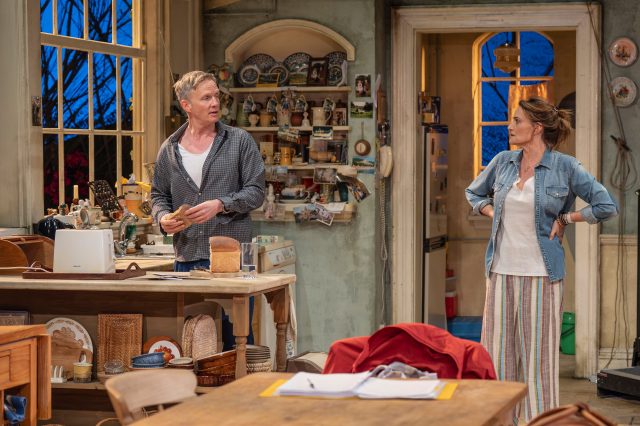
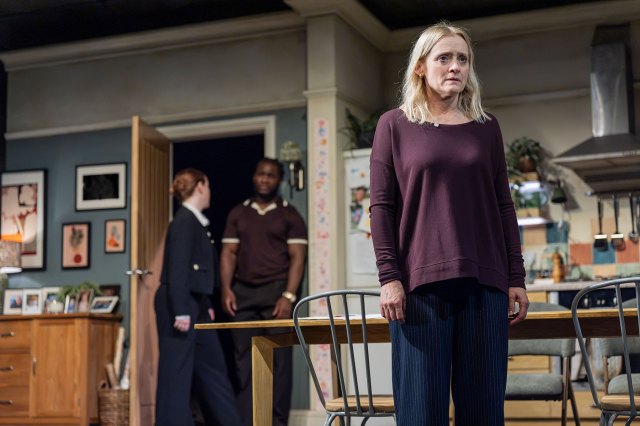
John Morton’s debut play, as both writer and director, is a perfect match for the intimacy of Chichester’s Minerva theatre. Simon Higlett’s handsomely crafted set of lusciously green garden and cluttered kitchen transports us impeccably to the comfortable home in Devon of siblings Sarah and Jonathan. They, along with a gallery of other visitors to the house, are caring for their father – who is never seen – as they fulfil his wishes of dying at home.
The action takes place in one day, but with many more days of history simmering and brooding beneath the surface as the tension of the situation takes its toll. The subtlety of the performances are all in the purse of the lips or the roll of the eyes and the emotion and resentment takes a grip of each in their own way.
For Sarah (a brilliantly pent up and emotionally drained Sarah Parish) it is on her thoroughly likeable husband Graham (a gently bumbling Paul Thornley) that she takes out her frustration. Castigating him at every opportunity as he endlessly tries to please her and help at every turn, it is as sad to watch as if she were constantly kicking a puppy. The skill of Morton’s writing is that the waspish short temperedness of Parish still draws sympathy as it is clear to see the strain that has brought her to this point.
Jonathan (a robust and assured Rupert Penry-Jones) is seemingly in control and on the surface less affected by the ailing hours of his father. Penry-Jones provides a subtle unravelling that results in an understated grief, both believable and moving. The arrival of Jonathan’s ex-partner (Mariam Haque) is partly an unnecessary distraction, but offers a glimpse into how family groups, including those now departed, can reunite in moments of grief.
Morton’s beautifully observed moments come into their own with the introduction of Karen (Selina Cadell) and Linda (Lizzie Hopley), two carers that come to help with Edward’s care. Cadell and Hopley both capture that enviable spirit of positivity amidst the sadness. There is an unerring and sympathetic ambivalence to the work they are doing, never anything less than deeply caring, but professional in getting the job done as they raise the energy of the house and are blithely unaffected by the grief, despite being respectful of it.
As is often the case, it is in the ordinariness of the script that this play really sits most comfortably. Battling with a temperamental toaster, discussing the benefits of a £12 pair of glasses from Boots or the divvying up of a Chinese takeaway are all moments of relatability that lean the audience into the mounting grief. As with Morton’s brilliantly observational TV work such as Twenty Twelve and W1A, this is where his skills as a writer lie and he recognises that sometimes the power is in the unspoken rather than the spoken.
Cadell’s carer Karen says to the family as the inevitable moment arrives “there’s nothing to be frightened of” as they go to say their final farewell to their father. It’s the simplest of moments and the most moving of all. There’s no need for outlandish dramatics; it will always be in the everyday that the interest lies.






source on Google
Related Articles
See all

Related City Guide

Latest Reviews
See all







Latest Videos

New musical Nero releases first listen with Andrew Barth Feldman
It is from the writers of Spring Awakening