
Owain & Henry review – Michael Sheen leads the charge in a monumental production
Co-produced by the Welsh National Theatre, Sheen and Steffan Donnelly’s staging runs until 28 November at Wales Millennium Centre
 |
Cardiff
|
18 November 2026
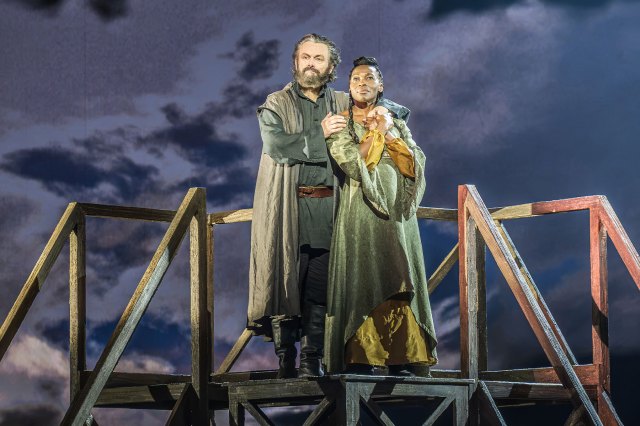
Gary Owen’s epic new play about the 14th-century Welsh prince Owain Glyndŵr is a sweeping, soaring argument with history – and specifically with the view of English history as communicated by Shakespeare. That’s why Falstaff (spoiler alert!) gets stabbed in a Welsh castle in an early scene, instead of being allowed a poignant offstage death in his bed at the Boar’s Head in East Cheap.
This is a different tale, of a Welsh lord who was diffident at best at taking on the role of rebel leader, of a king without a right to the crown, and of a bully-boy, bloodthirsty, warmonger of a Prince Hal, with his own definition of England as a xenophobic nation state.
Though its musings on the English view of “foreigners”, which include the Cymry, are possibly a bit too on the nose (at least to English ears), in the hands of Michael Sheen and the Welsh National Theatre company, a monumental staging and the sheer power of its ambition energetically sweeps through its Shakespearean-length running time.
At the heart of Owen’s clever, taut and often very witty writing is the key question – what are the stories we tell ourselves and who has the right to tell them? Glyndŵr is a bit player in Shakespeare’s Henry IV, Part 1; his rebellion on the borders is one of the skirmishes that the new king is fighting without any help from his layabout son. Part of the fun of this play is the way that it rewrites Shakespeare – with all due reference to his ghosts, his comets, and his general view of Henry IV as an upstart king desperate to hang on to the throne.
Glyndŵr is centre stage here, played with a characteristic combination of gravitas and wry charm by Sheen, who also co-directs with Steffan Donnelly. In this version, he’s forced to take up arms because Henry treats him badly and starts to take away the land of his tenants. Some of this is based in the historical record but a lot is counter-factual and imaginary, a kind of myth making about a Welsh hero, a truly nationalist Prince of Wales. Here Glyndŵr walks away from a great military confrontation with Henry’s forces that might have solidified his position because he believes in peace. The reality is at best unknown.
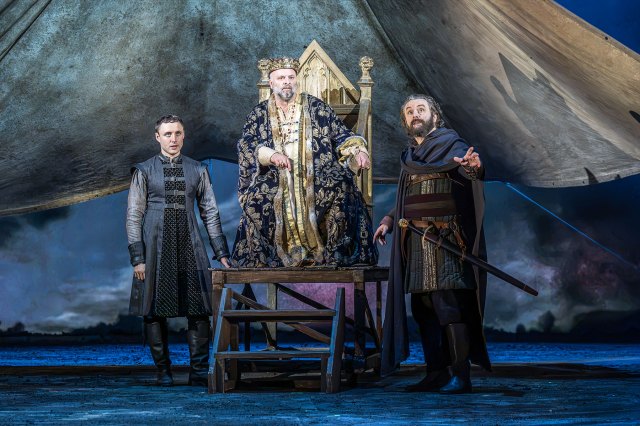
None of this really matters because what interests Owen is whether it is possible to break the bounds of the past and of destiny and so forge a better world. The narrative surges forwards on Jon Bausor’s impressive set, which makes great use of the Welsh Millennium Centre’s massive stage by setting corrugated pillars on either side of a deep recess, illuminated and defined by Aideen Malone’s evocative lighting, which conjures blazing cities, sunsets, stormy clouds, a constantly shifting panorama. Wooden stages are wheeled on to create rooms, thrones, tables.
A large cast blend into many roles, kept moving by Anthony Matsena’s fluid, punchy choreography that deals as effortlessly with battles (with fight director Ruth Cooper-Brown) and parties, underscored by Dyfan Jones’s enveloping compositions and sound design.
Individual performances make its arguments vital, particularly Rakie Ayola as a wonderfully vivid Mared, wife of Owain, who advises and eggs him on. “We gambled and we lost,” she says at one point. “But what joyful submission.” Such pleasure in freedom is in marked contrast to Ned Costello’s Hal, part spoilt child, part vindictive, sadistic warrior who prowls the stage determined to transform his kingdom into an engine of perpetual war.
As his father Henry, who favours real politick over the passions that surround him, Nigel Barrett (stepping into the role at very short notice) is suitably steely; James Wilbraham is an urbane Mortimer, revelling in the excellent jokes about the English not understanding Welsh, in a lovely nod to Shakespeare’s courtship scene in Henry V. David Judge is a brilliantly down-to-earth and charismatic Hotspur, Sophie Melville a roiling, battling female warrior, wedded to Owain’s cause.
All in all, Owain & Henry is a stimulating and enjoyable counterbalance both to Shakespeare and to the idea that there is any one view of history – and any single story worth telling.






source on Google
Featured Artist
Related Articles
See all

Latest Reviews
See all


Latest Videos
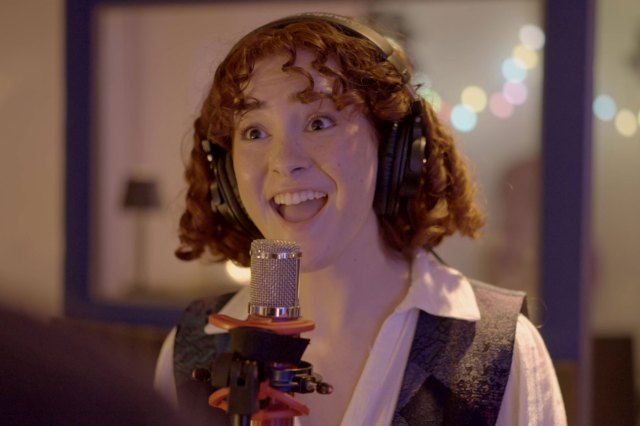
The Sorcerer’s Apprentice musical – take a first listen
The world premiere production begins performances at HOME Manchester next week