
Julius Caesar at Sam Wanamaker Playhouse at Shakespeare’s Globe – review
Joe Hill-Gibbins’ revival marks the first-ever staging of the tragedy in the indoor playhouse
 |
London
|
18 November 2026
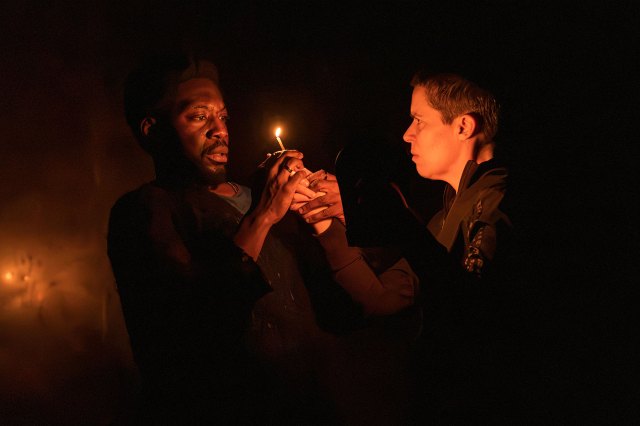
In the diminutive, candlelit space of the Sam Wanamaker, some plays feel confined. But Joe Hill-Gibbins’ intensely intimate production of Shakespeare’s thriller finds a fitting home here – its dark corners ripe for plotting, and its tight stage forcing rivals to circle one another as we, the people of Rome, press in to watch the personal play out in the political.
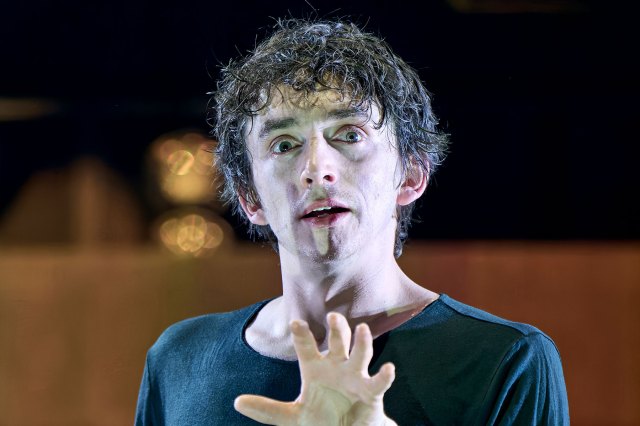
Hill-Gibbins’ adaptation strips the play’s sprawling character list to six, played by an excellent cast of four. Kate Duchêne offers a delicious collision of cruelty, ego and delusion as Rome’s would-be despot, leaving little doubt of the tyranny of his potential reign. Duchêne also plays Caesar’s heir, Octavius, and the Soothsayer, whose warnings spew from Caesar’s own throat as he writhes on the floor – his inner turmoil made flesh. Natey Jones is commanding, bitingly jealous and later touching as Cassius, the brains behind the plot against Caesar.
But most fascinating are Adam Gillen and Caoilfhionn Dunne as Mark Antony and Brutus, respectively. Usually a slippery tactician and charismatic orator, here Antony is a slow-witted, blindly loyal punching bag, who drapes himself, childlike, around Caesar’s neck. His famous speech, then, in which he turns the Romans against Caesar’s conspirators, takes on a wholly different tone. He is naïve, sincere, and his repeated references to Brutus as an honourable man (having just laid out why he is anything but) hold none of the usual sarcasm. Instead, he hits himself about the head as if he didn’t mean to speak his damning truth. It is a bold and provocative take, which explores authenticity in populist politics. But the question hovers: could this man really win a civil war?
Brutus meanwhile, usually a conflicted idealist, has more than a whiff of the dictator about him. His own speech at Caesar’s funeral – supposedly an appeal to reason – is delivered with simmering menace and a sneering entitlement that hovers over him for the rest of the play. Again, a thought-provoking and highly watchable interpretation, but undermining of his supposed role as “the noblest Roman of them all”.
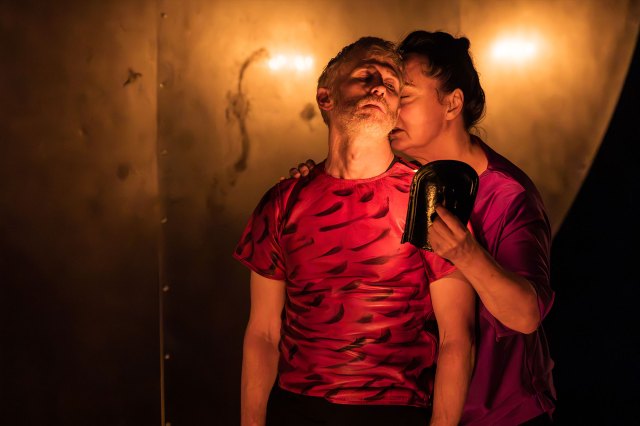
The axing of Caesar and Brutus’s wives, usually a grounding force against their husband’s delusions, lets the men follow their questionable instincts unfettered. And the transposition of the play into an unnamed modern setting – rather than the thematically charged likes of Gregory Doran’s post-colonial Africa production or Phyllida Lloyd’s women’s prison – focuses our attention on the play’s psychological aspects.
This focus is helped no end by Rosanna Vize’s sparse set: a shiny black floor and a back wall covered by a huge, suspended metal disc, against which Caesar is thrown with a crash during the dramatic, if bloodless, murder. Charles Balfour’s clever candlelight design, which includes small onstage fires, keeps the stage in a murky gloom that intensifies the men’s fear and paranoia. And the near constant rumble of drums ratchets up the tension, with one onstage drum beaten by the actors in key moments.
But the oppressive darkness also hosts more abstract moments, many of which feel impenetrable. Indeed, the show’s opening scene sees Cassius and Mark Antony jumping about and gurning into the flames – an early example of this production’s daring and riveting but sometimes ill-advised ideas.






source on Google
Featured In This Story

Related Articles
See all

Latest Reviews
See all



Latest Videos
The Sorcerer’s Apprentice musical – take a first listen
The world premiere production begins performances at HOME Manchester next week