
How the Other Half Loves at the Old Vic – review
Phillip Breen’s revival of the Alan Ayckbourn classic, starring Roger Allam and Dorothy Atkinson, runs until 19 September
 |
London
|
|
London
|
12 August 2026
The often-underrated genius of playwright Alan Ayckbourn is his consistent ability to make audiences laugh, but also to make them think. Continuing Matthew Warchus’s varied final season at the Old Vic, director Phillip Breen delivers a masterful interpretation of Ayckbourn’s How The Other Half Loves. A deliciously amusing exposure of class anxiety and gender politics, it is as relevant today as it was when written in 1969.
Frank and Fiona Foster are a long-married, but distinctly distant couple. Bob and Teresa Phillips are a chaotic, bickering couple with a baby. Fiona and Bob are having an affair, and their respective spouses are becoming suspicious. Enter the Featherstones, who unwittingly become their alibis. Two dinner parties, several crossed wires and inevitable chaos follow.
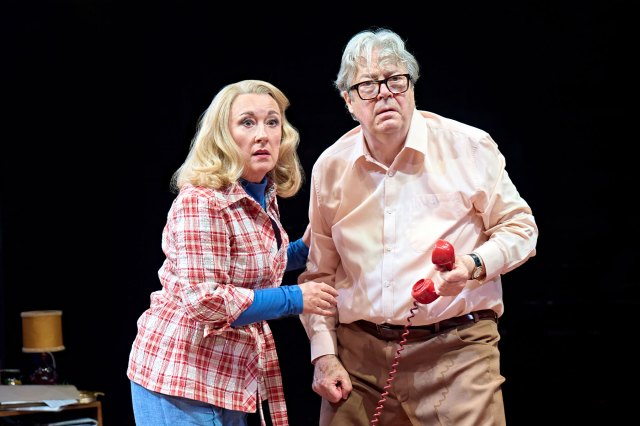
In an excellent cast, Roger Allam is a standout as befuddled Frank; totally confident in his own incorrect knowledge, but also fixated by the most mundane things. His focus on a broken toothbrush and his dry description of how Frank can get to the bathroom manage to be simultaneously tedious and hilarious: a task that would fail in lesser hands.
Allam is paired well with Dorothy Atkinson as his brittle wife Fiona, who bustles around organising her husband’s life while busying herself with Guild meetings and infidelity. Atkinson is an Ayckbourn veteran and excels at drawing out a world of emotion in a single raised eyebrow as she desperately tries to hide the truth.
Ayesha Antoine is very credible as Teresa, spiky and frustrated with the mundane domesticity of her life. Rowan Polonski is more one-dimensional as lothario and wide-boy Bob, who is quickly outwitted by his much more canny spouse.
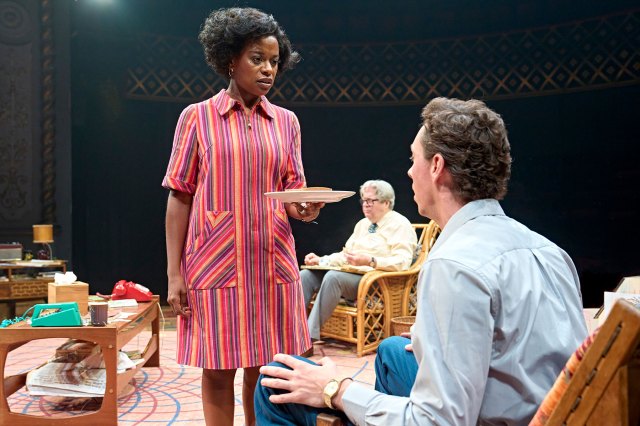
Adam Gillen does well with the harder role of the unlikable character of William Featherstone, a socially stilted and repressed Northerner who dominates his wife with contempt. Laura Elsworthy’s Mary is so paralysed by shyness, the character becomes more caricature; squeaking with fear and shying away at every sudden movement, the humour created quickly grates.
Ayckbourn’s structural skill is to overlap the two homes and two dinner parties, using tables crossed over each other so William and Mary engage with both dinners simultaneously. Breen’s choreography of the constantly intersecting scenes and use of swivel chairs is done with huge fluidity and dexterity, leading to some incredibly funny moments.
What creates depth beneath the farce is Ayckbourn’s characteristic comedic skewering of class, the vagaries of heterosexual marriage, and the varied weaknesses within the male ego: Frank through his misguided assurance of his powers of deduction, Bob through his blatant disrespect for his wife, and William by belittling Mary and resorting to threats of violence.
The production shows the British class system alive and well: the men all work for the same company but occupy very different worlds. Rob Howell’s set contains clever details that make these disparities clear. The Fosters have a stylish rattan chair with Liberty-print cushions; they drink coffee from bone china and take The Daily Telegraph. The items in the Phillips house are scuffed and run-down, stacked with boxes and old Guardian newspapers, while sugared tea is drunk from brown and yellow mugs.
The two-hour-45-minute running time could be tightened up, but it is testament to the skill of the performers that the energy never drops. A laugh-out-loud and multi-layered production.






source on Google
Featured In This Story
Related Articles
See all
Latest Reviews
See all
Latest Videos
Rory Kinnear and Natalia Osipova on the meaning of a good life in James Graham’s The Standard of Living
The world premiere play celebrated its official opening last night!