
Eurotrash review – Ben Whishaw and Kathryn Hunter on a merry, messy road trip
Colin Teevan’s stage adaptation of the Christian Kracht novel runs until 9 January
 |
London
|
20 November 2026
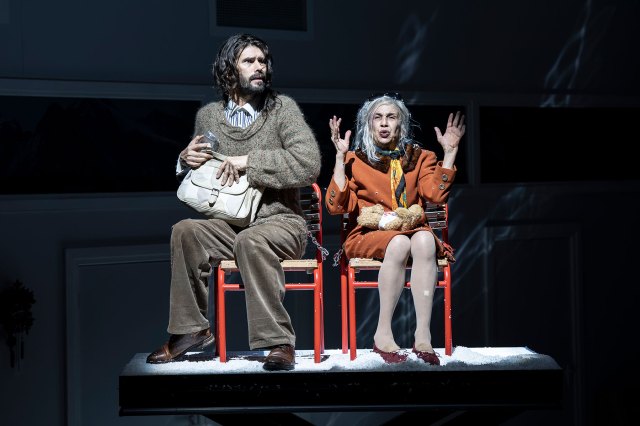
As Christmas theatre treats go, Eurotrash is both unusual and a delight. The pleasure of spending nearly two hours in the company of stage wizards Kathryn Hunter and Ben Whishaw is enough to justify it. But this surreal adaption of Christian Kracht’s best-selling novel by the playwright and screenwriter Colin Teevan is both supremely witty and unusually thoughtful, asking questions about remembrance, love and forgiveness that seem entirely fitting for this time of year. It also has snow.
The production, directed by Walter Meierjohann with brilliant control and just enough freedom, begins with Whishaw wandering through the auditorium to step up onto Lizzie Clachan’s pristine airport lounge setting and address the audience directly. He hates Zurich, he says, because it is a “city of charlatans and showoffs and humiliation.” He then launches into a story about a banana skin that sets much of the bizarre tone of what is to come.
Whishaw, wonderfully wry and troubled, is Christian, a writer who closely resembles Kracht in that he has had one early success and now has writer’s block. He’s here because his pill and alcohol addicted Mother (Hunter), now 80, has checked herself out of a psychiatric clinic and is existing on mouldy cheese slices in her lakeside flat. Faced with her habitual abuse – “You look like a wet dog when you visit,” she says, not untruthfully – to break the cycle of their relationship, he decides to take her on a trip, where they will attempt to spend the fortune she has accumulated by shrewd investment in the armaments industry.
The novel Eurotrash is much concerned with this reckoning with dirty money, and with Kracht’s own family history. Elements of this theme remain on stage: a conveyor belt in front of painted Alps intermittently sparks up, tipping luxury goods directly into a waiting bin. But the play has different emphases. As their chaotic road trip continues, the pair check into a commune run by a crazed yogi whose principles turn out to be based in Nazi ideology; they get stuck on a cable car where a flying colostomy bag has faecal consequences; they fail to give their money away; Christian unleashes his inner David Bowie.

Their adventures, full of moments of physical comedy and swiftly pointed dialogue – Whishaw’s ugly brown “eco” jumper is a source of some fun – turn Clachan’s white space into a chaos of bin bags and filth, as they unpack their own relationship and their remembrances of things past.
The play increasingly becomes an exploration of memories, and how we shape them. Christian not only offers his own narration of events, but in moments of crisis, entertains his mother with endless stories, some of them clearly true, many of them at best ambiguous. She constantly spins tales of her past which may or may not be true, skirting pain with fiction. The idea of history, both personal and political lies heavily on them. Epiphany comes from a visit to Borges’ grave.
In circling around different narratives, recognising truths, falsehoods and regrets, the couple’s uneasy relationship reaches a kind of love, a certain resolution – and in doing so, tentatively offers a moment of redemption.
It is also beautifully acted. Hunter is by turns monstrous and pitiable, always mobile, always thoughtful, mischief and sadness dancing across her face. At one point she does the splits and that flexibility animates every aspect of her playing; she is vividly and vigorously vital. Whishaw’s own sensitivities match her every step of the way, and he finds a truthful tenderness in Christian that grounds the play.
They are wonderfully supported by Glyn Pritchard, wearing many hats, sometimes at lightning speed, and by the composer Deanna H Choi who doubles as a sound engineer, sitting in her onstage box, and whipping out a violin at appropriate moments.
It’s whirring, wise and wonderful, a gift not just for Christmas but for life.






source on Google
Featured In This Story

Related Articles
See all


Latest Reviews
See all






Latest Videos

The Sorcerer’s Apprentice musical – take a first listen
The world premiere production begins performances at HOME Manchester next week