
Simon Stephens on weirdos, geeks, and life after the apocalypse
A Slow Fire has its London premiere at the Jermyn Street Theatre
 |
London
|
|
London
|
25 August 2026

Playwright Simon Stephens has plenty to reflect on.
“One of the joys of theatre is the absence of hierarchy by age,” he starts. “It’s a marginal art form attracting the weirdos and geeks.”
It is a place where passion matters more than age or status. “It’s one of the few industries where a 17-year-old can work as a peer with a 70-year-old. Where I might one day be working with a 20-year-old actor, and the next day working with an 87-year-old actor, we’re all collaborating. In that sense, the phenomenon is most like that of a family – where you can sit down with your great-grandad or your four-year-old niece and still be fundamentally at one with one another. I think it’s profound and it’s the element of the theatre industry that I cherish more and more.”
When we talk, he is fresh from a writer’s retreat in St Leonards, where he has been working on what will be his 60th play – he can’t reveal much, except that it is written with Anoushka Warden. “If you include all the adaptations and versions, that’s 45 original plays. On the one hand, that’s too many. But on the other hand, what a joyful thing to think of this as my job.”
Stephens is responsible for several contemporary theatre classics like The Curious Incident of the Dog in the Night-Time as well as groundbreaking adaptations like that of the solo WhatsOnStage and Olivier Award-winning Vanya, which starred Andrew Scott.
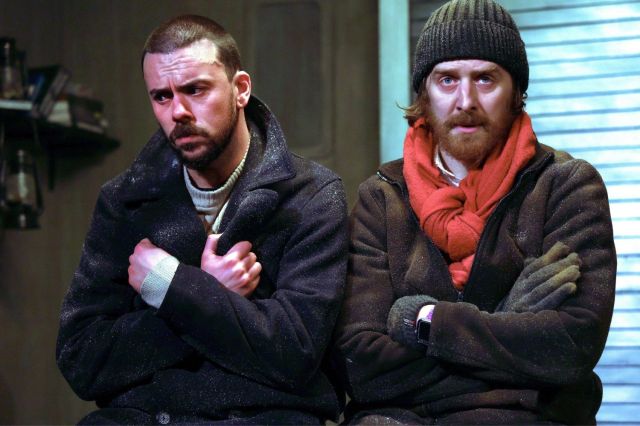
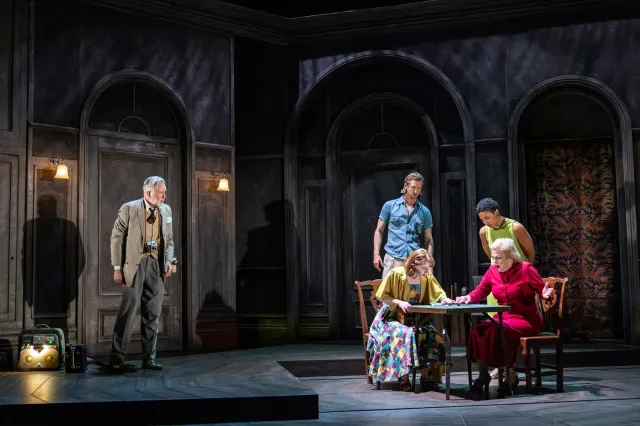
His newest original piece to be performed, A Slow Fire, came to him in a jet-lagged dream while working in New York: “I was pinged wide awake at four o’clock in the morning and trying to get back to sleep when the image of a play set in a world that is different to ours came to me.”
The piece is set in a secure, locked-up environment in the aftermath of a nuclear catastrophe, and he imagined two actors reenacting scenes of hope in this imaginary world.
“Their re-enactments were then interrupted by a man called Presley with an electronic generator, a side of pork, and a gun.”
All of that was written down in his notes app on his phone, and it took nine months to develop: “I’m a fastidious planner; I plan my plays more carefully than most playwrights, so to have a play come to me in a dream was really unsettling. I didn’t show the notes to anyone for nine months and eventually showed it to my son, who is my fiercest critic, and he thought it was a good idea. It took me a while to find its home with Glass Mask Theatre. It’s a strange nightmare play, and it unsettles people.”
Beneath the surface, however, Stephens is interested in what it means to be alive. “I think drama is about humanity, and humanity is defined by its consciousness of its own consciousness. It lives in time and space, and necessarily every human has a consideration for what it takes to be alive,” Stephens says. “You get that when you’re working on Chekhov, Ibsen… It’s what dramatists do. They try to get their head around what it is to be alive.”
At the start of the year, Stephens’ piece An Ark premiered at The Shed in New York. A “mixed reality” piece, it featured performers like Ian McKellen and had audience members wear spectacles. “You put these glasses on, and things appear to you in your mind, vision and consciousness that aren’t there in the real world. It’s a very strange and beautiful subjectivity, and it’s important to me that the audiences experience that subjectivity in the shared space.”
With that in mind, he shares his love for “beautiful punk theatres,” like the 70-seater in NYC and like the Jermyn Street Theatre, where A Slow Fire plays. “Spaces like that have intimacy and potency.”
He continues: “One of my favourite theatres in my whole working life is the Drama Barn at the University of York, which is where I went to university, which had 30 seats. There’s a part of me that thinks that for every play I write, I somehow see it in my mind in the Drama Barn; a battered old space leaving the possibility to imagination.”
Before the year is out, Curious Incident will have embarked on a new tour, and Stephens will have reunited with McKellen for a new take on Lear. “One of the joys for me as a playwright is I can be thrilled and inspired and moved by working on King Lear, learn so much about my own humanity and theatre as an art form, but then there will be some 20-year–old punk who’ll come and write about something I’ve not even imagined, and I’m able to sit in and celebrate that vitality.”
Though they may not identify as punks, Stephens is full of praise for new writers Ava Pickett and Sarah Power, and all of those he engages with as part of the Inspire group at Hampstead Theatre: “The vitality of the young in this ancient art form is a profound honour.”




source on Google
Related Articles
See all
Latest Reviews
See all

Latest Videos
Heathers The Musical releases new trailer with tour cast
Step into the candy store!