
Quartet in Autumn at the Arcola Theatre – review
Samantha Harvey’s stage adaptation of the Barbara Pym novel runs until 20 June
 |
London
|
|
London
|
21 May 2026
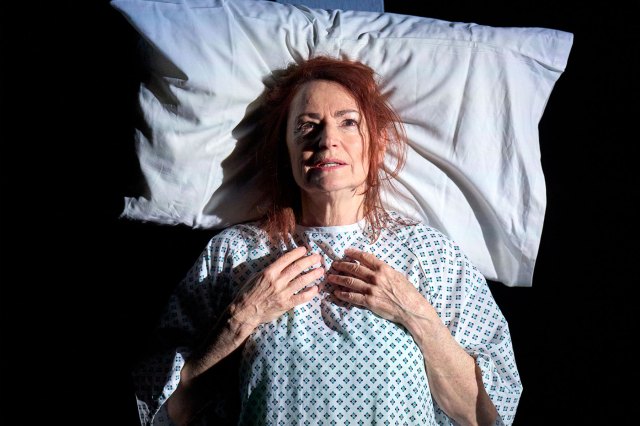
The sublimely acidic yet compassionate novelist Barbara Pym published six fairly commercially successful tragicomic novels between 1950 and 1961, after she was unceremoniously dropped by her publisher, Jonathan Cape. Eventually, following endorsements from David Cecil and her friend Philip Larkin in a feature about underrated writers in the Times Literary Supplement, she made a Booker-nominated return with Quartet in Autumn in 1977. It was the penultimate novel published during her lifetime, and possibly her greatest.
Directed with great sympathy and no nonsense by Dominic Dromgoole, Booker Prize winner Samantha Harvey’s (Orbital) adaptation marks the first time that one of Pym’s novels has been brought to the stage and showcases just how rich her work is for such treatment. Following four office workers who are approaching retirement (what they do is never specified, and they aren’t going to be replaced), the mundane becomes scathingly brilliant and laugh-out-loud funny. Anyone who has ever worked in a staid office setting doing a monotonous job will know that the silliest things can be rendered hysterical.
Relationships between colleagues can be both artificially cordial (these aren’t people you’ve chosen to spend your days with) and unexpectedly intimate due to the physical proximity and the amount of time spent together. Edwin (Anthony Calf), the de facto team leader and a widower (the only one of the four to have been married and to have children), embodies a kind of paternalistic dull decency with a life that’s organised by the church calendar (in his wig, Calf resembles that famous “grey man” John Major).
Norman (Paul Rider), the least genteel of the four, is blusteringly tactless and enjoys shouting at cars and complaining about the psychedelic colours of shopping bags, finding catharsis in nihilism. The snippy Marcia (Pooky Quesnel) doesn’t do friends, and she barely tolerates her colleagues, yet has a secret fondness for Norman, with whom she resentfully shares a family-sized tin of instant coffee. Heavily coded as anorexic and OCD, with her elaborately curated hoarding of tinned food (a hangover from the war) and maintaining a shed full of milk bottles, she’s keen for everyone to know that she has had a major operation (performed by Mr Strong, with whom she is infatuated), resulting in the loss of a body part, but refuses to be more specific.
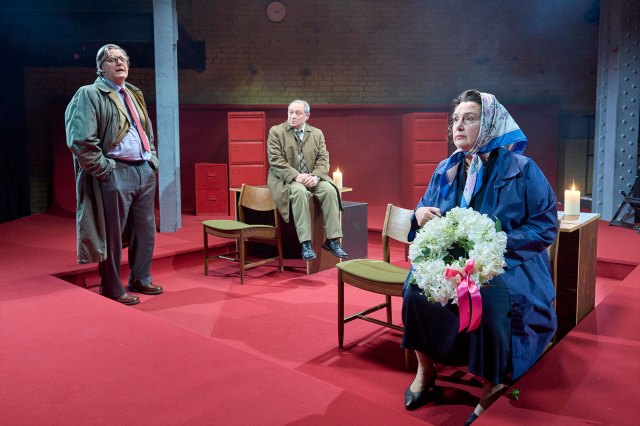
As the well-meaning, chattering Letty, who has never been assertive enough to be loved, Kate Duchêne (a millennial icon thanks to her role as the fearsome Miss Hardbroom in The Worst Witch in the ‘90s) gives the performance most different from how I imagined the character on page, but she’s superb and her tragicomic timing is impeccable. Letty gradually learns that she doesn’t have to be at her flighty friend Marjorie’s beck and call and has the autonomy to make decisions about her own life (perhaps Edwin will eventually half-heartedly propose, giving her the novelty of another life choice).
Designer Ellie Wintour provides a cluster of fusty desks in which the foursome is essentially stranded on their own island, and there is some effectively dowdy ‘70s styling. As they go their separate ways in the second half (retirement is as monotonous as work but without the social element) and reconvene under strained circumstances, things start to open up to a limited extent.
Literary adaptations of the likes of Pride and Prejudice and Sherlock Holmes have been done to death, and it’s a pleasure to see theatremakers tackle something different. Seasoned readers will be delighted, and hopefully, new fans will emerge passionate about Pym. A real gem that, with any luck, won’t go into retirement after this run at the Arcola.





source on Google
Featured In This Story

Related Articles
See all


Latest Reviews
See all








Latest Videos

West End vs Broadway: Paranormal Activity – Ami Okumura Jones and Cher Álvarez on transatlantic terror
‘Tis the spooky season, after all…