
Alexander Zeldin’s Care at the Young Vic – review
Zeldin’s production of his new play runs until 11 July
 |
London
|
|
London
|
20 May 2026
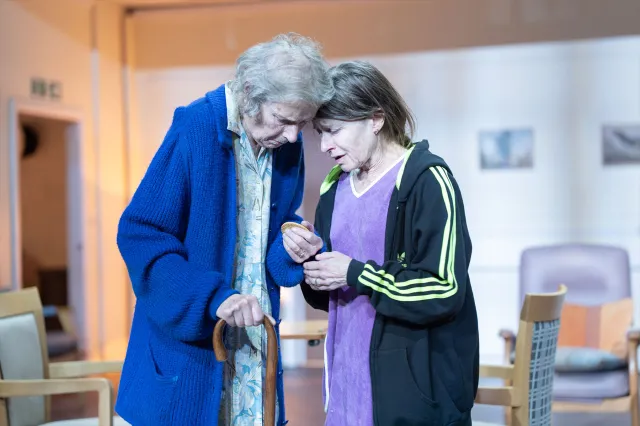
The plays of Alexander Zeldin reach parts that other plays do not reach. With an unstinting gaze, he turns his attention to subjects and people that society would prefer to turn away from. He insists we look. He asks we care.
Following the three works usually called The Inequalities trilogy, which focused on the lives of people worst affected by austerity, and two more recent plays (The Confessions and The Other Place) that concentrate on fractured families, his new play – actually called Care – brings both strands together.
It is a devastatingly raw portrait of people facing the end of their lives in an inadequately funded care home and a picture of a family torn apart by grief after a father’s early death. Inspired in part by Zeldin’s own visits to his grandmother in a care home after his father died when he was 15, a version was originally performed in French in 2023, though it has been much changed for its UK premiere.
I saw it with a friend. Both of us have, in different ways, lived through similar events. Both of us were in tears at the end.
At the very least, Care is a remarkably effective piece of immersive theatre. Rosanna Vize’s naturalistic set creates the lobby of the kind of institution with high-backed, purple plastic-covered chairs and bad “cheerful” art on the walls, where vague residents gather every day to begin to pass their time.
James Farnscombe’s lighting is both realistic – that flat fluorescent of hospitals and care homes – but also metaphorical. The lights flicker, plunging the place into darkness; for a moment, sunlight streams through a window, bathing everyone in golden light like gods; when a resident dies, the audience is lit up too, gathering us into complicity.
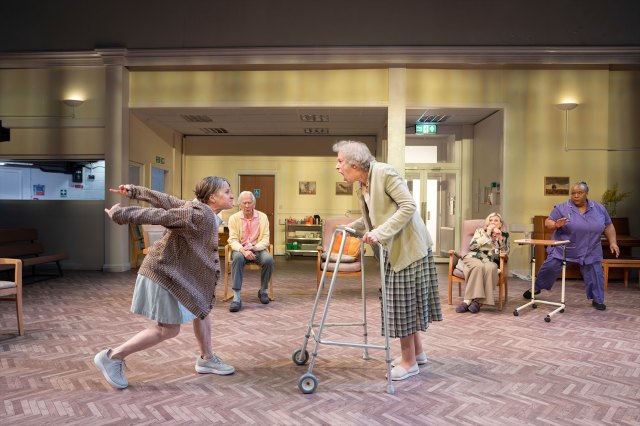
It is like being in a purgatorial waiting room for death, and when Joan (Linda Bassett) first arrives, she is sure she doesn’t belong there. She has had a fall, but she will soon be upright and strong again. She should be living alone, not surrounded by the lost souls who gather here. She is just waiting for her family to take her away.
But when her daughter Lynn (Rosie Cavaliero) and her grandsons do arrive, it becomes clear that they cannot cope. They are still reeling from the loss of a father, whose absence haunts every decision they make. In flight from death itself, Lynn can’t face the prospect of caring for her mother. She can barely bear to touch her.
It’s Zeldin’s achievement as writer and director to let the routine of the care home build slowly. Over an unbroken 130 minutes, he shows us the calm yet firm Hazel (Llewella Gideon), at once patronising and genuinely kind, and her perky probationer Fanta (Aoife Gaston), who leads the residents in a sing-along and doesn’t quite know where boundaries should be set.
They are overworked, under-funded (only one wipe to be used to clean each resident), but unfailingly attentive to the odd mixture of people they find under their control. Zeldin’s intent is not to make a political point about overstretched social services. This structure forms the backdrop to a different kind of storytelling about the residents themselves, living a kind of half-life, confused, lonely and afraid of the death they know is coming.
All are beautifully conjured, and all emerge differently as the time progresses and we come to know them: gentle John (Richard Durden) who mutters “I’m no-one, I’m nothing, I’m lost”, but who comes to life when he sings “One Enchanted Evening”, posh Agnes (Ann Mitchell) dreaming of Kenya but unable to remember her husband has died; abrasive former sex worker Simone (Hayley Carmichael), younger but damaged, who irritates until she hints at the sadness of her life.
“It’s a gift from the centre of my heart in the dark,” she says to Hazel as she lays her jewellery in front of her. The line, like the entire play, has a ring of Beckett, as it depicts people facing the unknown, dogged by their past, frightened and confused. But it has great empathy in its portrayal of the endgame, a determination not to look away from the pain.
Above all, this is there in the depiction of Joan and her family. Bassett is simply magnificent, charting Joan’s decline from courage to despair to a sort of staring acceptance of her fate, conveying whole worlds with a raise of an eyebrow or the touch of a hand on a cheek. And William Lawlor – as her teenage grandson, lost in his own despair at finding a world he believed certain is agonisingly full of emptiness – is unbearably touching.
Its tender truthfulness makes Care a great play. But for anyone who has loved and lost someone in these circumstances, it is almost unwatchable.






source on Google
Featured In This Story

Related Articles
See all


Latest Reviews
See all




Latest Videos
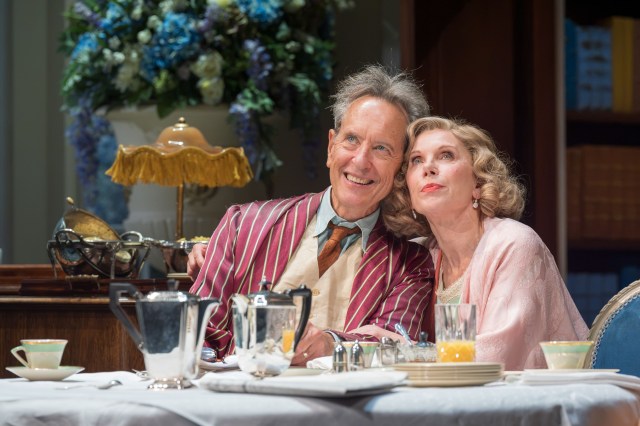
Christine Baranski and Richard E Grant on a blissful friendship, Anglophilia and onstage kissing – Hay Fever opens in the West End
The Noël Coward classic is back!