
Our Town with Michael Sheen at Swansea Grand Theatre and on tour – review
Following stops in Llandudno and Mold, the Welsh National Theatre and Rose Theatre co-production will also run in Kingston from 26 February to 28 March
 |
Tour
|
|
Tour
|
22 January 2026
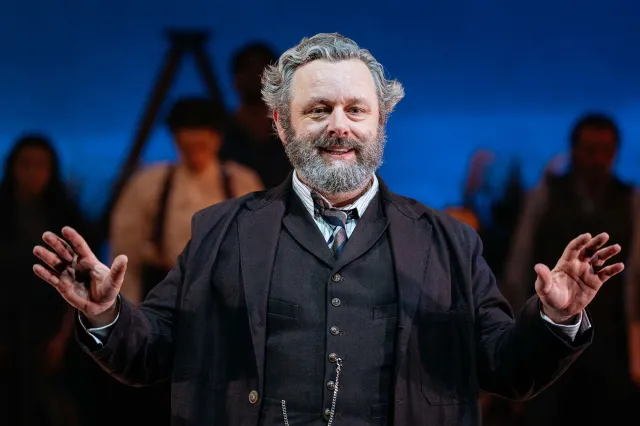
The house lights are up in the ornate white and red Grand Theatre, Swansea, the audience still settling as Michael Sheen walks onto the stage in a brown, three-piece suit and gently moves the ghost light to the wings. He hangs up his jacket and rolls up his sleeves before turning to speak, naming the play and the players.
It’s the perfect, low-key but deeply theatrical beginning to this new venture, a conjuring of something from nothing. Thornton Wilder’s Our Town marks the first production for Sheen’s Welsh National Theatre, founded by the actor with his own money when the National Theatre of Wales lost its Arts Council funding and his beloved country lost its theatrical voice.
And Wilder’s play too, written in 1938, but set from 1901 to 1913, is a canny start, an evocation of community and a plea to note the little things that illuminate an ordinary life, it relies on creating its effects through the power of the imagination and the impact of people sitting in a room listening to a story.
Sheen is magnificent as the Stage Manager, his expansiveness and subtlety gently guiding us through the first act, a description of a day in the life of Grover’s Corners, a small town in New Hampshire where nothing happens but everything matters. The place is American but the accents and some place names are Welsh; the hymns gently sung by the Congregational Choir – “leave loudness to the Methodists,” the choir master begs – are in Welsh too.
You suspect Sheen, director Francesca Goodridge and creative associate Russell T Davies, might have hoped the Wilder estate would have allowed them more latitude with shifting the play from rural America to Wales, but the compromise works. We are in a specific place and everywhere, and Hayley Grindle’s delicately designed set is both real and unreal.
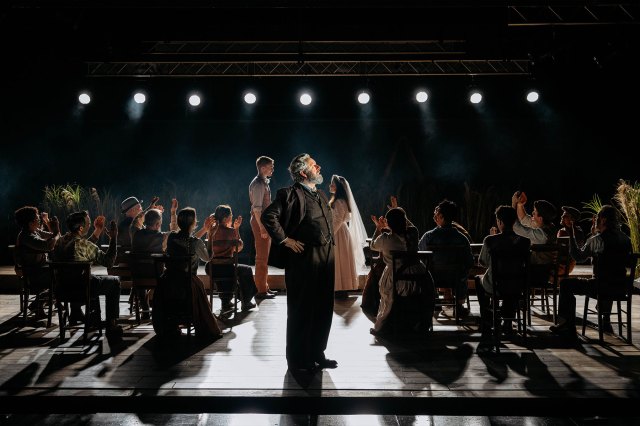
“Here’s some scenery,” remarks Sheen, wryly, as the cast whee grasses across the stage to represent a garden. They swiftly manipulate planks and chairs to act as buildings, tables and steps as well, as movement director Jess Williams sets them flowing in carefully contrived waves across the stage and Ryan Joseph Stafford’s glorious lighting moves from pale dawn to rich red sunlight and cool, magical moonlight.
With the help of Sheen’s warm narration, stepping in and out of the action, playing different parts with deft lightness, the characters of Grover’s Corners come gradually to life: the harassed housewives stringing beans; the doctor delivering twins; the newspaper proprietor dispensing halting history and wisdom. The sense of bustling life is there, but also of constriction: a clever bit of mime suggests that the drunken, unhappy choirmaster might be longing for a gay love.
The story gradually focuses on the burgeoning relationship between teenagers George Gibbs (Peter Devlin, all nerves and dawning manhood) and his next-door neighbour Emily Webb (Yasemin Özdemir, a glorious mix of anxiety and hope). The scene where they climb ladders and talk in the moonlight has a quality of wonder.
From the start, Wilder’s play is pre-figured by a sense of doom. Sheen tells us in the opening act that the loose-limbed newsboy, the cleverest in the class, will die in the war, and the sense of death in the midst of life is embodied in the final act, set in the graveyard where all light seeps away and the dead sit on ladders, watching the living with cool dispassion. “An awful lot of sorrow has quietened down up here,” says Sheen, his voice fading away.
Goodridge’s unobtrusive but tight direction manages the shift with grace, gently underlining the play’s moral: it’s important to focus on every moment because it can soon be gone. Life needs to be celebrated. Sheen’s Stage Manager, now in long coat, ends as he has begun, controlling the light.
The next time he appears on stage with Welsh National Theatre will be in a new play by the terrific Gary Owen. This revival of a slightly sentimental classic shows just what he and this new company can achieve. It makes the future look bright.






source on Google
Related Articles
See all




Latest Reviews
See all

Latest Videos
New musical Nero releases first listen with Andrew Barth Feldman
It is from the writers of Spring Awakening