
Last Haus on Earth at Brighton Festival – review
The show forms part of the 60th anniversary Brighton Festival
 |
Brighton
|
|
Brighton
|
22 May 2026
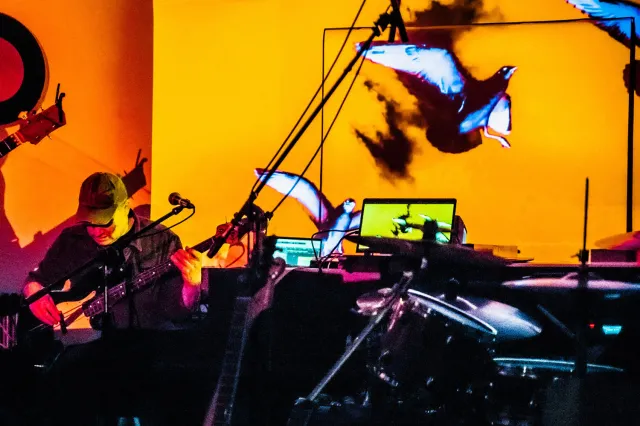
Klanghaus has always thrived on the fringes of conventional performance, and Last Haus on Earth – presented as a Brighton Festival exclusive for its 60th edition – sees the collective double down on their reputation for experimental, site-specific art.
Staged in Anita’s Room, a top-floor attic space at the Brighton Dome, this totally unique, site-responsive production strips away the traditional barrier between performer and audience, reframing (or rather reasserting) the power of theatre as a volatile laboratory. Part intimate gig, part cinematic installation, it interrogates how live music functions as a communal bind in a digital age.
The narrative framework is minimal, leaning into the premise of a final gathering at the end of the world. Co-devisers Klanghaus and maverick art-rock band The Neutrinos invite the crowd directly into a dramatically enhanced domestic setting. Here, the boundaries of personal space are deliberately dismantled; the small audience is invited to sit, stand, lean, and move in and around the musicians.
Visual artist and filmmaker Sal Pittman’s evocative projections cloak the entire space, transforming the brickwork into a living, breathing canvas of light and saturated colour. Most notably, a continuous relay video of a vehicle driving down a Turkish motorway – possibly fresh from the show’s recent run at Paribu Art in Istanbul – is projected onto the walls, creating a sense of forward momentum that underpins the evening.
This visual rush contrasts sharply with a sonic landscape that navigates a breathtaking spectrum from pin-drop quiet to full-on loud, with occasionally all hell breaking loose. The volume during the heavy musical movements is uncompromisingly loud – so much so that the venue issues earplugs at the door. Wearing them creates a curious duality: while the bass lines and industrial noise vibrate physically through your chest (sitting on a subwoofer probably didn’t help), the resultant head-space is slightly isolating.
The production’s most successful asset is its reliance on an unwavering sense of communion. In one particularly sequence, the small crowd is packed into an even tinier adjoining side room. Here, stripped of technology, the audience is asked to hold a single, vocal ‘A’ note together. It is an unexpected, vulnerable moment that pays off later in the set when a digital recording of that specific collective note is looped and integrated into the live soundscape of a subsequent song from the show’s soundtrack album.
Audience participation is entirely unscripted. During the performance reviewed, I was handed a guitar and roped into playing alongside the ensemble. Small problem: I’ve never played the electric guitar in my life. This loose, chaotic framework means the show is by no means perfect. It meanders in its midsection, and the sheer hostility of the louder musical movements will likely alienate those seeking a traditional narrative.
However, these flaws feel secondary to the overarching achievement of the piece. At a time when digital media dominates our cultural consumption, Last Haus on Earth reminds us of the raw value of live creation. It is the exact brand of uncompromising, fringe work you hope to stumble across at an arts festival. You enter the attic as a room of detached strangers; you leave with the distinct buzz of having survived a collective event.






source on Google
Related Articles
See all
Latest Reviews
See all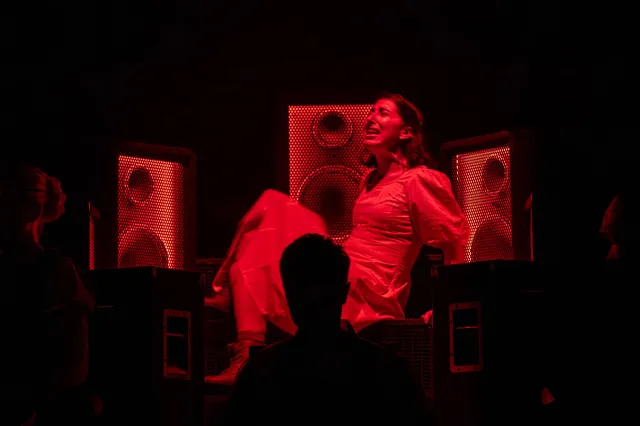

Latest Videos
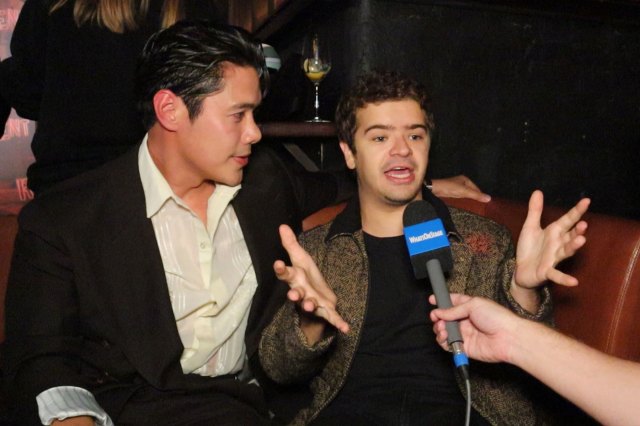
Gaten Matarazzo and the cast of Rent on living “La Vie Bohème” in the musical’s 30th anniversary year
Luke Sheppard’s West End revival is now officially open at the Tom Stoppard Theatre!