
Springwood at Hampstead Theatre – review
Richard Nelson’s world premiere play, starring Robert Lindsay and Jemma Redgrave, runs until 25 July
 |
London
|
|
London
|
30 June 2026
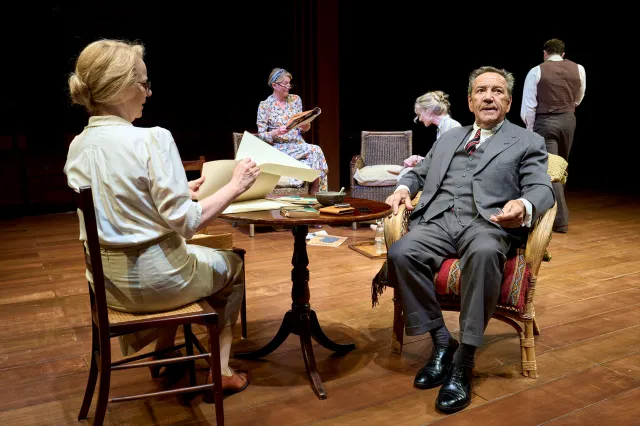
Richard Nelson is the most humane of playwrights. In an interview in the programme of his new play Springwood, he says: “The art of theatre is the art of the human being… strip away everything but what is essential and what you have left is the actor and the audience. That is, live human beings in front of live human beings.”
That has always been the 75-year-old American’s creed, whether it is in his two magnificent sequences of plays about American life and politics centring on the Apple and the Gabriel families, or in his more formal historical works such as Farewell to the Theatre (about Harley Granville Barker) or A General from America (about George Washington).
In Springwood, which is a close cousin of his screenplay for the film Hyde Park on Hudson, the human beings are President Franklin Roosevelt (Robert Lindsay), his wife Eleanor (Jemma Redgrave), and the new King of England, George VI, here called Bertie and his wife Elizabeth, played by Andrew Havill and Rebecca Night. It is June 1939, and on their first visit to the USA, the royal couple has agreed to stay at Roosevelt’s titular country house.
What unfolds is a drama of domestic and political understanding and misunderstanding – “the walls here are very thin” is a running gag – with a serious undertone. Bertie’s purpose is to ask Roosevelt for support when his country finds itself at war with Hitler; Roosevelt’s warning is that if America, committed to isolationism, ever should become involved, “I’m not at all sure that it’ll be your side that they choose.”
Nelson’s achievement is to peer behind the curtain of this weighty moment, the start of the special relationship, and offer a glimpse of the people and personalities who made it happen. He captures beautifully the complications of Roosevelt’s domestic life, where Eleanor turns a blind eye to the fact that “governess” Daisy (gently played by Rachel Pickup) is his current mistress and his assistant is his former love. Lindsay makes the most of the President’s apparent fear of his formidable mother (Eileen Nicholas), concerned with treating the royals just right and his simultaneous insistence on doing exactly what he pleases.
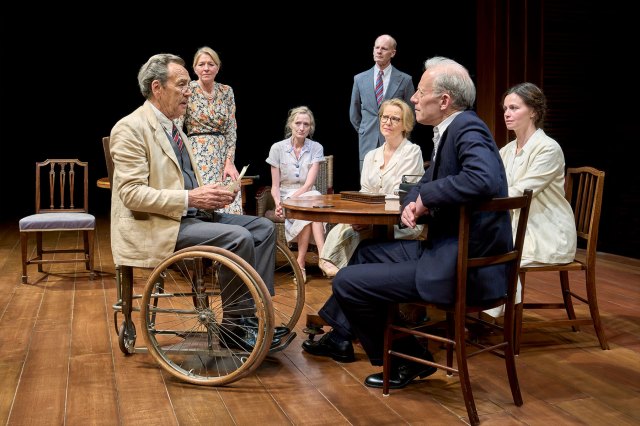
On the British side, Havill beautifully conveys, in twisted hands and stooping politeness, the way Bertie’s nervousness, his sense of being out of place, melts in late-night drinking sessions with a fatherly President who, like him, disguises a disability at odds with his powerful public image. As Elizabeth, Night is all beady anxiety, standing on her dignity when she fears that she is being mocked by a public picnic, almost hysterical with worry that she will be forced to eat a hotdog.
The scene between her and Redgrave’s wonderfully convincing Eleanor, sadness hidden behind a fiery exterior, is a quietly thoughtful piece of intimate theatre: as the two women resolve to be honest with one another, clarity emerges from confusion, and calm from madness.
The entire play is a bit like that. Directed as well as written by Nelson (after Stanley Tucci dropped out early in the process), its homely pace – with the actors rearranging the furniture on Tom Piper’s simple set – and atmospheric lighting by James F Ingalls allow for reflection and a kind of affection.
These people, placed in the spotlight and asked to make huge decisions, are endearingly, chaotically human, doing their best at a time when the world needed good people to stand up to be counted. They are surrounded by the affection of people who also care about them, who try to do their best. At a time when the special relationship has never been more under pressure, it’s an insightful reminder of people’s capacity for change – and for leadership.






source on Google
Featured In This Story

Related Articles
See all


Latest Reviews
See all







Latest Videos

West End vs Broadway: Paranormal Activity – Ami Okumura Jones and Cher Álvarez on transatlantic terror
‘Tis the spooky season, after all…